ExamBharo · UP TGT 2016 — Social Science: Economics (Series A) · exambharo.com/up-tgt/previous-year-papers/up-tgt-2016-social-science-economics-series-a/
Question paper · UP TGT
UP TGT 2016 — Social Science: Economics (Series A)
8 or 9 March 201963 questions+3.4 for a correct answer, −0 for a wrong one
Questions from the U.P. Secondary Education Services Selection Board’s paper of 8 or 9 March 2019. Each question’s answer is under it, hidden until you open it, and the full answer key is at the end. Take the paper as a timed practice test to be scored.
The official booklet is a scan with no text, so ExamBharo typed this paper from it by hand. A typing slip is possible; report one through the contact page.
The board deleted questions 16 and 56 in its final answer key: shown here, with no answer, and not counted in the score.
Economics
1. The quantity of a good that a consumer purchases in a market at a particular price, at a particular time is known as
- (a) Supply
- (b) Demand
- (c) Utility
- (d) Desire
Show answer
Answer: (b)
2. The open market operations aim at
- (a) Regulation of the use of credit
- (b) Determination of cash reserves of banks
- (c) Switch operations
- (d) Sale and purchase of Govt. securities
Show answer
Answer: (d)
3. Ricardo explained the law of comparative advantage on the basis of
- (a) Opportunity cost
- (b) The law of diminishing returns
- (c) Economies of scale
- (d) The labour theory of value
Show answer
Answer: (d)
4. The transfer of assets or service functions from public to private ownership is known as
- (a) Liberalization
- (b) Nationalization
- (c) Globalization
- (d) Privatisation
Show answer
Answer: (d)
5. Most of the unemployment in India is
- (a) Technical
- (b) Cyclical
- (c) Disguised
- (d) Structural
Show answer
Answer: (c)
6. Giffen goods refers to
- (a) Prestige goods
- (b) Necessary goods
- (c) Speculative goods
- (d) Inferior goods
Show answer
Answer: (d)
7. On the basis of which of the following we have perfect competition and imperfect market ?
- (a) Area
- (b) Time
- (c) Volume of business
- (d) Competition
Show answer
Answer: (d)
8. _______ function is the relationship between physical inputs and physical output of a firm.
- (a) Production
- (b) Consumption
- (c) Investment
- (d) Demand
Show answer
Answer: (a)
9. The sum total of the transactions demand, precautionary demand and speculative demand for money is called
- (a) Speculative motive
- (b) Supply of money
- (c) Loanable fund
- (d) Liquidity preference for money
Show answer
Answer: (d)
10. Classical economists advocated which of the following for public finance ?
- (a) Principle of economy
- (b) Principle of minimum collective sacrifice
- (c) Principle of minimum taxation
- (d) Principle of maximum social advantage
Show answer
Answer: (c)
11. Who wrote “External aid is like a sulpha drug. We must know when to use it, when to stop it and we should always have a B-complex to neutralise its effects” ?
- (a) Otto Eickstein
- (b) V. K. R. V. Rao
- (c) David Ricardo
- (d) J. S. Mill
Show answer
Answer: (b)
12. P = KR/M is the Cambridge equation given by
- (a) A. C. Pigou
- (b) J. M. Keynes
- (c) Robertson
- (d) Marshall
Show answer
Answer: (a)
13. Notes issued by the Central Government are unlimited legal tender. It is also called
- (a) Credit money
- (b) Electronic money
- (c) Fiat money
- (d) Metallic money
Show answer
Answer: (c)
14. The rate at which the currency of one country is converted into the currency of another country is known as
- (a) Devaluation
- (b) Rate of exchange
- (c) Foreign exchange
- (d) Foreign liquidity
Show answer
Answer: (b)
15. Which Agency gives “Soft loans” to the member countries ?
- (a) I.D.A.
- (b) I.M.F.
- (c) I.A.F.
- (d) I.F.C.
Show answer
Answer: (a)
16. Who has classified public expenditure under two heads ?
- (a) Dr. Hugh Dalton
- (b) Prof. Adam Smith
- (c) Prof. Pigou
- (d) Prof. J. S. Mill
Show answer
Answer: —
17. 1/cash reserve ratio or 1/r is
- (a) Statutory liquidity ratio
- (b) Liquidity ratio
- (c) Credit multiplier
- (d) Investment multiplier
Show answer
Answer: (c)
18. The most important outcome of the Uruguay Round Agreement was the establishment of
- (a) GATT
- (b) WTO
- (c) OECD
- (d) European Union
Show answer
Answer: (b)
19. _______ is the sum of the gross domestic product and net factor incomes from abroad.
- (a) N. N. P.
- (b) G. N. P.
- (c) G. D. P.
- (d) N. D. P.
Show answer
Answer: (b)
20. In the production process, point of equilibrium is where
- (a) Marginal cost = Marginal product
- (b) Marginal cost = Average cost
- (c) Marginal cost = Marginal revenue
- (d) Marginal cost = Average revenue
Show answer
Answer: (c)
21. The types of measures of central tendency are except which of the following ?
- (a) Mean
- (b) Median
- (c) Mode
- (d) Correlation
Show answer
Answer: (d)
22. If two goods are substitutes (like tea and coffee), the cross elasticity between them is
- (a) Negative
- (b) Positive
- (c) Infinite
- (d) Zero
Show answer
Answer: (b)
23. Theory of demographic transition correlates population growth and
- (a) Economic development
- (b) Per-capita income
- (c) Standard of living
- (d) Food supply
Show answer
Answer: (a)
24. A monopolist is able to maximize his profits when
- (a) His output is maximum
- (b) His average cost is minimum
- (c) He charges a high price
- (d) His marginal cost is equal to marginal revenue
Show answer
Answer: (d)
25. K = 1/MPs The above formula speaks about the
- (a) Multiplier
- (b) Accelerator
- (c) MPC
- (d) Investment
Show answer
Answer: (a)
26. Which are levied on exports and imports ?
- (a) Excise duties
- (b) Customs duties
- (c) Wealth tax
- (d) Corporation tax
Show answer
Answer: (b)
27. Finance Commission is appointed by the President of India, under Article
- (a) 180
- (b) 35
- (c) 280
- (d) 275
Show answer
Answer: (c)
28. The inverse relation between inflation and unemployment is called the
- (a) Inflationary Gap
- (b) Multiplier
- (c) Phillips Curve
- (d) Production Possibility Curve
Show answer
Answer: (c)
29. That portion of total deposits which a Commercial Bank has to keep with the Central Bank in the form of cash reserves is known as
- (a) Repo rate
- (b) Statutory Liquidity Ratio
- (c) Bank rate
- (d) Cash Reserve Ratio
Show answer
Answer: (d)
30. The ratio of internal purchasing power of two currencies is called the
- (a) Comparative cost theory
- (b) Payment equilibrium theory
- (c) Absolute cost theory
- (d) Purchasing power parity
Show answer
Answer: (d)
31. Where is the headquarter of Asian Development Bank situated ?
- (a) New Delhi
- (b) Manila
- (c) Kathmandu
- (d) Sri Lanka
Show answer
Answer: (b)
32. Which debt is a permanent burden on tax-payers ?
- (a) Long-term debt
- (b) External debt
- (c) Forced debt
- (d) Non-redeemable debt
Show answer
Answer: (d)
33. The Regional Rural Banks were established for the first time in which year ?
- (a) 1960
- (b) 1971
- (c) 1975
- (d) 1980
Show answer
Answer: (c)
34. The most controversial topic in the yet to conclude in the Doha Agenda is
- (a) Trade in manufactured goods
- (b) Trade in Intellectual Property Rights based goods
- (c) Trade in agricultural goods
- (d) Market-access to goods from developed countries
Show answer
Answer: (c)
35. _______ programme was started in 2005 to provide electricity to all the villages.
- (a) Rajiv Gandhi Grameen Vidhyutikaran
- (b) Compact fluorescent lamps
- (c) Ultra-mega power plants
- (d) Partnership in excellence programme
Show answer
Answer: (a)
36. According to the law of variable proportions, the best stage of production is
- (a) 1ˢᵗ stage
- (b) 2ⁿᵈ stage
- (c) 3ʳᵈ stage
- (d) None of the above
Show answer
Answer: (b)
37. A change in demand caused by a change in purchasing power of a consumer is called
- (a) Income effect
- (b) Price effect
- (c) Substitution effect
- (d) Demonstration effect
Show answer
Answer: (b)
38. A consumer is said to be in equilibrium when he derives maximum _______
- (a) Profit
- (b) Benefit
- (c) Satisfaction
- (d) None of the above
Show answer
Answer: (c)
39. Which stage of population transition is being experienced by India ?
- (a) First
- (b) Third
- (c) Second
- (d) Fourth
Show answer
Answer: (b)
40. “Rent is that portion of the earth which is paid to the landlord for the use of the original and indestructible powers of the soil” – is given by
- (a) J. S. Mill
- (b) Adam Smith
- (c) David Ricardo
- (d) J. M. Keynes
Show answer
Answer: (c)
41. M₁ in the money stock of India refers to
- (a) Post office saving deposits
- (b) Time deposits with banks
- (c) Total post office deposits
- (d) Currency + demand deposits + other deposits with RBI
Show answer
Answer: (d)
42. Burden of taxation must be distributed equally among all citizens in relation to ability to pay taxes refers to
- (a) Canon of certainty
- (b) Canon of equality
- (c) Canon of economy
- (d) Canon of diversity
Show answer
Answer: (b)
43. The value of money is the reciprocal of the level of
- (a) Income
- (b) Quantity
- (c) Prices
- (d) Expenditure
Show answer
Answer: (c)
44. “Banks are not merely purveyors of money but also, in an important sense, manufacturers of money”. This statement was given by
- (a) R. S. Sayers
- (b) Prof. Edwin Cannon
- (c) Hawtrey
- (d) Johnson
Show answer
Answer: (a)
45. Policy of non-interference by government in foreign trade is referred as
- (a) Liberalisation
- (b) Free trade
- (c) Globalization
- (d) Protectionist trade
Show answer
Answer: (b)
46. I.M.F. and I.B.R.D. came into existence simultaneously in 1944 as a result of
- (a) GATT
- (b) WTO
- (c) Bretton Woods Conference
- (d) Dunkel Agreement
Show answer
Answer: (c)
47. When the economic burden of the tax is passed onto other person by the tax payer, it is known as
- (a) Tax evasion
- (b) Shifting of taxation
- (c) Impact of tax
- (d) None of the above
Show answer
Answer: (b)
48.
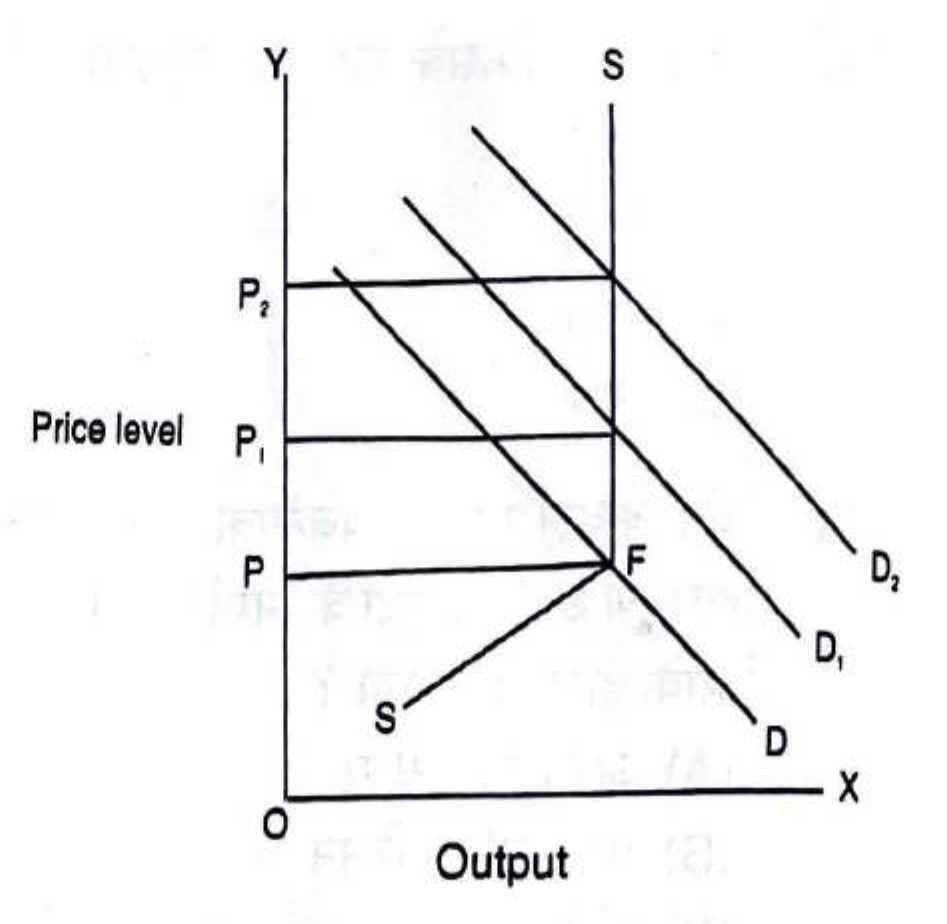 The above diagram speaks about the
- (a) Cost-push theory of inflation
- (b) Phillips curve
- (c) Demand-pull theory of inflation
- (d) Inflationary gap
Show answer
Answer: (c)
49. Who propounded the theory of comparative costs ?
- (a) Adam Smith
- (b) David Ricardo
- (c) J. S. Mill
- (d) G. V. Haberler
Show answer
Answer: (b)
50. _______ is the difference between total receipts and total expenditure.
- (a) Budget deficit
- (b) Fiscal deficit
- (c) Revenue deficit
- (d) Deficit budget
Show answer
Answer: (a)
51. Under New Industrial Policy, obtaining of industrial licence is compulsory for all of the below sector except
- (a) Clothes
- (b) Electronic aerospace
- (c) Cigarettes or tobacco
- (d) Specified hazardous chemicals
Show answer
Answer: (a)
52. “Numerical facts systematically collected” is the definition of statistics from the viewpoint of
- (a) Singular sense
- (b) Plural
- (c) Economics
- (d) Mathematical
Show answer
Answer: (b)
53. The elasticity can be found out by using the following formula.
- (a) Eₚ = (q₁ − q₂)/(q₂ + q₂) × (p₁ + p₂)/(p₁ − p₂)
- (b) Eₚ = q/p × p/q
- (c) Eₚ = Δq/Δp × p/q
- (d) Eₚ = Δq/Δy × y/q
Show answer
Answer: (c)
54. _______ explain the physical relationship between input and output in the long-run.
- (a) Law of variable proportions
- (b) Laws of returns
- (c) Laws of returns to scale
- (d) Isoquants
Show answer
Answer: (c)
55. Product differentiation is one of the characteristics of
- (a) Monopolistic competition
- (b) Monopoly
- (c) Duopoly
- (d) Oligopoly
Show answer
Answer: (a)
56. According to Prof. Knight, profit is due to
- (a) Insurable risk
- (b) Non-insurable risk
- (c) Uncertainties
- (d) Risk-taking
Show answer
Answer: —
57. The taxes which are not shifted to others are known as
- (a) Direct taxes
- (b) Indirect taxes
- (c) Sales taxes
- (d) G. S. T.
Show answer
Answer: (a)
58. Which of the following is not an instrument of fiscal policy ?
- (a) Taxation
- (b) Public expenditure
- (c) Bank rate
- (d) Public debt
Show answer
Answer: (c)
59. Prices being pushed up by an increase in production costs is known as
- (a) Demand-pull inflation
- (b) Cost-push inflation
- (c) Stagflation
- (d) Partial inflation
Show answer
Answer: (b)
60. “International trade is but a special case of interlocal or interregional trade” – the statement was given by
- (a) David Ricardo
- (b) Adam Smith
- (c) Bertil Ohlin
- (d) Heckscher
Show answer
Answer: (c)
61. Identify the bilateral method in the following.
- (a) Payments agreement
- (b) Clearing agreement
- (c) Transfer moratoria
- (d) All the above
Show answer
Answer: (d)
62. Who contributed Principle of Minimum Taxation ?
- (a) J. B. Say
- (b) J. M. Keynes
- (c) H. Dalton
- (d) Hicks
Show answer
Answer: (a)
63. The Fourth Five Year Plan was launched in
- (a) 1969
- (b) 1966
- (c) 1968
- (d) 1962
Show answer
Answer: (a)
Show answers
Answer key
Answer key from the U.P. Secondary Education Services Selection Board’s official answer key for this sitting. “—” means the key gave none: the question was deleted.
Economics
- Q 1
- (b)
- Q 2
- (d)
- Q 3
- (d)
- Q 4
- (d)
- Q 5
- (c)
- Q 6
- (d)
- Q 7
- (d)
- Q 8
- (a)
- Q 9
- (d)
- Q 10
- (c)
- Q 11
- (b)
- Q 12
- (a)
- Q 13
- (c)
- Q 14
- (b)
- Q 15
- (a)
- Q 16
- —
- Q 17
- (c)
- Q 18
- (b)
- Q 19
- (b)
- Q 20
- (c)
- Q 21
- (d)
- Q 22
- (b)
- Q 23
- (a)
- Q 24
- (d)
- Q 25
- (a)
- Q 26
- (b)
- Q 27
- (c)
- Q 28
- (c)
- Q 29
- (d)
- Q 30
- (d)
- Q 31
- (b)
- Q 32
- (d)
- Q 33
- (c)
- Q 34
- (c)
- Q 35
- (a)
- Q 36
- (b)
- Q 37
- (b)
- Q 38
- (c)
- Q 39
- (b)
- Q 40
- (c)
- Q 41
- (d)
- Q 42
- (b)
- Q 43
- (c)
- Q 44
- (a)
- Q 45
- (b)
- Q 46
- (c)
- Q 47
- (b)
- Q 48
- (c)
- Q 49
- (b)
- Q 50
- (a)
- Q 51
- (a)
- Q 52
- (b)
- Q 53
- (c)
- Q 54
- (c)
- Q 55
- (a)
- Q 56
- —
- Q 57
- (a)
- Q 58
- (c)
- Q 59
- (b)
- Q 60
- (c)
- Q 61
- (d)
- Q 62
- (a)
- Q 63
- (a)