ExamBharo · UP TGT 2021 — Science (Series A) · exambharo.com/up-tgt/previous-year-papers/up-tgt-2021-science-series-a/
Question paper · UP TGT
UP TGT 2021 — Science (Series A)
7 or 8 August 2021125 questions+4 for a correct answer, −0 for a wrong one
Questions from the U.P. Secondary Education Services Selection Board’s paper of 7 or 8 August 2021. Each question’s answer is under it, hidden until you open it, and the full answer key is at the end. Take the paper as a timed practice test to be scored.
The official booklet is a scan with no text, so ExamBharo typed this paper from it by hand. A typing slip is possible; report one through the contact page.
The board deleted questions 24, 51 and 66 in its final answer key: shown here, with no answer, and not counted in the score.
Science
1. If a neutral atom has 2K electrons, 8L electrons and 6M electrons, the total number of s-electrons, p-electrons and d-electrons separately in the atom will be
- (a) 4, 6, 1
- (b) 6, 8, 1
- (c) 6, 10, 0
- (d) 6, 10, 1
Show answer
Answer: (c)
2. Which trihydride has most thermal stability?
- (a) PH₃
- (b) AsH₃
- (c) NH₃
- (d) SbH₃
Show answer
Answer: (c)
3.
- (a) decrease
- (b) increase
- (c) stay unchanged
- (d) decrease or increase depending on surfaces of contact
Show answer
Answer: (a)
4. Some postulates of atomic theory of matter are quoted below (A) The ultimate particles of a given pure substance, called atoms, are chemically alike. (B) Atoms can neither be created nor destroyed. (C) Atoms though chemically identical, differ slightly in their weights. (D) Chemical reactions do not change nature of atoms, but cause their rearrangement. One of the above postulates was not part of Dalton's atomic theory. Identify it.
- (a) (A)
- (b) (B)
- (c) (C)
- (d) (D)
Show answer
Answer: (c)
5. Out of the following which compound does not show sp³ hybridization?
- (a) CH₄
- (b) BF₃
- (c) NH₃
- (d) H₂O
Show answer
Answer: (b)
6.
- (a) v decreases, ν unchanged, λ decreases
- (b) v and ν unchanged, λ decreases
- (c) v decreases, ν and λ unchanged
- (d) v, ν, λ all remain unchanged
Show answer
Answer: (a)
7. Which one of the following is not an element?
- (a) Diamond
- (b) Graphite
- (c) Ozone
- (d) Silica
Show answer
Answer: (d)
8. Whose experiment showed that atoms have discrete energy levels?
- (a) Davisson and Germer
- (b) Franck and Hertz
- (c) Planck
- (d) Rutherford
Show answer
Answer: (b)
9. Newton's Law of cooling is an approximate form of
- (a) Wien displacement law
- (b) Stefan's law
- (c) Kirchoff's law
- (d) Jean's law
Show answer
Answer: (b)
10. Which of the following species can act as a Bronsted acid?
- (a) (CH₃)₃C⁺
- (b) CH₃C̄H₂
- (c) CH₃ĊH₂
- (d) C₅H₅⁻
Show answer
Answer: (a)
11. In two-dimensional space, a particle A of mass 2 kg, velocity (3, 0) is moving along line x = 5, while particle B of mass 3 kg, velocity (−2, 0) is moving along line x = −3. What is the total angular momentum of the system?
- (a) Zero
- (b) 48 clockwise
- (c) 12 anti clockwise
- (d) Cannot be determined since axis of rotation not specified
Show answer
Answer: (b)
12. An electric heater draws a current of 10 A when connected to 220 V output terminal. Its resistance is
- (a) 44 Ω
- (b) 33 Ω
- (c) 22 Ω
- (d) 11 Ω
Show answer
Answer: (c)
13. The following element does not show positive oxidation number
- (a) P
- (b) S
- (c) F
- (d) Cl
Show answer
Answer: (c)
14. If an object travels half its total path in the last second of its fall from rest, the height of its fall, is
- (a) 20 m
- (b) 42 m
- (c) 57 m
- (d) 67 m
Show answer
Answer: (c)
15. If the atomic size increases, the non-metallic character will
- (a) Increase
- (b) Decrease
- (c) Sometimes increases and sometimes decreases
- (d) No change
Show answer
Answer: (b)
16. The wavelength of the matter waves associated with a fast moving sub-atomic particle depends upon – (i) charge (ii) mass (iii) velocity (iv) spin state and (v) momentum. The correct factors are
- (a) Only (iii)
- (b) Only (i), (ii) and (iii)
- (c) Only (ii), (iii) and (iv)
- (d) Only (ii), (iii) and (v)
Show answer
Answer: (d)
17. The temperature scale which is independent of the properties of any substance is the
- (a) Celsius scale
- (b) Reaumur scale
- (c) Fahrenheit scale
- (d) Kelvin scale
Show answer
Answer: (d)
18. Which one of the following compound contain both ionic and covalent bond?
- (a) Carbon tetrachloride
- (b) Calcium chloride
- (c) Ammonium chloride
- (d) Water
Show answer
Answer: (c)
19. Arrange the following according to decreasing order of bond angles.
- (a) H₂S > H₂Se > H₂Te > H₂O
- (b) H₂O > H₂S > H₂Se > H₂Te
- (c) H₂Te > H₂O > H₂S > H₂Se
- (d) H₂Se > H₂S > H₂O > H₂Te
Show answer
Answer: (b)
20. The earth has mass M and radius R. If 'g' is acceleration due to gravity on the surface of the earth, what is its value at height R/3 above the earth's surface?
- (a) (9/16) g
- (b) (4/9) g
- (c) g/3
- (d) zero
Show answer
Answer: (a)
21. Ethylbromide on treatment with silver cyanide gives
- (a) CH₃—CH₂—CN
- (b) CH₂=CH₂
- (c) CH₃—CH₂—N≡C
- (d) H—C≡C—H
Show answer
Answer: (c)
22. According to VSEPR theory, the repulsive interaction of electron pairs decrease in the order
- (a) Lone pair – Bond pair > Bond pair – Bond pair > Lone pair – Lone pair
- (b) Lone pair – Lone pair > Lone pair – Bond pair > Bond pair – Bond pair
- (c) Bond pair – Bond pair > Lone pair – Lone pair > Lone pair – Bond pair
- (d) Lone pair – Lone pair > Bond pair – Bond pair > Lone pair – Bond pair
Show answer
Answer: (b)
23.
- (a) 2 m
- (b) 1 m
- (c) 0.5 m
- (d) 0.25 m
Show answer
Answer: (b)
24. What will be the mass of 3.2 gram atoms of oxygen?
- (a) 10.24 gram
- (b) 102.4 gram
- (c) 1.024 gram
- (d) 1024 gram
Show answer
Answer: —
25. AC, voltage 100 V, 50 Hz is applied to the ends of a choke of L = 2 Henry. What current will flow through it (in amperes)?
- (a) 1/(2π) A.C.
- (b) 1/(2π) D.C.
- (c) 2/π A.C.
- (d) 2/π D.C.
Show answer
Answer: (a)
26. Two identical spheres A and B are at temperature 7°C and 17°C respectively. In what ratio will they emit thermal radiation?
- (a) 1 : 1.143
- (b) 7 : 17
- (c) 49 : 289
- (d) 7⁴ : 17⁴
Show answer
Answer: (a)
27. In each of the ions given below, the charge bearing carbon atom makes a σ-bond with the other carbon atom. In such a bond formation, it utilizes a hybrid orbital which bears maximum s-character in case of
- (a) CH₃—C̄H₂
- (b) CH₃—C⁺H₂
- (c) H₂C=C̄H
- (d) HC≡C̄
Show answer
Answer: (d)
28. Given the equation → Angular Momentum = (αβ − γ/time) × velocity, which of the following are possible dimensions of α, β and γ?
- (a) M, L, T
- (b) M, L, MLT
- (c) ML, ML, MLT
- (d) M²L⁻², ML, T
Show answer
Answer: (b)
29. In the potentiometer circuit shown, an e.m.f. E is balanced at C, 40 cm from the end B of the wire AB, which has a length of 100 cm and a resistance of 4 Ω. If the potential difference across the resistor R of 200 Ω is 1.00 V, the e.m.f. E in mV is
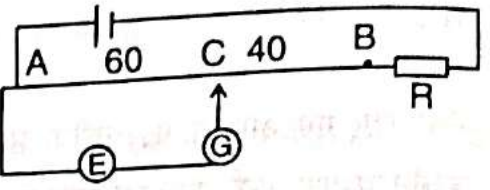
- (a) 12
- (b) 10
- (c) 8
- (d) 6
Show answer
Answer: (a)
30. The ratio of specific charge of a proton and a α-particle is
- (a) 2 : 1
- (b) 1 : 2
- (c) 1 : 4
- (d) 1 : 1
Show answer
Answer: (a)
31. All the four quantum numbers of last electron of sodium atom are
- (a) n = 3, l = 0, m = 0, s = +1/2
- (b) n = 3, l = 1, m = +1, s = +1/2
- (c) n = 3, l = 2, m = +1, s = +1/2
- (d) n = 2, l = 0, m = 0, s = +1/2
Show answer
Answer: (a)
32. Which of these can be the fuel in a nuclear fission reactor?
- (a) Cadmium
- (b) Thorium
- (c) Helium
- (d) Deuterium
Show answer
Answer: (b)
33. The electronegativity of the atom would increase with increase in ____ character of its hybrid orbitals.
- (a) p
- (b) d
- (c) f
- (d) s
Show answer
Answer: (d)
34. Arrange the following according to penetrating power of the rays.
- (a) β > α > γ
- (b) γ > β > α
- (c) α > γ > β
- (d) α > β > γ
Show answer
Answer: (b)
35. Kepler's law of "Areal Velocity is constant" is equivalent to law of conservation of
- (a) Mass
- (b) Energy
- (c) Linear Momentum
- (d) Angular Momentum
Show answer
Answer: (d)
36. Who postulated that the momentum of an electron in an atom is quantized?
- (a) Erwin Schrodinger
- (b) Niels Henrik David Bohr
- (c) Louis Victor Pierre Raymond Duc de Broglie
- (d) Wolfgang Pauli
Show answer
Answer: (b)
37. Identify the product of the following reaction.

- (a)
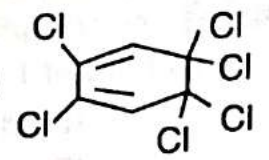
- (b)
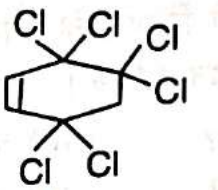
- (c)
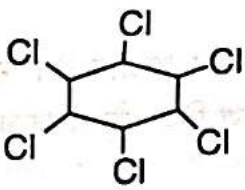
- (d)
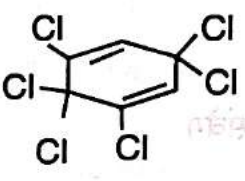
Show answer
Answer: (c)
- (a)
38. Two plane mirrors are placed at 60° angle to each other. How many images will be seen if the object is placed between them?
- (a) 2
- (b) 3
- (c) 5
- (d) Infinite
Show answer
Answer: (c)
39. Who made the observation that there must be very large empty space within the atom?
- (a) Einstein
- (b) Arrhenius
- (c) Chadwick
- (d) Rutherford
Show answer
Answer: (d)
40. An ideal transformer has 100 turns in primary and N turns in secondary. If the input is 220 V A.C. and we want 11 V output, what is the value of N?
- (a) 1
- (b) 5
- (c) 100
- (d) 500
Show answer
Answer: (b)
41. If the refractive index of glass is 1.5, the speed of light in glass is
- (a) 2.3 × 10⁸ m/s
- (b) 3.0 × 10⁸ m/s
- (c) 1.5 × 10⁸ m/s
- (d) 2.0 × 10⁸ m/s
Show answer
Answer: (d)
42. Which gas is evolved when water is added to calcium carbide at room temperature?
- (a) Hydrogen
- (b) Methane
- (c) Acetylene
- (d) Allene
Show answer
Answer: (c)
43. Rain is falling vertically on the ground at speed 5√3 m/s. If a man walks towards the East with speed 5 m/s, he will feel the rain falling at what angle to the vertical?
- (a) 0°
- (b) 30°
- (c) 45°
- (d) 60°
Show answer
Answer: (b)
44. Transmission of heat by molecular collision is
- (a) Conduction
- (b) Convection
- (c) Radiation
- (d) Scattering
Show answer
Answer: (a)
45. If the standard electrode potentials for zinc and copper electrodes in the cell Zn|Zn²⁺||Cu²⁺|Cu are − 0.76 V and 0.34 V respectively, the value of standard potential of the cell in volts will be
- (a) 0.11
- (b) 11.0
- (c) 1.10
- (d) 0.011
Show answer
Answer: (c)
46. The temperature at which the vapour pressure of a liquid becomes equal to atmospheric pressure is called
- (a) Melting point
- (b) Freezing point
- (c) Critical temperature
- (d) Boiling point
Show answer
Answer: (d)
47. The resistances in a post office box are made of
- (a) Copper
- (b) Iron
- (c) Manganin
- (d) Brass
Show answer
Answer: (c)
48. Choose the correct statement.
- (a) Oxidation state of central atom is +5 in HClO and +1 in HClO₃.
- (b) The chlorine atom will be more electronegative in HClO₃ than in HClO.
- (c) The chlorine atom will be more electronegative in HClO than in HClO₃.
- (d) The chlorine atom have equal electronegativity in both HClO and HClO₃.
Show answer
Answer: (b)
49. Which has maximum spin multiplicity?
- (a) p¹
- (b) p²
- (c) p³
- (d) p⁴
Show answer
Answer: (c)
50.
- (a) Zero
- (b) − GM/R
- (c) − 3GM/8R
- (d) − 3GM/2R
Show answer
Answer: (c)
51. Among the chemical reactions given below, identify the double decomposition reaction.
- (a) 6CO₂ + 6H₂O → C₆H₁₂O₆ + 6O₂
- (b) 4Fe + 3O₂ → 2Fe₂O₃
- (c) H₂CO₃ → CO₂ + H₂O
- (d) CuSO₄ + Fe → FeSO₄ + Cu
Show answer
Answer: —
52. Find out the meta directing group from the following.
- (a) −Cl
- (b) −NH₂
- (c) −CH₃
- (d) −CN
Show answer
Answer: (d)
53. Which mirror is best suited to focus parallel rays at a point?
- (a) Spherical convex
- (b) Spherical concave
- (c) Hyperbolic
- (d) Parabolic
Show answer
Answer: (d)
54. Na⁺ and F⁻, both the ions have 1s², 2s² 2p⁶ electronic configuration, but ionic radius of Na⁺ ion is only 0.691 times that of F⁻ ion. If sum of their ionic radii is 231 pm, the ionic radius of F⁻ ion will be
- (a) 136 pm
- (b) 115 pm
- (c) 95 pm
- (d) 41 pm
Show answer
Answer: (a)
55. Specific heat at constant pressure is Cₚ and at constant volume is Cᵥ. Why is the ratio Cₚ/Cᵥ greater than one?
- (a) For constant pressure external work has to be done
- (b) Cₚ includes rotational energy
- (c) Cₚ includes vibrational energy
- (d) Cₚ/Cᵥ > 1 only for ideal gases, not for real ones
Show answer
Answer: (a)
56. For an adiabatic process the first law of thermodynamics becomes
- (a) dU = dQ − dW
- (b) dU = dQ
- (c) dU = −dW
- (d) dU = dW
Show answer
Answer: (c)
57. The following d-block element does not show variable valency
- (a) Cu
- (b) Zn
- (c) Mn
- (d) Fe
Show answer
Answer: (b)
58. If Force (F), velocity (V) and time (T) are taken as the fundamental dimensions, instead of mass, length and time, what will be dimensions of linear momentum (P)?
- (a) FVT⁻¹
- (b) FT
- (c) FT⁻¹
- (d) VT⁻²
Show answer
Answer: (b)
59. The maximum acceleration of a SHM is α and the maximum velocity is β. What is the amplitude of oscillations?
- (a) β²/α
- (b) α/β²
- (c) β/α
- (d) α/β
Show answer
Answer: (a)
60. Why usually covalent compounds have low melting and boiling points?
- (a) Strong van der Waal's force
- (b) Weak van der Waal's force
- (c) No van der Waal's force
- (d) Strong magnetic force
Show answer
Answer: (b)
61. Which of the following is incorrect statement?
- (a) Bohr's model of atom fails to explain spectra of multielectron atoms.
- (b) Bohr's atomic model fails to explain Zeeman effect.
- (c) Bohr's atomic model fails to explain Stark effect.
- (d) Bohr's atomic model treats electron as a particle and as a wave.
Show answer
Answer: (d)
62. When a p-n junction is reverse biased, its depletion region
- (a) becomes wider
- (b) becomes narrower
- (c) disappears
- (d) does not change
Show answer
Answer: (a)
63. Which one is optically active?
- (a) Propanoic acid
- (b) 3-chloropropanoic acid
- (c) 2-chloropropanoic acid
- (d) 3-chloropropene
Show answer
Answer: (c)
64. Out of the following set of compounds which set has bond order +1?
- (a) F₂ and O₂²⁻
- (b) N₂ and CO
- (c) F₂ and NO⁺
- (d) O₂²⁻ and N₂
Show answer
Answer: (a)
65. Which property of light shows it is a transverse wave?
- (a) Refraction
- (b) Interference
- (c) Diffraction
- (d) Polarization
Show answer
Answer: (d)
66. Which one of the following is a permanent effect?
- (a) Inductive effect
- (b) Electromeric effect
- (c) Resonance effect
- (d) Baker Nathan effect
Show answer
Answer: —
67.
- (a) Drift speed only
- (b) Resistivity only
- (c) Resistance only
- (d) All of the above
Show answer
Answer: (d)
68. [Latent heat of ice = 80 cals/gm]
- (a) 0°C
- (b) (50/3)°C
- (c) 12.5°C
- (d) 25°C
Show answer
Answer: (a)
69. There are ____ number of ions in CoCl₃.5NH₃.
- (a) 4
- (b) 3
- (c) 2
- (d) 5
Show answer
Answer: (b)
70. Two forces F⃗ and − 3F⃗ act at a perpendicular distance 'd' from each other. This is equivalent to which one of the following?
- (a) Net linear force − 2F⃗ only
- (b) Net linear force zero only
- (c) A net couple of moment 2Fd only
- (d) A net linear force of − 2F⃗ and a net couple of moment Fd
Show answer
Answer: (d)
71.
- (a) 59°C
- (b) 62.1°C
- (c) 56.05°C
- (d) 60°C
Show answer
Answer: (d)
72. The dilute solution of all the alkali metals in anhydrous liquid ammonia is
- (a) Diamagnetic
- (b) Paramagnetic
- (c) Ferromagnetic
- (d) Antiferromagnetic
Show answer
Answer: (b)
73. Which shows inert pair effect?
- (a) Na
- (b) Mg
- (c) Pb
- (d) Sc
Show answer
Answer: (c)
74. Given four forces (i) Gravitational (ii) Electrostatic (iii) Magnetic (iv) Frictional Which of these are non-conservative?
- (a) All
- (b) Only Electrostatic
- (c) Only Magnetic
- (d) Both Magnetic and Frictional
Show answer
Answer: (d)
75. An automobile fitted with a lead storage battery sometimes has starting trouble in cold climate. The low power output in such a case is due to
- (a) Poor ionization of the electrolyte in it
- (b) Mobility of the ions in the electrolyte is reduced significantly
- (c) Specific gravity of sulfuric acid is increased
- (d) Specific gravity of sulfuric acid falls
Show answer
Answer: (b)
76.
- (a) velocity 9.8 m/s
- (b) velocity 4.9 m/s
- (c) acceleration 9.8 m/s²
- (d) acceleration 4.9 m/s²
Show answer
Answer: (c)
77. The first law of thermodynamics is equivalent to the principle of conservation of
- (a) energy
- (b) temperature
- (c) heat
- (d) volume
Show answer
Answer: (a)
78. (σ = 5.67 × 10⁻⁸ W/m²K⁴)
- (a) 231 W
- (b) 462 W
- (c) 923 W
- (d) 1050 W
Show answer
Answer: (c)
79. In which of the compounds given below, bonding among atoms is explained on the basis of ionic, covalent as well as coordinate covalent bonds?
- (a) Sodium carbonate
- (b) Barium chloride
- (c) Nitric acid
- (d) Ammonia
Show answer
Answer: (c)
80. In a pure semiconductor
- (a) holes and electrons have equal mobility
- (b) holes have higher mobility
- (c) electrons have higher mobility
- (d) only electrons are mobile
Show answer
Answer: (c)
81.
- (a) 0
- (b) 1/4
- (c) 15/16
- (d) 1
Show answer
Answer: (d)
82. Among the halides of silver, the one with lowest solubility in water is
- (a) AgF
- (b) AgCl
- (c) AgBr
- (d) AgI
Show answer
Answer: (d)
83. If one molecule of hydrogen gas reacts with one molecule of chlorine gas to produce two molecules of hydrochloric acid, the number of molecules present in equal volumes of different gases at identical pressure and temperature will be
- (a) Different
- (b) Same
- (c) Volume of H₂ is greater than O₂
- (d) Volume of H₂ is less than O₂
Show answer
Answer: (b)
84.
- (a) in less than 10 seconds
- (b) at exactly 10 seconds
- (c) only after 10 seconds
- (d) cannot be predicted
Show answer
Answer: (d)
85. Identify the name of the following reaction. CH₃Br + 2Na + BrCH₃ —(Dry Et₂O)→ C₂H₆ + 2NaBr
- (a) Kolbe's reaction
- (b) Hydrogenation reaction
- (c) Wurtz reaction
- (d) Corey-House reaction
Show answer
Answer: (c)
86. Which one is electrophile reagent?
- (a) ⁻OH
- (b) R − NH₂
- (c) AlCl₃
- (d) Cl⁻
Show answer
Answer: (c)
87. Which defect of vision is corrected using cylindrical lenses in spectacles?
- (a) Myopia
- (b) Hypermetropia
- (c) Astigmatism
- (d) Loss of accommodation
Show answer
Answer: (c)
88. According to the Planck's law the energy density of radiation in thermal equilibrium with matter at temperature T is given by u(ν, T) = (8πh/c³) · νⁿ/(e^(hν/kT) − 1), where 'n' is an integer equal to
- (a) − 1
- (b) 1
- (c) 2
- (d) 3
Show answer
Answer: (d)
89. Carbon atoms in graphite have their electrons neither in pure s- nor in pure p-orbitals but contain these in the orbitals that have
- (a) 50% s- and 50% p-orbital character
- (b) 33% s- and 66% p-orbital character
- (c) 75% s- and 25% p-orbital character
- (d) 25% s- and 75% p-orbital character
Show answer
Answer: (b)
90. The mechanical equivalent of heat
- (a) has same dimension as work
- (b) has same dimension as heat
- (c) has same dimension as rate of doing work
- (d) dimensionless
Show answer
Answer: (d)
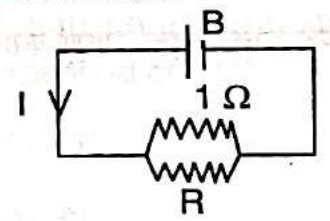
91. In the circuit below, battery B has electro motive force 2 V and internal resistance 0.5 Ω. What should be the value of Resistance R for current I to be maximum?
- (a) Infinite
- (b) 1 Ω
- (c) 0.5 Ω
- (d) Zero
Show answer
Answer: (d)
92. Which among the following is a pair of isotones?
- (a) ²³₁₁Na, ²³₁₂Mg
- (b) ²³₁₁Na, ²⁴₁₂Mg
- (c) ²⁴₁₁Na, ²⁴₁₂Mg
- (d) ²⁴₁₁Na, ²³₁₂Mg
Show answer
Answer: (b)
93. An electric heater of power 1000 W raises the temperature of 5 kg of a liquid from 25°C to 31°C in 2 minutes. What is heat capacity of the liquid?
- (a) 4 × 10³ J/kg°C
- (b) 2 × 10⁴ J/°C
- (c) 1.2 × 10⁵ J
- (d) 1 × 10⁴ J/°C
Show answer
Answer: (a)
94. Three particles of masses 2, 3 and 4 units are placed at points (0, 0, 0), (1, 1, 0) and (0, 1, 1) respectively. What is the moment of inertia of the system about the z-axis?
- (a) Zero
- (b) 4
- (c) 7
- (d) 10
Show answer
Answer: (d)
95. Which element was assigned Group III A in the Mendeleev's periodic table but is a member of Group-13 in the 18-group modern periodic table?
- (a) Cu
- (b) Al
- (c) Zn
- (d) Sn
Show answer
Answer: (b)
96. What will be the value of gram atoms present in 2.3 grams of sodium?
- (a) 0.02
- (b) 0.01
- (c) 0.1
- (d) 0.03
Show answer
Answer: (c)
97. When a nucleus emits a β-ray, what does not change?
- (a) Sum of proton and neutron numbers
- (b) Proton number
- (c) Neutron number
- (d) Total charge
Show answer
Answer: (a)
98. Which compound does not show expanded octet?
- (a) PF₆
- (b) SF₆
- (c) NO₂
- (d) H₂SO₄
Show answer
Answer: (c)
99. Which shows maximum oxidation number +7 in 3d series?
- (a) Cr
- (b) Mn
- (c) Fe
- (d) Co
Show answer
Answer: (b)
100.
- (a) 45°C
- (b) 35°C
- (c) 50°C
- (d) 64.3°C
Show answer
Answer: (c)
101. Electro motive force represents
- (a) Force
- (b) Work
- (c) Energy per unit charge
- (d) Momentum
Show answer
Answer: (c)
102. Standard reduction potentials of the two electrodes Co²⁺/Co and Fe²⁺/Fe are − 0.28 V and − 0.44 V respectively. The EMF of the cell for which cell reaction is Co + Fe²⁺ → Co²⁺ + Fe will be
- (a) − 0.16 V
- (b) − 0.72 V
- (c) + 0.72 V
- (d) + 0.16 V
Show answer
Answer: (a)
103. For which one of the following concave mirror is not used?
- (a) Shaving glass
- (b) Reflector in search lights
- (c) Examination of internal parts of ear
- (d) Rear-view mirror in cars
Show answer
Answer: (d)
104.
- (a) 5 Ω
- (b) 2.5 Ω
- (c) 1.25 Ω
- (d) 1 Ω
Show answer
Answer: (c)
105. The radio isotope ²¹²₈₃Bi decays with α- and β-emissions simultaneously to give the radioactive products X and Y. X and Y further decay to give an identical product Z.
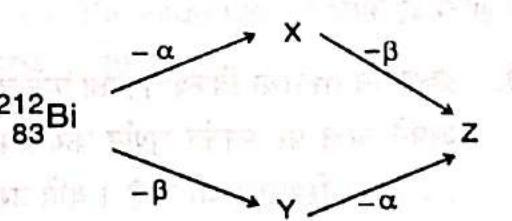 The common product Z is an isotope of
- (a) ₈₁Tl
- (b) ₈₂Pb
- (c) ₈₃Bi
- (d) ₈₄Po
Show answer
Answer: (b)
106. Which element was discovered through the Fraunhofer lines in the solar radiation?
- (a) Hydrogen
- (b) Helium
- (c) Lithium
- (d) Uranium
Show answer
Answer: (b)
107. "A given compound always contains exactly the same proportion of elements by weight". This statement belongs to the
- (a) Law of conservation of mass
- (b) Law of multiple proportions
- (c) Law of creation of mass
- (d) Law of definite proportions
Show answer
Answer: (d)
108. Modern periodic table was given by the following
- (a) Lother Meyer
- (b) Moseley
- (c) Mendeleef
- (d) New Land
Show answer
Answer: (b)
109.
- (a) mR²t
- (b) Ft
- (c) FRt
- (d) Ft/R
Show answer
Answer: (c)
110. The refractive index of water aμw = 4/3 and refractive index of glass aμg = 3/2. A lens placed in air has focal length 10 cm. What will be its focal length if placed inside water?
- (a) 10 cm
- (b) 15 cm
- (c) 20 cm
- (d) 40 cm
Show answer
Answer: (d)
111. Which among the oxides of transition elements listed below is not coloured?
- (a) TiO₂
- (b) Cr₂O₃
- (c) MnO₂
- (d) Fe₂O₃
Show answer
Answer: (a)
112. What is the cause of nuclear fission?
- (a) Centrifugal force
- (b) Coulomb force
- (c) Surface tension
- (d) Viscous force
Show answer
Answer: (b)
113.
- (a) t½ = 0.6931/λ
- (b) t½ = λ/0.6931
- (c) t½ = 0.936/λ
- (d) t½ = λ/0.936
Show answer
Answer: (a)
114. Antibonding molecular orbital is formed by
- (a) Additive overlapping of two atomic orbitals
- (b) Subtractive overlapping of two atomic orbitals
- (c) Only by additive overlapping of two p orbitals
- (d) Only by subtractive overlapping of two s orbitals
Show answer
Answer: (b)
115.
- (a) Zero
- (b) 5°
- (c) 7.5°
- (d) 15°
Show answer
Answer: (b)
116. If the halides of calcium are arranged in the increasing order of their melting points, the correct sequence will be
- (a) CaI₂ < CaBr₂ < CaCl₂ < CaF₂
- (b) CaI₂ < CaBr₂ < CaF₂ < CaCl₂
- (c) CaF₂ < CaCl₂ < CaBr₂ < CaI₂
- (d) CaCl₂ < CaF₂ < CaBr₂ < CaI₂
Show answer
Answer: (a)
117. An electron in an atom though revolves around the nucleus, the radius of its path is not constant but varies between a maximum and a minimum values. This suggestion was given by
- (a) John Dalton
- (b) Sir Ernest Rutherford
- (c) Niels Henrik David Bohr
- (d) Arnold Johannes Wilhelm Sommerfeld
Show answer
Answer: (d)
118. (g = acceleration due to gravity)
- (a) M(g + α)
- (b) (M + μL)g
- (c) (M + μL/2)(g + α)
- (d) (M + μL/2)g
Show answer
Answer: (c)
119.
- (a) 750 m/s²
- (b) 500 m/s²
- (c) 300 m/s²
- (d) 250 m/s²
Show answer
Answer: (a)
120. Which one of the following acts as an anode in the Leclanche cell?
- (a) Carbon rod
- (b) Zinc rod
- (c) Copper rod
- (d) Aluminium rod
Show answer
Answer: (b)
121. In which of the following pairs, compounds of the ion with lower oxidation state are more common and stable?
- (a) Cuperous, Cuperic
- (b) Ferrous, Ferric
- (c) Thallous, Thallic
- (d) Mercurous, Mercuric
Show answer
Answer: (c)
122.
- (a) 0.16 cm³
- (b) 0.16 π cm³
- (c) 0.32 π cm³
- (d) 0.48 π cm³
Show answer
Answer: (d)
123.
- (a) F⃗ · d²r⃗/dt²
- (b) r⃗ · dr⃗/dt
- (c) r⃗ · d²r⃗/dt²
- (d) None of the above
Show answer
Answer: (c)
124. Which have maximum electron affinity?
- (a) F
- (b) Cl
- (c) Br
- (d) I
Show answer
Answer: (b)
125. The maximum number of electrons, that can be accommodated in an orbital is
- (a) 2
- (b) 6
- (c) 10
- (d) 14
Show answer
Answer: (a)
Show answers
Answer key
Answer key from the U.P. Secondary Education Services Selection Board’s official answer key for this sitting. “—” means the key gave none: the question was deleted.
Science
- Q 1
- (c)
- Q 2
- (c)
- Q 3
- (a)
- Q 4
- (c)
- Q 5
- (b)
- Q 6
- (a)
- Q 7
- (d)
- Q 8
- (b)
- Q 9
- (b)
- Q 10
- (a)
- Q 11
- (b)
- Q 12
- (c)
- Q 13
- (c)
- Q 14
- (c)
- Q 15
- (b)
- Q 16
- (d)
- Q 17
- (d)
- Q 18
- (c)
- Q 19
- (b)
- Q 20
- (a)
- Q 21
- (c)
- Q 22
- (b)
- Q 23
- (b)
- Q 24
- —
- Q 25
- (a)
- Q 26
- (a)
- Q 27
- (d)
- Q 28
- (b)
- Q 29
- (a)
- Q 30
- (a)
- Q 31
- (a)
- Q 32
- (b)
- Q 33
- (d)
- Q 34
- (b)
- Q 35
- (d)
- Q 36
- (b)
- Q 37
- (c)
- Q 38
- (c)
- Q 39
- (d)
- Q 40
- (b)
- Q 41
- (d)
- Q 42
- (c)
- Q 43
- (b)
- Q 44
- (a)
- Q 45
- (c)
- Q 46
- (d)
- Q 47
- (c)
- Q 48
- (b)
- Q 49
- (c)
- Q 50
- (c)
- Q 51
- —
- Q 52
- (d)
- Q 53
- (d)
- Q 54
- (a)
- Q 55
- (a)
- Q 56
- (c)
- Q 57
- (b)
- Q 58
- (b)
- Q 59
- (a)
- Q 60
- (b)
- Q 61
- (d)
- Q 62
- (a)
- Q 63
- (c)
- Q 64
- (a)
- Q 65
- (d)
- Q 66
- —
- Q 67
- (d)
- Q 68
- (a)
- Q 69
- (b)
- Q 70
- (d)
- Q 71
- (d)
- Q 72
- (b)
- Q 73
- (c)
- Q 74
- (d)
- Q 75
- (b)
- Q 76
- (c)
- Q 77
- (a)
- Q 78
- (c)
- Q 79
- (c)
- Q 80
- (c)
- Q 81
- (d)
- Q 82
- (d)
- Q 83
- (b)
- Q 84
- (d)
- Q 85
- (c)
- Q 86
- (c)
- Q 87
- (c)
- Q 88
- (d)
- Q 89
- (b)
- Q 90
- (d)
- Q 91
- (d)
- Q 92
- (b)
- Q 93
- (a)
- Q 94
- (d)
- Q 95
- (b)
- Q 96
- (c)
- Q 97
- (a)
- Q 98
- (c)
- Q 99
- (b)
- Q 100
- (c)
- Q 101
- (c)
- Q 102
- (a)
- Q 103
- (d)
- Q 104
- (c)
- Q 105
- (b)
- Q 106
- (b)
- Q 107
- (d)
- Q 108
- (b)
- Q 109
- (c)
- Q 110
- (d)
- Q 111
- (a)
- Q 112
- (b)
- Q 113
- (a)
- Q 114
- (b)
- Q 115
- (b)
- Q 116
- (a)
- Q 117
- (d)
- Q 118
- (c)
- Q 119
- (a)
- Q 120
- (b)
- Q 121
- (c)
- Q 122
- (d)
- Q 123
- (c)
- Q 124
- (b)
- Q 125
- (a)