ExamBharo · UP TGT 2016 — Music Vocal (Series A) · exambharo.com/up-tgt/previous-year-papers/up-tgt-2016-music-vocal-series-a/
Question paper · UP TGT
UP TGT 2016 — Music Vocal (Series A)
8 or 9 March 2019125 questions+3.4 for a correct answer, −0 for a wrong one
Questions from the U.P. Secondary Education Services Selection Board’s paper of 8 or 9 March 2019. Each question’s answer is under it, hidden until you open it, and the full answer key is at the end. Take the paper as a timed practice test to be scored.
The official booklet is a scan with no text, so ExamBharo typed this paper from it by hand. A typing slip is possible; report one through the contact page.
The board deleted questions 12 and 92 in its final answer key: shown here, with no answer, and not counted in the score.
Music Vocal
1. Pt. V.D. Paluskar was a desciple of
- (a) Pt. Krishna Kulkarni
- (b) Pt. Ramashray Jha
- (c) Pt. Kumar Gandharv
- (d) Pt. Balakrishna Bua
Show answer
Answer: (d)
2. “Abhinav Raag Manjari” was written by
- (a) Swamy Haridas
- (b) Ahobal
- (c) Pt. V. D. Paluskar
- (d) None of the above
Show answer
Answer: (d)
3. Amir Khusro was under ________ ruler.
- (a) Jahangir
- (b) Shahjahan
- (c) Allahuddin Khilji
- (d) Akbar
Show answer
Answer: (c)
4. Jhaptaal has ________ maatras.
- (a) 10
- (b) 12
- (c) 14
- (d) 16
Show answer
Answer: (a)
5. What is that Murchhana called in which Antar-Gandhar is used ?
- (a) Sakakali
- (b) Antar-Sanhita
- (c) Shuddha
- (d) Purna
Show answer
Answer: (b)
6. Audhava-sampoorna jaati of a raaga will have ________ swaras in Aaroh and ________ swaras in Avaroh.
- (a) 5, 6
- (b) 5, 7
- (c) 6, 7
- (d) 7, 7
Show answer
Answer: (b)
7. Pick the odd one.
- (a) Kuaad
- (b) Biaad
- (c) Aad
- (d) Duaad
Show answer
Answer: (d)
8. In North India, the Bhakti Aandolan started by singing more of Bhajan and Sankeertans. During whose period did this Aandolan take place ?
- (a) Mughal period
- (b) British period
- (c) Mauryan period
- (d) Vedic period
Show answer
Answer: (a)
9. In which Thaat, all the swaras are ‘komal’ ?
- (a) Bhairavi
- (b) Yaman
- (c) Bhairav
- (d) Kafi
Show answer
Answer: (a)
10. Taal Jhoomra has ________ maatras; ________ number of khandas and khaali on ________ maatras.
- (a) 14; 6; [4, 11]
- (b) 14; 4; 8
- (c) 14; 4; [4, 11]
- (d) 14; 6; [6, 12]
Show answer
Answer: (b)
11.
 Identify the laya in which the above taal has been written.
- (a) Aad laya
- (b) Dugun laya
- (c) Tigun laya
- (d) Chougun laya
Show answer
Answer: (b)
12. At what maatra is taali in taal Gajajhampa ?
- (a) 1, 5, 12
- (b) 1, 5, 13
- (c) 1, 5, 9
- (d) 1, 9, 13
Show answer
Answer: —
13. The sam in a taal is indicated by ________ in Paluskar Notation System.
- (a) +
- (b) 0
- (c) Maatra number
- (d) ×
Show answer
Answer: (c)
14. In Bhatkhande system of notation, the sam is indicated by
- (a) +
- (b) ×
- (c) 0
- (d) ~
Show answer
Answer: (b)
15. What are the total number of swaras in a saptak ?
- (a) 7
- (b) 12
- (c) 22
- (d) 0
Show answer
Answer: (b)
16. Which among the four is not one of the parts of a Dhrupad ?
- (a) Sthayi
- (b) Antara
- (c) Sanchari
- (d) Bhog
Show answer
Answer: (d)
17. The taan in which, along with taan the words of the geet are sung, is called
- (a) Aalap taan
- (b) Bol taan
- (c) Halka taan
- (d) Shuddh taan
Show answer
Answer: (b)
18. What is the 7ᵗʰ note of shuddh saptak ?
- (a) Ṡa
- (b) Shuddh Ni
- (c) Komal Ni
- (d) Teevra Ma
Show answer
Answer: (b)
19.
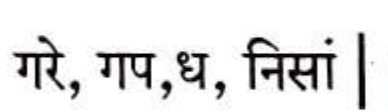 Identify the raaga.
- (a) Kalyan
- (b) Bhoopali
- (c) Bilawal
- (d) None
Show answer
Answer: (c)
20. कोमल गमधनि तिश रिशब चढ़त गनी न सुहाइ । ध–ग वादी–संवादी ते ________ कहाइ । – राग चन्द्रिकासार Identify the raaga.
- (a) Bhairav
- (b) Bhairavi
- (c) Purvi
- (d) Aasavari
Show answer
Answer: (d)
21. Vadi and samvadi of Raag Yaman are
- (a) Ga and Ni respy.
- (b) Sa and Ga respy.
- (c) Re and Pa respy.
- (d) Pa and Ga respy.
Show answer
Answer: (a)
22. What swaras are missing [वर्ज] in raag Malkauns ?
- (a) Ga and Pa
- (b) Ga and Dha
- (c) Re and Dha
- (d) Re and Pa
Show answer
Answer: (d)
23.
 Ṇi, Sa Re Ga, Ma Ga, Maˡ, Ga, Re Ga Re Sa. Identify the raaga.
- (a) Todi
- (b) Purvi
- (c) Bhairav
- (d) None
Show answer
Answer: (b)
24. तीखे रिध कोमल गमनि आरोहित रिधहीन । स–म संवादी – वादि तें ________ चीन्ह ।। – राग चन्द्रिकासार Identify the raaga.
- (a) Kafi
- (b) Bihag
- (c) Bhimpalasi
- (d) Yaman
Show answer
Answer: (c)
25. Thumri singer Girija Devi belongs to which Gharana ?
- (a) Kirana gharana
- (b) Delhi gharana
- (c) Banaras gharana
- (d) Jaipur gharana
Show answer
Answer: (c)
26. A composition exclusively made of swaras and is bound in a particular raag and taal is called
- (a) Raag Aalap
- (b) Sargam geet
- (c) Lakshan geet
- (d) Lavani
Show answer
Answer: (b)
27. The upper rendition of the swar from its original position is called
- (a) Anudatt
- (b) Udatt
- (c) Swarit
- (d) None of the above
Show answer
Answer: (b)
28. How many strings are mainly found in Taanpura ?
- (a) 1
- (b) 3
- (c) 4
- (d) 7
Show answer
Answer: (c)
29. The black material found in the center of both right and left tabla is called
- (a) Baddhi
- (b) Chati
- (c) Lava ( लव )
- (d) Syahi ( स्याही )
Show answer
Answer: (d)
30. Shatshruti Dha in Carnatic is called ________ in Hindustani.
- (a) Teevra Ni
- (b) Teevra Dha
- (c) Shuddha Dha
- (d) Komal Ni
Show answer
Answer: (d)
31. In ________ Tansen came to Akbar’s Palace.
- (a) 1555
- (b) 1556
- (c) 1557
- (d) 1558
Show answer
Answer: (b)
32. Pt. Vishnu Digambar Paluskar was born in
- (a) Satara
- (b) Miraj
- (c) Kurundwad
- (d) None
Show answer
Answer: (c)
33. Pt. V. N. Bhatkhande was born in
- (a) Pune
- (b) Miraj
- (c) Mumbai
- (d) Belgaum
Show answer
Answer: (c)
34. Shuddha and Vikrita are the types of
- (a) Jaati
- (b) Gram
- (c) Prabandha
- (d) Murchhana
Show answer
Answer: (a)
35. Which swara is necessary to recognise the ‘Uttar raag’ ?
- (a) Graha swara
- (b) Nyas swara
- (c) Vadi swara
- (d) Langhan swara
Show answer
Answer: (c)
36. What is the first maatra of any taal called ?
- (a) Khali
- (b) Sam
- (c) Khand
- (d) Taali
Show answer
Answer: (b)
37. Total number of maatras, taali and khaali in taal teentaal are
- (a) 16, 3, 1
- (b) 16, 13, 0
- (c) 16, 4, 0
- (d) 16, 2, 2
Show answer
Answer: (a)
38. In Aad layakari of Dadra taal, at what maatra does the third cycle of taal begins to complete the layakari in 2ⁿᵈ Aavartan ?
- (a) 3ʳᵈ
- (b) 4ᵗʰ
- (c) 2ⁿᵈ
- (d) 5ᵗʰ
Show answer
Answer: (a)
39. Which naad is used in music ?
- (a) Ahat naad
- (b) Anahat naad
- (c) Sushir naad
- (d) Swayambhu naad
Show answer
Answer: (a)
40. Sadarang, Adarang were under Raja
- (a) Babar
- (b) Humayun
- (c) Akbar
- (d) Mohammed Rangeele
Show answer
Answer: (d)
41. The process of counting the beats in a taal by making sound is called
- (a) Shabd kriya
- (b) Sashabd kriya
- (c) Nishabd kriya
- (d) Kriya
Show answer
Answer: (b)
42. For example, in 16 seconds, if we sing 16 words, then the laya of the taal is called
- (a) Drut laya
- (b) Madhya laya
- (c) Vilambit laya
- (d) Dugun laya
Show answer
Answer: (b)
43.
 Identify the taal given above.
- (a) Sultaal
- (b) Ektaal
- (c) Choutaal
- (d) Deepchandi
Show answer
Answer: (c)
44. What is the relation between Tigun and Aad laya ?
- (a) Tigun = (3/2) × Aad laya
- (b) Tigun = 2 × Aad laya
- (c) Tigun = (2/3) × Aad laya
- (d) Tigun = ½ × Aad laya
Show answer
Answer: (b)
45. Taal Jhoomra has ________ maatras.
- (a) 10
- (b) 12
- (c) 14
- (d) 16
Show answer
Answer: (c)
46. The Mandra, Madhya and Taar of a note is called
- (a) Sthayi
- (b) Naad sthan
- (c) Timbre
- (d) None
Show answer
Answer: (b)
47. The swaras by singing which will spoil the raaga are called ________ swaras.
- (a) Vadi
- (b) Anuvadi
- (c) Samvadi
- (d) Vivadi
Show answer
Answer: (d)
48.
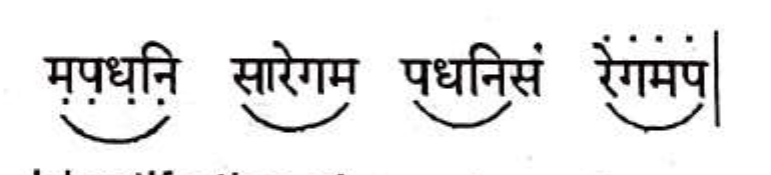 Identify the above taan type.
- (a) Koot taan
- (b) Sapat taan
- (c) Palta taan
- (d) Vakra taan
Show answer
Answer: (b)
49. According to Shivamath in “Sangeet-Darpan” there are ________ raagas and ________ Raaginis.
- (a) 5; 25
- (b) 6; 36
- (c) 7; 49
- (d) 8; 64
Show answer
Answer: (b)
50. The swara which becomes a Vikrit when it is raised from its original position.
- (a) Re
- (b) Ga
- (c) Ma
- (d) Dha
Show answer
Answer: (c)
51. Raag Yaman belongs to ________ thaat.
- (a) Yaman thaat
- (b) Kalyan thaat
- (c) Bilawal thaat
- (d) Kafi thaat
Show answer
Answer: (b)
52. Vadi and samvadi of raag kafi is
- (a) Pa and Sa
- (b) Sa and Pa
- (c) Ga and Ni
- (d) Ni and Ga
Show answer
Answer: (a)
53.
 Identify the raaga.
- (a) Kalyan
- (b) Bilawal
- (c) Bihag
- (d) Khamaj
Show answer
Answer: (c)
54. तीखे गनि कोमल रिगध वादी धैवत साज । संवादी गंधार है, ________ राग बिराज ।। – राग चन्द्रिकासार Identify the raaga.
- (a) Bhairav
- (b) Purvi
- (c) Darbaari
- (d) Todi
Show answer
Answer: (d)
55. The important move (मुख्य चलन) of the raag is in ________ places.
- (a) Mandra and Madhya
- (b) Madhya
- (c) Mandra
- (d) None
Show answer
Answer: (a)
56. The khyal which is sung in a slow speed is called
- (a) Bada khyal
- (b) Chhota khyal
- (c) Khyal
- (d) None
Show answer
Answer: (a)
57. Dhamaar singing usually describes
- (a) Bhakti
- (b) Holi
- (c) Plays of Lord Krishna
- (d) None
Show answer
Answer: (b)
58. Thumri is not popularly sung in one of the four raagas.
- (a) Kafi
- (b) Jhinjhoti
- (c) Barwa (बरवा)
- (d) Lalit
Show answer
Answer: (d)
59. The long wooden part of the tambura which is joined to the Thumba (तूँबा) is called
- (a) Meru
- (b) Bridge (ब्रिज)
- (c) Dand (डाँड)
- (d) Gulu (गुलू)
Show answer
Answer: (c)
60. Sound vibrations due to any external source/influences is called
- (a) Diffraction of sound
- (b) Reflection of sound
- (c) Reverberation
- (d) Resonance
Show answer
Answer: (d)
61. Shuddha Ma in Hindustani is called ________ in Carnatic.
- (a) Antara Ga
- (b) Sadharana Ga
- (c) Shuddha Ma
- (d) Prati Ma
Show answer
Answer: (c)
62. Who among the four is not one of child of Tansen ?
- (a) Sharatsen
- (b) Suratsen
- (c) Vilas Khan
- (d) Rangsen
Show answer
Answer: (d)
63. Swamy Haridas expired at the age of
- (a) 95
- (b) 96
- (c) 97
- (d) 98
Show answer
Answer: (a)
64. Pt. V.D. Paluskar expired on
- (a) 21 August 1931
- (b) 22 August 1931
- (c) 23 August 1931
- (d) 24 August 1931
Show answer
Answer: (a)
65. Pt. Omkarnath Thakur was born to
- (a) Sri Radhakrishna Thakur
- (b) Sri Ramamitra Thakur
- (c) Sri Gaurishankar Thakur
- (d) Sri Bolenath Thakur
Show answer
Answer: (c)
66. “Brihaddeshi” was written by
- (a) Bharat
- (b) Lochan
- (c) Matang
- (d) Ahobal
Show answer
Answer: (c)
67. Harmonium was introduced by
- (a) E-clements
- (b) Faux Strangvej
- (c) Alexandre Debain
- (d) Mojart
Show answer
Answer: (c)
68.
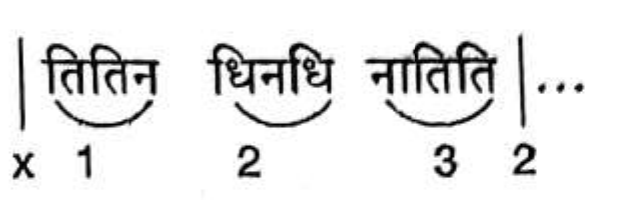 Identify the laya of the taal.
- (a) Dugun
- (b) Tigun
- (c) Chougun
- (d) Aad
Show answer
Answer: (b)
69. If a raaga has 7 swaras in both Aaroh and Avaroh, but the swaras are not in the regular order, the jaati of that raaga is
- (a) Audhava-Sampoorna
- (b) Vakra-Sampoorna
- (c) Shadhava-Sampoorna
- (d) None of the above
Show answer
Answer: (b)
70. Who among the four was not one of the musician during the period of Akbar ?
- (a) Amir Khusro
- (b) Tansen
- (c) Ramdas
- (d) Baijubavra
Show answer
Answer: (a)
71. “Ramacharitamanas” was written by
- (a) Surdas
- (b) Tulsidas
- (c) Kabirdas
- (d) Meera Bai
Show answer
Answer: (b)
72. Pick the odd one.
- (a) Nom-Tom Aalap
- (b) Raagaalap
- (c) Rupakalap
- (d) Kootalap
Show answer
Answer: (d)
73. If the song [गाना] is started after the ‘Sam’ is played in a taal, then it is called ________ Griha.
- (a) Sam
- (b) Vishama
- (c) Ateet [अतीत]
- (d) Anagat
Show answer
Answer: (b)
74. If a taal is played 1½ times faster its basic speed, then it is called ________ laya.
- (a) Dugun laya
- (b) Tigun laya
- (c) Chougun laya
- (d) Aad laya
Show answer
Answer: (d)
75. What is the speed of Aad laya ?
- (a) 2/3 (two in three)
- (b) 3/2 (three in two)
- (c) 3/4 (three in four)
- (d) 4/3 (four in three)
Show answer
Answer: (b)
76.
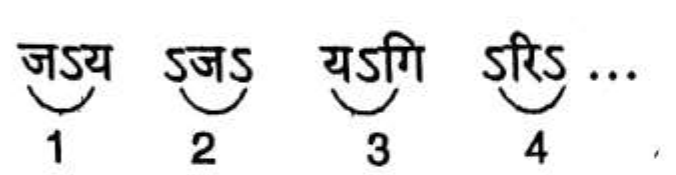 The above bandish is written in ________ layakari.
- (a) Dugun
- (b) Tigun
- (c) Aad
- (d) Vilambit
Show answer
Answer: (c)
77. The point in a taal from which, the gayan - vaadan or the theka of the taal begin is called
- (a) KHAND
- (b) AVRUT
- (c) SAM
- (d) KAYDA
Show answer
Answer: (c)
78. If a raag has 6 swaras in aaroh and 7 swaras in avaroh, then its jaati is
- (a) Audhava-Sampoorna
- (b) Shadhava-Sampoorna
- (c) Sampoorna-Audhava
- (d) Sampoorna-Shadhava
Show answer
Answer: (b)
79. Which among the four is not a type of Nibaddh Gaan ?
- (a) Prabandh
- (b) Vastu
- (c) Rupak
- (d) Dhatu
Show answer
Answer: (d)
80. A geet composed of Swar, Pad (पद), Taal and Marg is called
- (a) Rupak
- (b) Akshiptika
- (c) Raag
- (d) None
Show answer
Answer: (b)
81. Which among the four is not one of the Thaat mentioned ?
- (a) Kalyan
- (b) Bhairav
- (c) Bhairavi
- (d) Malhar
Show answer
Answer: (d)
82. Gayan samay of Raag Bhoopali is
- (a) Ratri ka pratham prahar
- (b) Ratri ka dwitiya prahar
- (c) Ratri ka tritiya prahar
- (d) Ratri ka chaturtha prahar
Show answer
Answer: (a)
83.
 Identify the raaga.
- (a) Bhairav
- (b) Aasavari
- (c) Bhimpalasi
- (d) Bhairavi
Show answer
Answer: (b)
84. Raag Bihag belongs to ________ thaat.
- (a) Kalyan thaat
- (b) Bilawal thaat
- (c) Kafi thaat
- (d) Khamaj thaat
Show answer
Answer: (b)
85. What is the Samvadi swar of Raag Kedar ?
- (a) Shuddh Ma
- (b) Sa
- (c) Teevra Ma
- (d) Ni
Show answer
Answer: (b)
86. What is the main description in the text of Dhamar songs ?
- (a) Basant geet
- (b) Shobha yatra
- (c) Gods and Goddess
- (d) Holi geet
Show answer
Answer: (d)
87. Vadi and samvadi of Raag Bhoopali are
- (a) Ga and Dha respectively
- (b) Dha and Ga respectively
- (c) Ga and Pa respectively
- (d) Pa and Ga respectively
Show answer
Answer: (a)
88. Which among the four is not one of the vani (वाणी) mentioned in Dhrupad style of singing ?
- (a) Gobarhar
- (b) Khandhar
- (c) Dagur
- (d) Nihar
Show answer
Answer: (d)
89. Which gharanas are famous for Thumri style of singing ?
- (a) Lucknow, Banaras
- (b) Delhi, Patiyala
- (c) Lucknow, Gwalior
- (d) Banaras, Agra
Show answer
Answer: (a)
90. Bhajan is popularly not sung in one of the four taalas.
- (a) Kehrwa
- (b) Jhoomra
- (c) Rupak
- (d) Dhumali
Show answer
Answer: (b)
91. Adhvadarshak swar is called to
- (a) Sa
- (b) Komal Ni
- (c) Pa
- (d) Ma
Show answer
Answer: (d)
92. The place between Chati and Gota is called
- (a) Baddhi
- (b) Pudi (पुड़ी)
- (c) Dualo (दुआलों)
- (d) Lava (लव)
Show answer
Answer: —
93. What is the original name of Tansen ?
- (a) Tanna Mishra
- (b) Tanna Pande
- (c) Tansen
- (d) Tan Pande
Show answer
Answer: (a)
94. Who among the four is not one of the upmost desciples of Swamy Haridas ?
- (a) Baiju
- (b) Gopal Lal
- (c) Diwakar Pandit
- (d) Ramnath
Show answer
Answer: (d)
95. Gandharva Mahavidyalay was started by Pt. V.D. Paluskar in the year
- (a) 5 May 1901
- (b) 5 May 1902
- (c) 5 May 1903
- (d) 5 May 1904
Show answer
Answer: (a)
96. Pt. Omkarnath Thakur was the desciple of
- (a) Pt. V. N. Bhatkhande
- (b) Pt. V. D. Paluskar
- (c) Pt. Faiyaz Khan
- (d) None of the above
Show answer
Answer: (b)
97. For the first time ________ divided the length of the string of veena into parts and established 12 swaras.
- (a) Srinivas
- (b) Bharat
- (c) Ahobal
- (d) Matang
Show answer
Answer: (c)
98. The note at which the geet ends is called
- (a) Griha
- (b) Amsha
- (c) Nyas
- (d) Apanyas
Show answer
Answer: (c)
99. Which of the 2 swaras are called Achal swaras ?
- (a) Sa, Ma
- (b) Sa, Pa
- (c) Ma, Pa
- (d) None of the above
Show answer
Answer: (b)
100. Total number of times the taal jhaptaal played in chougun laya is
- (a) 2
- (b) 3
- (c) 4
- (d) None of the above
Show answer
Answer: (c)
101. Kalhan the historian of Kashmir has recorded the facts about the royal patronage received by music, dance and drama in history of Kashmir in
- (a) Rajavaibhavi
- (b) Sangeet Shastra
- (c) Kashmir Sultan
- (d) Rajatarangini
Show answer
Answer: (d)
102. Tansen was a disciple of
- (a) Amir Khusro
- (b) Abdul Kareem Khan
- (c) Swamy Haridas
- (d) Baijubavra
Show answer
Answer: (c)
103. The SAMAGANA, together with its various forms, constitutes the fabric of the ________ music.
- (a) Gandharva music
- (b) Modern music
- (c) Vedic music
- (d) Laukika music
Show answer
Answer: (c)
104. Which among the four is not one of the types of Ang [अंग] in taalas ?
- (a) Anudrut
- (b) Drut
- (c) Atidrut
- (d) Kakapada
Show answer
Answer: (c)
105. Jhaptaal has ________ maatras; ________ khandas and the khandas have ________ number of maatras respectively.
- (a) 10; 4 and [3/3/2/2]
- (b) 10; 4 and [2/3/2/3]
- (c) 10; 4 and [3/2/3/2]
- (d) 10; 4 and [2/2/3/3]
Show answer
Answer: (b)
106. What are the total number of maatras in VILAMBIT TEENTAAL ?
- (a) 16
- (b) 32
- (c) 64
- (d) 128
Show answer
Answer: (a)
107. Sharangdev is the author of which text ?
- (a) Sangeet Ratnakar
- (b) Sangeet Vibodh
- (c) Kramik Pustak Malika
- (d) Sangeet Parijaat
Show answer
Answer: (a)
108. In which style of singing ‘Ek Taal’ is used ?
- (a) Dhrupad
- (b) Khyal
- (c) Thumri
- (d) Tappa
Show answer
Answer: (b)
109. Which among the four given below is an Achal [अचल] swara ?
- (a) Re
- (b) Ga
- (c) Ma
- (d) Pa
Show answer
Answer: (d)
110. The speed at which the song is sung is called
- (a) Magnitude
- (b) Maatra
- (c) Timbre
- (d) Laya
Show answer
Answer: (d)
111. The type of gamak in which the note is vibrated at 1 maatra kaal is ________ gamak.
- (a) Tirip gamak
- (b) Sphurit gamak
- (c) Kampit gamak
- (d) Aandolit gamak
Show answer
Answer: (d)
112. What is the third part of Dhrupad style of singing ?
- (a) Raagaalap
- (b) Bandish
- (c) Sanchari
- (d) Taan
Show answer
Answer: (c)
113. Raag Bhoopali belongs to ________ thaat.
- (a) Bilawal thaat
- (b) Kalyan thaat
- (c) Khamaj thaat
- (d) Kafi thaat
Show answer
Answer: (b)
114. Raag Aasavari belongs to ________ thaat.
- (a) Aasavari
- (b) Bhairav
- (c) Jaunpuri
- (d) Todi
Show answer
Answer: (a)
115. ________ Komal Re ma dha sur, tivra Gandhar Nishad Dhaiwat vadi sur Kahyo, Tasu Rikhab, Samvadi. – Raag Chandrikasaar Identify the raaga.
- (a) Bhairavi
- (b) Bhoopali
- (c) Bihag
- (d) Bhairav
Show answer
Answer: (d)
116. What is the jaati of Raag Kedar ?
- (a) Audhava-Sampoorna
- (b) Shadhava-Sampoorna
- (c) Audhava-Shadhava
- (d) Shadhava-Audhava
Show answer
Answer: (c)
117. Raag Miyan Malhar belongs to ________ thaat.
- (a) Khamaj
- (b) Kafi
- (c) Bhairavi
- (d) None
Show answer
Answer: (b)
118.
 Identify the raaga.
- (a) Bihag
- (b) Bhimpalasi
- (c) Yaman
- (d) Kafi
Show answer
Answer: (b)
119. Dhrupad geet are usually not found in one of the following four languages.
- (a) Hindi
- (b) Urdu
- (c) Brij
- (d) Sanskrit
Show answer
Answer: (d)
120. It is said that, ________ invented the Tappa style of singing.
- (a) Asif Uddual Miyan
- (b) Shori Miyan
- (c) Gulam Ali
- (d) Ali Akbar Khan
Show answer
Answer: (b)
121. Kajri songs usually do not describe
- (a) Monsoon
- (b) Viraha (Separation)
- (c) About Radha-Krishna
- (d) Bhakti
Show answer
Answer: (d)
122. ‘Layakari’ is used in which singing style ?
- (a) Dhamaar
- (b) Khyal
- (c) Chaturang
- (d) Tarana
Show answer
Answer: (a)
123. The left tabla is also called
- (a) Tabla
- (b) Dagga
- (c) Pudi
- (d) Dholak
Show answer
Answer: (b)
124. Who was the Fakeer (फ़कीर) who blessed Tansen parents to have a child ?
- (a) Mohd. Mirza
- (b) Mohd. Naheem
- (c) Mohd. Nadeem
- (d) Mohd. Gauns (गौंस)
Show answer
Answer: (d)
125. Swamy Haridas was born in
- (a) U.P., Aligad
- (b) Banaras
- (c) Gwalior
- (d) Varanasi
Show answer
Answer: (a)
Show answers
Answer key
Answer key from the U.P. Secondary Education Services Selection Board’s official answer key for this sitting. “—” means the key gave none: the question was deleted.
Music Vocal
- Q 1
- (d)
- Q 2
- (d)
- Q 3
- (c)
- Q 4
- (a)
- Q 5
- (b)
- Q 6
- (b)
- Q 7
- (d)
- Q 8
- (a)
- Q 9
- (a)
- Q 10
- (b)
- Q 11
- (b)
- Q 12
- —
- Q 13
- (c)
- Q 14
- (b)
- Q 15
- (b)
- Q 16
- (d)
- Q 17
- (b)
- Q 18
- (b)
- Q 19
- (c)
- Q 20
- (d)
- Q 21
- (a)
- Q 22
- (d)
- Q 23
- (b)
- Q 24
- (c)
- Q 25
- (c)
- Q 26
- (b)
- Q 27
- (b)
- Q 28
- (c)
- Q 29
- (d)
- Q 30
- (d)
- Q 31
- (b)
- Q 32
- (c)
- Q 33
- (c)
- Q 34
- (a)
- Q 35
- (c)
- Q 36
- (b)
- Q 37
- (a)
- Q 38
- (a)
- Q 39
- (a)
- Q 40
- (d)
- Q 41
- (b)
- Q 42
- (b)
- Q 43
- (c)
- Q 44
- (b)
- Q 45
- (c)
- Q 46
- (b)
- Q 47
- (d)
- Q 48
- (b)
- Q 49
- (b)
- Q 50
- (c)
- Q 51
- (b)
- Q 52
- (a)
- Q 53
- (c)
- Q 54
- (d)
- Q 55
- (a)
- Q 56
- (a)
- Q 57
- (b)
- Q 58
- (d)
- Q 59
- (c)
- Q 60
- (d)
- Q 61
- (c)
- Q 62
- (d)
- Q 63
- (a)
- Q 64
- (a)
- Q 65
- (c)
- Q 66
- (c)
- Q 67
- (c)
- Q 68
- (b)
- Q 69
- (b)
- Q 70
- (a)
- Q 71
- (b)
- Q 72
- (d)
- Q 73
- (b)
- Q 74
- (d)
- Q 75
- (b)
- Q 76
- (c)
- Q 77
- (c)
- Q 78
- (b)
- Q 79
- (d)
- Q 80
- (b)
- Q 81
- (d)
- Q 82
- (a)
- Q 83
- (b)
- Q 84
- (b)
- Q 85
- (b)
- Q 86
- (d)
- Q 87
- (a)
- Q 88
- (d)
- Q 89
- (a)
- Q 90
- (b)
- Q 91
- (d)
- Q 92
- —
- Q 93
- (a)
- Q 94
- (d)
- Q 95
- (a)
- Q 96
- (b)
- Q 97
- (c)
- Q 98
- (c)
- Q 99
- (b)
- Q 100
- (c)
- Q 101
- (d)
- Q 102
- (c)
- Q 103
- (c)
- Q 104
- (c)
- Q 105
- (b)
- Q 106
- (a)
- Q 107
- (a)
- Q 108
- (b)
- Q 109
- (d)
- Q 110
- (d)
- Q 111
- (d)
- Q 112
- (c)
- Q 113
- (b)
- Q 114
- (a)
- Q 115
- (d)
- Q 116
- (c)
- Q 117
- (b)
- Q 118
- (b)
- Q 119
- (d)
- Q 120
- (b)
- Q 121
- (d)
- Q 122
- (a)
- Q 123
- (b)
- Q 124
- (d)
- Q 125
- (a)