ExamBharo · UP PGT 2021 — Logic (Series A) · exambharo.com/up-pgt/previous-year-papers/up-pgt-2021-logic-series-a/
Question paper · UP PGT
UP PGT 2021 — Logic (Series A)
17 or 18 August 2021125 questions+3.4 for a correct answer, −0 for a wrong one
Questions from the U.P. Secondary Education Services Selection Board’s paper of 17 or 18 August 2021. Each question’s answer is under it, hidden until you open it, and the full answer key is at the end. Take the paper as a timed practice test to be scored.
The official booklet is a scan with no text, so ExamBharo typed this paper from it by hand. A typing slip is possible; report one through the contact page.
The board deleted questions 80 and 84 in its final answer key: shown here, with no answer, and not counted in the score.
Logic
1. In categorical syllogism, if minor premise is negative, then
- (a) Middle term distributed in both premises
- (b) Middle term distributed in one premise
- (c) Middle term undistributed
- (d) None of the above
Show answer
Answer: (d)
2. “If all gold of golden temple is mine then I would be a rich person. But all gold of golden temple is not mine. Therefore I am not a rich person”. The argument is
- (a) Valid
- (b) Invalid
- (c) Probable
- (d) None of the above
Show answer
Answer: (b)
3. ‘Organon’ is related to
- (a) Mill
- (b) Aristotle
- (c) Pears
- (d) Venn
Show answer
Answer: (b)
4. Fallacy of undistributed Middle Term is found in which one of the following pairs of moods ?
- (a) IAA & AAA
- (b) IIA & OIE
- (c) AIA & AOE
- (d) IEE & EIE
Show answer
Answer: (b)
5. Syllogism of the form ‘AAA – 2’ is
- (a) Valid
- (b) Invalid
- (c) Valid and invalid both
- (d) None of these
Show answer
Answer: (b)
6. Rule of material implication is
- (a) (p⊃q) ≡ (p∨q)
- (b) (p⊃q) ≡ (~p∨q)
- (c) (p⊃q) ≡ (~p•q)
- (d) (p⊃q) ≡ (p∨~q)
Show answer
Answer: (b)
7. How many moods are possible in a syllogism ?
- (a) 32
- (b) 64
- (c) 16
- (d) 128
Show answer
Answer: (b)
8. Which logician had introduced notion of ‘Variable’ into logic ?
- (a) George Boole
- (b) Bertrand Russell
- (c) Leibniz
- (d) Aristotle
Show answer
Answer: (d)
9. Which one of the following is correct for contrary relation ?
- (a) They cannot both be true together, although both may be false
- (b) They cannot both be false together, although both may be true
- (c) They are true together
- (d) They both are undetermined
Show answer
Answer: (a)
10. Which one of the following rule is used for the following inference ? (P⊃~G) ⊃ (~H∨~I) ~(~H∨~I) ∴~(P⊃~G)
- (a) Modus Ponens
- (b) Modus Tollens
- (c) Demorgan’s Law
- (d) Constructive Dilemma
Show answer
Answer: (b)
11. p↓q means
- (a) p is true and q is true
- (b) p is true and q is false
- (c) neither p is true and nor q is true
- (d) none of these
Show answer
Answer: (c)
12. Which one of the following is equivalent to p|q ?
- (a) ~p∨q
- (b) ~p∨~q
- (c) p∨~q
- (d) P∨q
Show answer
Answer: (b)
13. A mediate inference has
- (a) Only one premise
- (b) At least one premise
- (c) Exactly two premise
- (d) More than one premise
Show answer
Answer: (d)
14. In Syllogism who added the fourth figure ?
- (a) Aristotle
- (b) Galen
- (c) Julius Pacius
- (d) B. Russell
Show answer
Answer: (b)
15. Find out fallacy gone through the following argument. All poets are human. All students are human. ∴ All students are poets.
- (a) Illicit major
- (b) Illicit minor
- (c) Existential fallacy
- (d) Undistributed middle term
Show answer
Answer: (d)
16. In following which are contradictories ?
- (a) SP = 0 and SP̄ ≠ 0
- (b) SP̄= 0 and SP̄ ≠ 0
- (c) SP̄ = 0 and SP ≠ 0
- (d) SP ≠ 0 and SP̄≠0
Show answer
Answer: (b)
17. Which one of the following is correct about mood ?
- (a) The mood of a syllogism is decided by minor term
- (b) The mood of a syllogism is decided by major term
- (c) The mood of a syllogism is determined by the types of categorical proposition
- (d) The mood of a syllogism is decided by figure
Show answer
Answer: (c)
18. Which one of the following is true ?
- (a) Deductive reasoning is strong and Inductive reasoning is weak
- (b) Deductive reasoning is weak and Inductive reasoning is strong
- (c) Deductive reasoning is certain and Inductive reasoning is probable
- (d) Deductive reasoning is probable and Inductive reasoning is necessary
Show answer
Answer: (c)
19. Which proposition have existential import in Boolean interpretation ?
- (a) A and E
- (b) I and O
- (c) Only A
- (d) Only E
Show answer
Answer: (b)
20. Probability is associated with
- (a) Inductive logic
- (b) Deductive logic
- (c) Both inductive as well as deductive logics
- (d) Neither inductive nor deductive logics
Show answer
Answer: (a)
21. Statement form p•~p is called
- (a) Contradiction
- (b) Contingent
- (c) Tautology
- (d) None of these
Show answer
Answer: (a)
22. Which one of the following is equivalent to ‘p∨q’ ?
- (a) ~(p∨q)
- (b) ~p•~q
- (c) ~(~p•~q)
- (d) ~(~p•q)
Show answer
Answer: (c)
23. ‘Principia Mathematica’ was written by
- (a) Gottlob Frege and R. Marsh
- (b) C.S.Peirce and Wettgenstein
- (c) John Venn and Boole
- (d) Russell and A. N. Whithead
Show answer
Answer: (d)
24. Which one of the following is correct for Dagger-function ?
- (a) p|q
- (b) p∨q
- (c) p↓q
- (d) p↑q
Show answer
Answer: (c)
25. Peirce’s Law is
- (a) [(p ⊃ q)⊃q]⊃q
- (b) [(p ⊃ q)⊃p]⊃q
- (c) [(p ⊃ q)⊃p]⊃p
- (d) [(p ⊃ q)⊃q]⊃p
Show answer
Answer: (c)
26. Which one of the following mood and figure of a categorical syllogism is valid ?
- (a) EAO – 4
- (b) OAI – 3
- (c) OAO – 3
- (d) OAO – 4
Show answer
Answer: (c)
27. Which one of the following is correct for contingent statement ?
- (a) Only false instances in the conclusion
- (b) Only true instances in the conclusion
- (c) Both true and false instances in the conclusion
- (d) None of the above
Show answer
Answer: (c)
28. ~(P•Q) ≡ ~(~P∨~Q) The above statement form is a
- (a) Tautology
- (b) Contingent
- (c) Contradictory
- (d) None of the above
Show answer
Answer: (c)
29. Which one of the following is the correct symbolic from of strong sense disjunction ?
- (a) ~p∨~q
- (b) (p∨q)•~(p•q)
- (c) ~p∨q
- (d) p∨q
Show answer
Answer: (b)
30. What is basic function of language ?
- (a) Directive
- (b) Expressive
- (c) Informative
- (d) All the above
Show answer
Answer: (d)
31. Negation of statement p•q will be
- (a) ~(~p•q)
- (b) ~p•q
- (c) ~(p•q)
- (d) p•~q
Show answer
Answer: (c)
32. Which one of the following represents Law of material equivalence ?
- (a) P ≡ (P∨P)
- (b) (P ≡ Q) ≡ (P•Q)∨(~P•~Q)
- (c) P ≡ (P•P)
- (d) P ≡ (P⊃P)
Show answer
Answer: (b)
33. Not every S is P, represent by proposition
- (a) E
- (b) O
- (c) I
- (d) A
Show answer
Answer: (b)
34. Which fallacy is committed in this syllogism ? Some professors are scholars. Some professors are politicians. Therefore, some politicians are scholars.
- (a) Fallacy of illicit major term
- (b) Fallacy of illicit minor term
- (c) Fallacy of undistributed middle term
- (d) Fallacy of four terms
Show answer
Answer: (c)
35. Which one of the following is deduced from (~p•q)• [(r•s)⊃ p]•r ?
- (a) ~q
- (b) q ⊃ r
- (c) ~s
- (d) r ⊃ s
Show answer
Answer: (c)
36. Which one of the following is correct for symmetrical relation ?
- (a) (x) (y) (Rxy ⊃ ~Ryx)
- (b) (x) Rxx
- (c) (x) Rx
- (d) (x) (y) (Rxy ⊃ Ryx)
Show answer
Answer: (d)
37. ‘Some politicians are honest.’ Which class is distributed in this statement ?
- (a) Politicians
- (b) Honest
- (c) Both politicians and honest
- (d) Neither politicians nor honest
Show answer
Answer: (d)
38. Which of the following statements is true ?
- (a) All material equivalences are logical equivalences too
- (b) All logical equivalences are material equivalences too
- (c) Some material equivalences are logical equivalences too
- (d) Both B and C
Show answer
Answer: (d)
39. If “No man is mortal” is true, what can be said about “No mortal is man” ?
- (a) True
- (b) False
- (c) Contingent
- (d) None of the above
Show answer
Answer: (a)
40. Identify the figure and mood of given Venn Diagram.
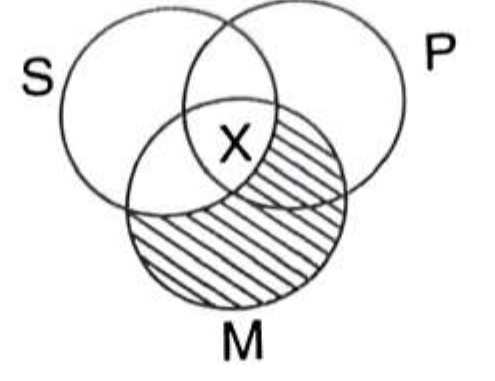
- (a) EAO – IV
- (b) AAI – II
- (c) IAO – I
- (d) IAI – III
Show answer
Answer: (d)
41. Which logician has criticized the traditional square of opposition ?
- (a) Aristotle
- (b) Plato
- (c) De Morgan
- (d) George Boole
Show answer
Answer: (d)
42. When we replace the predicate term by its complement and change quality of a proposition, it is called
- (a) Obversion
- (b) Contraposition
- (c) Inversion
- (d) Conversion
Show answer
Answer: (a)
43. What will be correct Venn Diagram of AEE – IV figure ?
- (a)
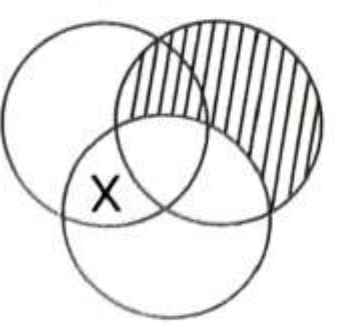
- (b)
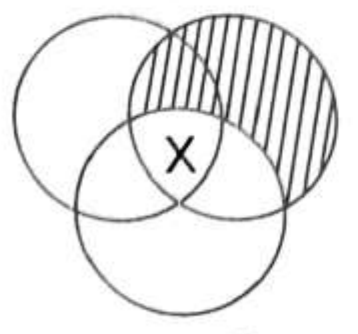
- (c)
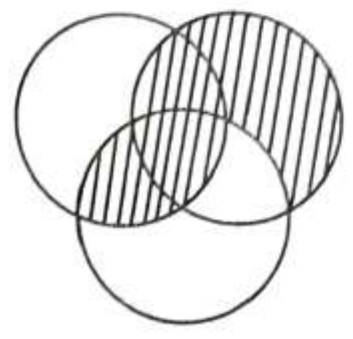
- (d)
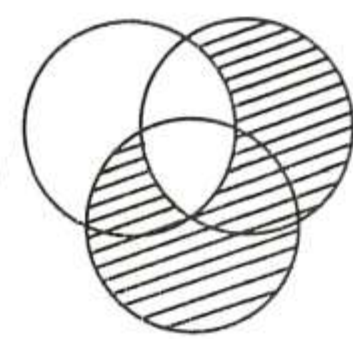
Show answer
Answer: (c)
- (a)
44. Which fallacy have been committed in following argument ? All Russians were revolutionists. All anarchists were revolutionists. Therefore, all anarchists were Russians.
- (a) Fallacy of four term
- (b) Fallacy of illicit major
- (c) Fallacy of illicit minor
- (d) Fallacy of undistributed middle
Show answer
Answer: (d)
45. Which one of the following is correct if the conclusion of a valid syllogism is ‘A’ ?
- (a) IIA – 2
- (b) AAA – 1
- (c) AAA – 2
- (d) AAA – 3
Show answer
Answer: (b)
46. In traditional square of opposition which one of the following is the opposite of ‘E’ proposition
- (a) ‘I’ proposition
- (b) ‘A’ and ‘I’ proposition
- (c) ‘A’, ‘I’ and ‘O’ proposition
- (d) ‘A’ and ‘O’ proposition
Show answer
Answer: (c)
47. Which one of the following statements is true about the inversion ?
- (a) There is no inversion of I-proposition
- (b) There is no inversion of O-proposition
- (c) Both (A) and (B) are true
- (d) Neither (A) nor (B) is true
Show answer
Answer: (c)
48. Which rule is betrayed in the following inference ? Varanasi is situated on the bank of Ganges. ∴ All cities are situated on the bank of Ganges.
- (a) Universal Generalization
- (b) Existential Generalization
- (c) Universal Instantiation
- (d) Existential Instantiation
Show answer
Answer: (a)
49. According to Russell ‘The King of France’ is
- (a) A name
- (b) Description
- (c) Not a description
- (d) None of these
Show answer
Answer: (b)
50. Which one of the following is correct for ‘p∨~p’ ?
- (a) The law of identity
- (b) The law of excluded middle
- (c) The law of contradiction
- (d) None of the above
Show answer
Answer: (b)
51. If A and B propositions are sub contraries, then
- (a) If A is true, then B is false
- (b) If A is false, then B is false
- (c) If A is true, then B is true
- (d) If A is false, then B is true
Show answer
Answer: (d)
52. “God helps those who help themselves”. Symbolize this statement. [Symbol : Px = x is a person, Axy = x helps y, Agx = God helps x]
- (a) (∃x) [(Px•Axx) ⊃ Agx]
- (b) (x) [(Px ∨ Axx) ⊃ Agx]
- (c) (x) [(Px•Axx) ⊃ Agx]
- (d) (∃x) [(Px ∨ Axx)⊃ Agx]
Show answer
Answer: (c)
53. Choose correct option. ϕy ∴(x) (ϕx)
- (a) U.I.
- (b) U.G.
- (c) E.G.
- (d) E.I.
Show answer
Answer: (b)
54. Which one of the following represents Law of excluded middle ?
- (a) P•~P
- (b) P⊃~P
- (c) P∨~P
- (d) P≡~P
Show answer
Answer: (c)
55. p∨q will be true
- (a) p and q both are true
- (b) p is true and q is false
- (c) p is false and q is true
- (d) all of the above
Show answer
Answer: (d)
56. A Deductive Argument is
- (a) Only valid
- (b) Only invalid
- (c) Neither valid nor invalid
- (d) Either valid or invalid
Show answer
Answer: (d)
57. Which one of the following is not correct for categorical syllogism ?
- (a) It is a deductive argument
- (b) It consists of three terms only
- (c) It is an inductive argument
- (d) It must have a conclusion
Show answer
Answer: (c)
58. We can infer a conjunct from a conjunctive proposition. This law is called
- (a) Law of addition
- (b) Law of conjunction
- (c) Law of simplification
- (d) None of the above
Show answer
Answer: (c)
59. Two statements are said to be logically equivalent in which one of the following cases ?
- (a) Their biconditional is tautologous
- (b) Their biconditional is contradictory
- (c) Their biconditional is contingent
- (d) Both have the same truth value
Show answer
Answer: (a)
60. Which one of the following is not the purpose of definition ?
- (a) To increase vocabulary
- (b) To eliminate ambiguity
- (c) To clarify meaning
- (d) To increase vagueness
Show answer
Answer: (d)
61. If there are three variables in Truth Table then number of rows will be
- (a) 4
- (b) 6
- (c) 8
- (d) 12
Show answer
Answer: (c)
62. According to square of opposition, if two propositions are contrary to each other, what will be their mutual position ?
- (a) Both can be true, but cannot be false
- (b) Both can be false, but cannot be true
- (c) If one is true, the other will be false
- (d) Truth of one proposition implies the truth of the other proposition
Show answer
Answer: (b)
63. ‘Love’, ‘Hate’ and ‘Teacher’ represent which type of relation ?
- (a) Only non-symmetrical
- (b) Only non-transitive
- (c) Only non-reflexive
- (d) All of them
Show answer
Answer: (d)
64. “Sohan is not ill”, this is a
- (a) Simple proposition
- (b) Relational proposition
- (c) Complex proposition
- (d) None of the above
Show answer
Answer: (c)
65. Name the rule in the following argument from which the conclusion is drawn. 1. (A⊃B)⊃(C∨D) 2. (A⊃B) /∴(C∨D)
- (a) Modus Ponens
- (b) Modus Tollens
- (c) Hypothetical syllogism
- (d) Addition
Show answer
Answer: (a)
66. Foundation of Logic were laid by
- (a) Plato
- (b) Socretes
- (c) Aristotle
- (d) Zeno
Show answer
Answer: (c)
67. ‘Minor term’ in this syllogism is All dogs are mammals. All cats are mammals. Therefore, all cats are dogs.
- (a) Mammals
- (b) Dogs
- (c) Cats
- (d) None of these
Show answer
Answer: (c)
68. Which one of the following is correct regarding ‘Propositions’ ?
- (a) All sentences are propositions
- (b) No sentences are propositions
- (c) Those sentences are propositions which either true or false
- (d) Commands and exclamations are propositions
Show answer
Answer: (c)
69. Which one of the following proposition only predicate term is distributed ?
- (a) A
- (b) E
- (c) I
- (d) O
Show answer
Answer: (d)
70. ‘The Mathematical Analysis of Logic’ is written by
- (a) Augustus de Morgan
- (b) Bertrand Russell
- (c) George Boole
- (d) A.N. Whithead
Show answer
Answer: (c)
71. Which one of the following relation between propositions is accepted in modern logic ?
- (a) Contrary
- (b) Sub-contrary and contrary
- (c) Contradictory and sub-contrary
- (d) Contradictory
Show answer
Answer: (d)
72. Which is a proposition ?
- (a) (x) [(Px• By)⊃Rx]
- (b) (∃x)[Rx• {(y) My⊃Nx}]
- (c) (y) [{Ay• (x) Rx}⊃Mx]
- (d) (x) [(Ax• Bx)⊃{(∃y)Ry• My}]
Show answer
Answer: (b)
73. Choose correct alternative from the following. “Being as old as” is
- (a) Irreflexive relation
- (b) Non-reflexive relation
- (c) Reflexive relation
- (d) None of the above
Show answer
Answer: (c)
74. What is the correct symbolization of ‘p if q’ ?
- (a) p ≡ q
- (b) p ⊃ q
- (c) q ⊃ p
- (d) p ⊃ ~q
Show answer
Answer: (c)
75. If both premises are particular in a syllogism then conclusion will be
- (a) Universal
- (b) Particular
- (c) Affirmative
- (d) Conclusion will not be drawn
Show answer
Answer: (d)
76. Find out fallacy gone through the following argument. All racers are hard workers. All racers are students. ∴ All students are hard workers.
- (a) Illicit major
- (b) Illicit minor
- (c) Existential fallacy
- (d) Undistributed middle term
Show answer
Answer: (b)
77. Which term is distributed in proposition ‘Some soldiers are cowards’ ?
- (a) Only soldiers
- (b) Only cowards
- (c) Both soldiers and cowards
- (d) Neither soldiers nor cowards
Show answer
Answer: (d)
78. First of all who discovered incompleteness of the 19 Rules of inference ?
- (a) Leo Simons
- (b) I.M. Kopy
- (c) Albertus Magnus
- (d) B. Russell
Show answer
Answer: (a)
79. Strong or exclusive sense of disjunction means
- (a) At least one and at most two
- (b) At least one and at most one
- (c) Both (A) and (B)
- (d) None of these
Show answer
Answer: (b)
80. Which one of the following can be true or false ?
- (a) (x) (Hx ⊃ Mx)
- (b) (x) (Hx • Mx)
- (c) (∃x) (Hx • Mx)
- (d) Ha ∨ Hb
Show answer
Answer: —
81. “If Ram is bachelor then Ram is unmarried.” Above statement is which type of implication ?
- (a) Logical implication
- (b) Causal implication
- (c) Definitional implication
- (d) Decisional implication
Show answer
Answer: (c)
82. Which rule is used in the following inference ? ~(X) Lxy ∴(∃x) ~ Lxy
- (a) Existential Generalization
- (b) Universal Generalization
- (c) Existential Instantiation
- (d) Quantifier negation
Show answer
Answer: (d)
83. The Rule of Transposition is
- (a) (p ⊃ q) ≡ (~p∨q)
- (b) ~(p ⊃ q) ≡ (p• ~q)
- (c) [(p•q)⊃r] ≡ [p⊃(q⊃r)]
- (d) (p ⊃ q) ≡ (~q⊃~p)
Show answer
Answer: (d)
84. Which one of the following is not a truth-function ?
- (a) ~(Negation)
- (b) • (Dot)
- (c) ⊃ (Horse-shoe)
- (d) ≡ (Bi-Conditional)
Show answer
Answer: —
85. If ‘All socialists are pacifists is true, what may be inferred about’ some nonpacifists are not nonsocialists ?
- (a) False
- (b) True
- (c) Undetermined
- (d) None of these
Show answer
Answer: (a)
86. What will be immediate inference based on traditional square of opposition if proposition O being given as false ?
- (a) I is undetermined
- (b) I is false
- (c) I is true
- (d) None of the above
Show answer
Answer: (c)
87. Which one of the following is equivalent to ‘~ (x) (Ax ⊃ Bx)’ ?
- (a) (x) (Ax ⊃ ~Bx)
- (b) (x) (Ax • Bx)
- (c) (3x) (Ax• ~Bx)
- (d) (3x) (Ax• Bx)
Show answer
Answer: (c)
88. Which one is correct statement about the categorical propositions ?
- (a) There are six types of categorical propositions
- (b) The term-subject is not distributed in universal affirmative proposition
- (c) The term-predicate is distributed in particular negative proposition
- (d) Particular affirmative proposition is denoted by the symbol – ‘A’
Show answer
Answer: (c)
89. Some athletes are not actors. All actors are runners. Therefore, some runners are not athletes. This figure and mood of the above mentioned syllogism are
- (a) OAO in figure IV
- (b) OAO in figure III
- (c) OAO in figure I
- (d) IAO in figure IV
Show answer
Answer: (a)
90. Which one of the following is a proposition ?
- (a) (X) (Fx• Gy)
- (b) Fx• Gy
- (c) (∃x) (Fx• Gb)
- (d) (Fa• Gb)∨Gc
Show answer
Answer: (d)
91. In which figure is the middle term, subject term in both the premises ?
- (a) First figure
- (b) Second figure
- (c) Third figure
- (d) Fourth figure
Show answer
Answer: (c)
92. Which one of the following is not the criteria for the assessment of hypothesis ?
- (a) Relevance
- (b) Testability
- (c) Complexity
- (d) Simplicity
Show answer
Answer: (c)
93. Which one of the following is contradictory of “SP = 0” ?
- (a) SP = 0
- (b) SP̄ ≠ 0
- (c) S̄P = 0
- (d) SP ≠ 0
Show answer
Answer: (d)
94. Obversion is valid in
- (a) Only A and E propositions
- (b) Only I and O propositions
- (c) Only E and O Propositions
- (d) A, E, I , O all propositions
Show answer
Answer: (d)
95. For a disjunctive proposition to be false
- (a) Only one disjunct must be false
- (b) Only one disjunct must be true
- (c) Both disjuncts must be true
- (d) Both disjuncts must be false
Show answer
Answer: (d)
96. A proposition should have
- (a) At least one bound variable
- (b) At least one constant
- (c) At least one free variable
- (d) No free variable
Show answer
Answer: (d)
97. Which one of the following is correct ?
- (a) An inductive argument is either valid or Invalid
- (b) A deductive argument is one whose premises are claimed to provide conclusive ground for the truth of its conclusion
- (c) A deductive argument is good or bad
- (d) A deductive argument is probable
Show answer
Answer: (b)
98. Which one of the following shows the quality of the propositions ?
- (a) Affirmative and Negative
- (b) Universal and Particular
- (c) Affirmative and Universal
- (d) Negative and Particular
Show answer
Answer: (a)
99. Which one of the following fallacies is correct in the question – ‘Have you abandoned the beating of your wife’ ?
- (a) The fallacy of moral question
- (b) The fallacy of pseudo question
- (c) The fallacy of legal question
- (d) All the three (A), (B) and (C)
Show answer
Answer: (b)
100. “John and Gilbert will not both be respected” will be symbolized as
- (a) ~(J∨G)
- (b) ~J•~G
- (c) J∨~G
- (d) ~(J•G)
Show answer
Answer: (d)
101. Barbara is valid mood. What is figure of it ?
- (a) 4
- (b) 3
- (c) 2
- (d) 1
Show answer
Answer: (d)
102. Name the fallacies committed in ‘IEO – 1’.
- (a) Undistributed middle
- (b) Illicit major
- (c) Illicit minor
- (d) Existential fallacy
Show answer
Answer: (b)
103. If A and B are true propositions, X and Y are false propositions and the values of P and Q are unknown, which one of the following compound statements is true ?
- (a) P∨~P
- (b) ~A•Q
- (c) ~A•P
- (d) ~(P•Q)•X
Show answer
Answer: (a)
104. If X, Y, Z are true and P, Q, R false, what will be value of the following ? [(X⊃P)•(Y⊃Q)] ∨ (Z⊃R)
- (a) False
- (b) True
- (c) Probable
- (d) None of the above
Show answer
Answer: (a)
105. I proposition can be expressed as
- (a) (x) (ϕx ⊃ ψx)
- (b) (∃x) (ϕx• ψx)
- (c) (x) (ϕx ⊃~ψx)
- (d) (∃x) (ϕx• ~ψx)
Show answer
Answer: (b)
106. Propositions are
- (a) Either true or false
- (b) Neither true nor false
- (c) Only true
- (d) Only false
Show answer
Answer: (a)
107. Which one of the following is correct about figure ?
- (a) Figure is the major term
- (b) The position of the middle term in the premises
- (c) Figure is the minor term
- (d) The position of categorical proposition
Show answer
Answer: (b)
108. Pick out correct symbolic form for the following proposition. “Bats are not men.”
- (a) (∃x) (Bx ⊃~Mx)
- (b) (X) (Bx ⊃ ~ Mx)
- (c) (∃x) (Bx• ~ Mx)
- (d) (X) (~Bx⊃Mx)
Show answer
Answer: (b)
109. Which is not a rule of replacement ?
- (a) Commutation
- (b) Association
- (c) Transposition
- (d) Inconsistency
Show answer
Answer: (d)
110. The statement [(p ⊃ q) ≡ (p ∨ q)] is a
- (a) Tautology
- (b) Contradiction
- (c) Contingent statement
- (d) True statement
Show answer
Answer: (c)
111. Which one is true ?
- (a) The term that occurs as the subject of the conclusion is called ‘major term’
- (b) The term that occurs as the predicate of the conclusion is called ‘major term’
- (c) The term that occurs as the predicate term of the conclusion is called ‘middle term’
- (d) The term that occurs as the subject term of the conclusion is called ‘middle term’
Show answer
Answer: (b)
112. Which one of the following statement forms is not contradictory ?
- (a) (P•Q)•(P⊃~Q)
- (b) (P⊃P)⊃(Q•~Q)
- (c) [P⊃(Q⊃P)]⊃[(Q⊃Q)⊃~(R⊃R)]
- (d) (P⊃Q)≡(~Q⊃~P)
Show answer
Answer: (d)
113. The correct symbolic form of “Not everything is mortal” would be
- (a) ~(∃x) Mx
- (b) (X) ~ Mx
- (c) (∃x) ~Mx
- (d) None of the above
Show answer
Answer: (c)
114. Find out the mood and figure of the following : All artists are egoists. Some artists are paupers. ∴ Some paupers are egoists.
- (a) AII – 1
- (b) AII – 2
- (c) AEE – 4
- (d) AII – 3
Show answer
Answer: (d)
115. Which one is true about the following symbols ?
- (a) Symbol for ‘conjunction’ is ∨
- (b) Respective symbols for ‘implication’ and ‘equivalence’ are ⊃ & ≡
- (c) ‘Curl’ is the symbol for ‘Disjunction’
- (d) ‘Wedge’ is the symbol for ‘Negation’
Show answer
Answer: (b)
116. Choose contradictory of (X)~Mx from the following.
- (a) ~(X) Mx
- (b) ~(∃X) Mx
- (c) (X) Mx
- (d) (∃X) Mx
Show answer
Answer: (d)
117. According to traditional square of opposition if two propositions cannot both be true and cannot both be false are called
- (a) Contrary
- (b) Sub contrary
- (c) Subalternation
- (d) Contradictory
Show answer
Answer: (d)
118. Which one of the following relations of square of opposition is found between particular affirmative and particular negative propositions ?
- (a) Contradictory
- (b) Contrary
- (c) Sub-contrary
- (d) Subalternation
Show answer
Answer: (c)
119. Which one of the following is correct for Stroke function ?
- (a) p|q
- (b) p∨q
- (c) p ⊃ q
- (d) p↓q
Show answer
Answer: (a)
120. How many kinds are there of categorical propositions ?
- (a) One
- (b) Two
- (c) Three
- (d) Four
Show answer
Answer: (d)
121. Which one of the following is an example of rule of absorption ?
- (a) p ⊃ q /∴p ≡ (p•q)
- (b) p ⊃ q /∴~p∨q
- (c) p ∨ q ~p /∴q
- (d) p ⊃ q /∴p ⊃ (p•q)
Show answer
Answer: (d)
122. When a proposition is first obverted then converted then obverted again, it is called
- (a) Conversion
- (b) Inversion
- (c) Obversion
- (d) Contraposition
Show answer
Answer: (d)
123. According to George Boole in which one of the following relations of traditional square of opposition, there is not an Existential fallacy ?
- (a) Contradictory
- (b) Contrary
- (c) Sub-contrary
- (d) Subalternation
Show answer
Answer: (a)
124. T∨F is
- (a) True in the exclusive sense of disjunction
- (b) False in the inclusive sense of disjunction
- (c) True in the inclusive sense of disjunction
- (d) Both A and C
Show answer
Answer: (d)
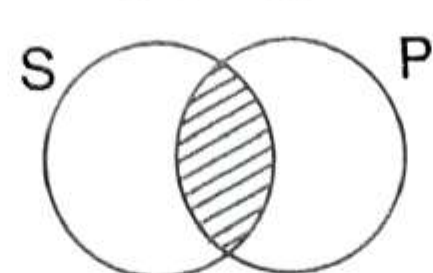
125. ‘Some P is not S’ is represented by Venn diagram
- (a)
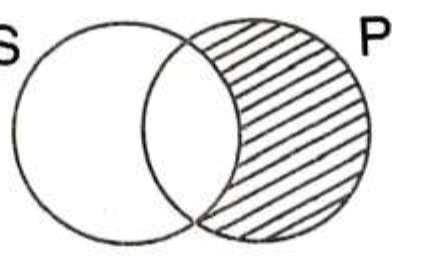
- (b)
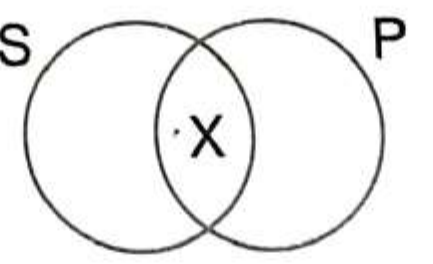
- (c)
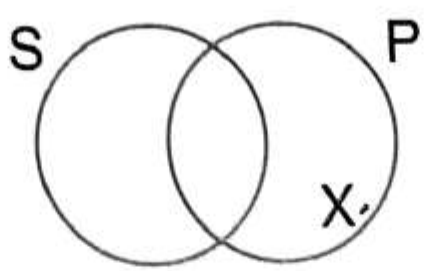
- (d)
Show answer
Answer: (c)
- (a)
Show answers
Answer key
Answer key from the U.P. Secondary Education Services Selection Board’s official answer key for this sitting. “—” means the key gave none: the question was deleted.
Logic
- Q 1
- (d)
- Q 2
- (b)
- Q 3
- (b)
- Q 4
- (b)
- Q 5
- (b)
- Q 6
- (b)
- Q 7
- (b)
- Q 8
- (d)
- Q 9
- (a)
- Q 10
- (b)
- Q 11
- (c)
- Q 12
- (b)
- Q 13
- (d)
- Q 14
- (b)
- Q 15
- (d)
- Q 16
- (b)
- Q 17
- (c)
- Q 18
- (c)
- Q 19
- (b)
- Q 20
- (a)
- Q 21
- (a)
- Q 22
- (c)
- Q 23
- (d)
- Q 24
- (c)
- Q 25
- (c)
- Q 26
- (c)
- Q 27
- (c)
- Q 28
- (c)
- Q 29
- (b)
- Q 30
- (d)
- Q 31
- (c)
- Q 32
- (b)
- Q 33
- (b)
- Q 34
- (c)
- Q 35
- (c)
- Q 36
- (d)
- Q 37
- (d)
- Q 38
- (d)
- Q 39
- (a)
- Q 40
- (d)
- Q 41
- (d)
- Q 42
- (a)
- Q 43
- (c)
- Q 44
- (d)
- Q 45
- (b)
- Q 46
- (c)
- Q 47
- (c)
- Q 48
- (a)
- Q 49
- (b)
- Q 50
- (b)
- Q 51
- (d)
- Q 52
- (c)
- Q 53
- (b)
- Q 54
- (c)
- Q 55
- (d)
- Q 56
- (d)
- Q 57
- (c)
- Q 58
- (c)
- Q 59
- (a)
- Q 60
- (d)
- Q 61
- (c)
- Q 62
- (b)
- Q 63
- (d)
- Q 64
- (c)
- Q 65
- (a)
- Q 66
- (c)
- Q 67
- (c)
- Q 68
- (c)
- Q 69
- (d)
- Q 70
- (c)
- Q 71
- (d)
- Q 72
- (b)
- Q 73
- (c)
- Q 74
- (c)
- Q 75
- (d)
- Q 76
- (b)
- Q 77
- (d)
- Q 78
- (a)
- Q 79
- (b)
- Q 80
- —
- Q 81
- (c)
- Q 82
- (d)
- Q 83
- (d)
- Q 84
- —
- Q 85
- (a)
- Q 86
- (c)
- Q 87
- (c)
- Q 88
- (c)
- Q 89
- (a)
- Q 90
- (d)
- Q 91
- (c)
- Q 92
- (c)
- Q 93
- (d)
- Q 94
- (d)
- Q 95
- (d)
- Q 96
- (d)
- Q 97
- (b)
- Q 98
- (a)
- Q 99
- (b)
- Q 100
- (d)
- Q 101
- (d)
- Q 102
- (b)
- Q 103
- (a)
- Q 104
- (a)
- Q 105
- (b)
- Q 106
- (a)
- Q 107
- (b)
- Q 108
- (b)
- Q 109
- (d)
- Q 110
- (c)
- Q 111
- (b)
- Q 112
- (d)
- Q 113
- (c)
- Q 114
- (d)
- Q 115
- (b)
- Q 116
- (d)
- Q 117
- (d)
- Q 118
- (c)
- Q 119
- (a)
- Q 120
- (d)
- Q 121
- (d)
- Q 122
- (d)
- Q 123
- (a)
- Q 124
- (d)
- Q 125
- (c)