ExamBharo · UP PGT 2016 — Logic (Series A) · exambharo.com/up-pgt/previous-year-papers/up-pgt-2016-logic-series-a/
Question paper · UP PGT
UP PGT 2016 — Logic (Series A)
1 or 2 February 2019125 questions+3.4 for a correct answer, −0 for a wrong one
Questions from the U.P. Secondary Education Services Selection Board’s paper of 1 or 2 February 2019. Each question’s answer is under it, hidden until you open it, and the full answer key is at the end. Take the paper as a timed practice test to be scored.
The official booklet is a scan with no text, so ExamBharo typed this paper from it by hand. A typing slip is possible; report one through the contact page.
The board deleted questions 11, 60 and 112 in its final answer key: shown here, with no answer, and not counted in the score.
Logic
1. In an argument the statement which logically follows from given statements is called
- (a) Premises
- (b) Conclusion
- (c) Proposition
- (d) Judgement
Show answer
Answer: (b)
2. The logical process of deducing a conclusion directly from a single premise is called
- (a) inference
- (b) mediate inference
- (c) immediate inference
- (d) direct inference
Show answer
Answer: (c)
3. The statement “Roses are red and violets are blue” is an example for ______ statement.
- (a) Simple
- (b) Complicated
- (c) Compound
- (d) Unitary
Show answer
Answer: (c)
4. A categorical statement
- (a) is a statement of fact
- (b) states a condition which follows from that condition
- (c) states alternatives
- (d) is a negation
Show answer
Answer: (a)
5. The quantity and quality of S A P are ______ and ______ respectively.
- (a) Particular, affirmative
- (b) Particular, negative
- (c) Universal, affirmative
- (d) Universal, negative
Show answer
Answer: (c)
6. The statement “Socrates is Greek” is
- (a) Particular affirmative
- (b) Universal affirmative
- (c) Particular negative
- (d) Universal negative
Show answer
Answer: (b)
7. In which of the following statements predicate (P) is distributed ? i. SAP ii. SEP iii. SIP iv. SOP
- (a) ii, iv
- (b) i, iii
- (c) ii, iii
- (d) iii, iv
Show answer
Answer: (a)
8. In sub-altern relationship, if universal sub-altern is true, the particular sub-altern is
- (a) False
- (b) Doubtful
- (c) True
- (d) Neither true nor false
Show answer
Answer: (c)
9. In sub contrary relationship if one statement is false, the other statement is
- (a) False
- (b) True
- (c) Doubtful
- (d) Neither true nor false
Show answer
Answer: (b)
10. In ______ the quality of the given proposition should not be changed in the conclusion.
- (a) Obversion
- (b) Absorption
- (c) Conversion
- (d) Addition
Show answer
Answer: (c)
11. In Obversion
- (a) the quality of premise should not be changed in the conclusion
- (b) the quality of the premise should be changed in the conclusion
- (c) there must be transposition of terms
- (d) no term undistributed in the premise should be made distributed in the conclusion
Show answer
Answer: —
12. In case of Subalternation between two propositions
- (a) if universal is true, then particular is true
- (b) if universal is false, then particular is false
- (c) if particular is true, then universal is true
- (d) none of the above
Show answer
Answer: (a)
13. In an argument the premise in which minor term appears is called
- (a) Middle premise
- (b) Major premise
- (c) Minor premise
- (d) None of the above
Show answer
Answer: (c)
14. In an argument the predicate of the conclusion is called
- (a) Predicate term
- (b) Minor term
- (c) Middle term
- (d) Major term
Show answer
Answer: (d)
15. If the major premise is MIP and the minor premise is SIM, then the fallacy of ______ arises.
- (a) Ambiguous middle
- (b) Undistributed middle
- (c) Four terms
- (d) Negative premises
Show answer
Answer: (b)
16. In the first figure the major premise must be universal and the minor premise must be
- (a) Particular
- (b) Negative
- (c) Affirmative
- (d) Universal only
Show answer
Answer: (c)
17. In a valid argument
- (a) Premises must be true
- (b) Conclusion must be true
- (c) Both premises and conclusion must be true
- (d) None of the above
Show answer
Answer: (c)
18. In the third figure middle term is in the place of
- (a) Subject in the major premise and predicate in the minor premise
- (b) Predicate in both the premises
- (c) Subject in both the premises
- (d) Predicate in the major premise and subject in the minor premise
Show answer
Answer: (c)
19. The mood AII in the fourth figure involves the fallacy of
- (a) Ambiguous middle
- (b) Four terms
- (c) Illicit minor
- (d) Undistributed middle
Show answer
Answer: (d)
20. Which of the following moods is valid ?
- (a) P I M / M A S / S I P
- (b) P A M / S A M / S A P
- (c) M I P / M I S / S I P
- (d) P E M / S O M / S O P
Show answer
Answer: (a)
21. Inductive arguments are
- (a) Valid
- (b) Invalid
- (c) Valid or invalid
- (d) None of the above
Show answer
Answer: (d)
22. The house was built as a present for Mrs. X, who married in 2015, at a cost of twenty lakhs. The above statement is an example for
- (a) Amphiboly
- (b) Ambiguity
- (c) Equivocation
- (d) Accent
Show answer
Answer: (a)
23. In a syllogism, the predicate of the conclusion is the
- (a) Middle term
- (b) Major term
- (c) Minor term
- (d) Important term
Show answer
Answer: (b)
24. The book written by B.Russell along with A. N. Whitehead is
- (a) Principia Mathematica
- (b) A Modern Introduction to Logic
- (c) An Essay Concerning Human Understanding
- (d) A History of Greek Philosophy
Show answer
Answer: (a)
25. Logical form of the statement “An elephant is a pachyderm” is
- (a) Some elephants are pachyderms
- (b) Some elephants are not pachyderms
- (c) All elephants are pachyderms
- (d) No elephant is a pachyderm
Show answer
Answer: (c)
26. (∃y) [Fy ⊃ (x) Fx] expresses
- (a) Universal generalization
- (b) Universal instantiation
- (c) Existential generalization
- (d) Existential instantiation
Show answer
Answer: (a)
27. If both the conjuncts are false, the conjunction is
- (a) False
- (b) True
- (c) Doubtful
- (d) None of the above
Show answer
Answer: (a)
28. The totally reflexive attribute of binary relation may be depicted as
- (a) (x) (Rxy ⊃ Ryx)
- (b) (x) Rxy
- (c) (x) Rxx
- (d) (x) (y) [Rxy]
Show answer
Answer: (c)
29. (p . q) is a/an
- (a) Implication
- (b) Conjunction
- (c) Negation
- (d) Disjunction
Show answer
Answer: (b)
30. The falsity of any negation means that it is
- (a) True
- (b) False
- (c) Doubtful
- (d) None of the above
Show answer
Answer: (a)
31. The symbolic form of the statement “London is not the capital of America and Washington is not the capital of Japan” is
- (a) (~ L . ~W)
- (b) (~ L . W)
- (c) (L . ~W)
- (d) (L . W)
Show answer
Answer: (a)
32. Which of the following forms of categorical syllogism is valid ?
- (a) AAA – 2
- (b) AII – 1
- (c) AIO – 3
- (d) AII – 4
Show answer
Answer: (b)
33. Logic is concerned with ______ of the argument.
- (a) Only form
- (b) Only matter
- (c) Both form and matter
- (d) None of the above
Show answer
Answer: (a)
34. If both p and q are false (p ⊃ q) is
- (a) False
- (b) Doubtful
- (c) True
- (d) None of the above
Show answer
Answer: (c)
35. The symbolic form of the statement “Brazil will protest to the UN if Argentina mobilizes” is
- (a) B ⊃ A
- (b) A ⊃ B
- (c) B . A
- (d) A . B
Show answer
Answer: (b)
36. Match the following : Statements a. Conjunction b. Negation c. Disjunction d. Implication Symbols i. Horse shoe ii. Wedge iii. Curl iv. Dot Codes :
- (a) a-i, b-iii, c-iv, d-ii
- (b) a-ii, b-i, c-iii, d-iv
- (c) a-iii, b-ii, c-i, d-iv
- (d) a-iv, b-iii, c-ii, d-i
Show answer
Answer: (d)
37. An argument form is ______ if it has true premises and false conclusion.
- (a) Invalid
- (b) Valid
- (c) Doubtful
- (d) None of the above
Show answer
Answer: (a)
38. p ⊃ q q ⊃ r ∴ p ⊃ r The above argument form is
- (a) A mixed hypothetical syllogism
- (b) A pure hypothetical syllogism
- (c) Modus ponens
- (d) Modus tollens
Show answer
Answer: (b)
39. The statement
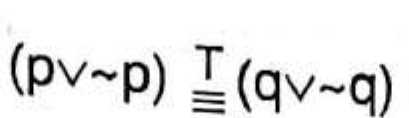 is
- (a) True
- (b) False
- (c) Undetermined
- (d) None of the above
Show answer
Answer: (a)
40. (p ∨ ~ p) is a/an ______ statement.
- (a) Analytic
- (b) Synthetic
- (c) Tautologous
- (d) Contingent
Show answer
Answer: (c)
41. (p . ~ p) is a
- (a) Contradiction
- (b) Tautology
- (c) Contingent
- (d) Contrary
Show answer
Answer: (a)
42. The following mathematician and logician is known for his theorem on logical equivalence
- (a) Leibnitz
- (b) B.Russel
- (c) A.N.Whitehead
- (d) Augustus de Morgan
Show answer
Answer: (d)
43. ~ ( p . q ) is logically equivalent to
- (a) (~ p ∨ ~ q)
- (b) ~ p ∨ q
- (c) (p ∨ ~ q)
- (d) (p ∨ q)
Show answer
Answer: (a)
44. According to the principle of ______ no statement can be both true and false.
- (a) Identity
- (b) Excluded middle
- (c) Difference
- (d) Contradiction
Show answer
Answer: (d)
45. p ⊃ q ∴ p ⊃ (p . q) The above is the rule of
- (a) Absorption
- (b) Conjunction
- (c) Addition
- (d) Simplification
Show answer
Answer: (a)
46. Logic is a sub-branch coming under the branch of philosophy namely
- (a) Ontology
- (b) Epistemology
- (c) Axiology
- (d) Sociology
Show answer
Answer: (c)
47. The argument which appears to be correct but is proved to be incorrect on closer examination is called
- (a) Conversion
- (b) Eduction
- (c) Obversion
- (d) A fallacy
Show answer
Answer: (d)
48. When a mother tells her child to wash up for dinner, her statement is said to be
- (a) Informative
- (b) Expressive
- (c) Directive
- (d) None of the above
Show answer
Answer: (c)
49. ______ furnishes the best example of expressive language.
- (a) Science
- (b) Poetry
- (c) Commands of an army officer
- (d) None of the above
Show answer
Answer: (b)
50. In the statement “We should not speak ill of our students”, if the word ‘our’ is overstressed, we commit the fallacy of
- (a) Accent
- (b) Ascent
- (c) Descent
- (d) Amphiboly
Show answer
Answer: (a)
51. 1. A ⊃ B 2. C ⊃ D 3. B ∨ C/∴ A ∨ D If the above argument be invalid, what truth values can be assigned to A, B, C and D ?
- (a) False, True, False and False
- (b) True, True, False and False
- (c) False, False, False and False
- (d) True, True, True and False
Show answer
Answer: (a)
52. The term ‘Philosophy’ was popularised by
- (a) Thales
- (b) Anaximander
- (c) Socrates
- (d) Pythagoras
Show answer
Answer: (d)
53. The truth value of a statement is
- (a) false only
- (b) true only
- (c) doubtful only
- (d) either true or false
Show answer
Answer: (d)
54. The exclusive sense of p ∨ q is
- (a) Either p or q
- (b) Either p or q but not both
- (c) Either p or q but both
- (d) None of the above
Show answer
Answer: (b)
55. The alternative version of material implication is
- (a) (p ⊃ q) ≡ (~p ∨ q)
- (b) (p ⊃ ~q) ≡ (~p ∨ ~q)
- (c) ~(p ⊃ q) ≡ (p . ~ q)
- (d) (~p ⊃ q) ≡ (p . q)
Show answer
Answer: (c)
56. In traditional logic, if one of the premises is particular, the conclusion must be
- (a) Negative
- (b) Affirmative
- (c) Universal
- (d) Particular
Show answer
Answer: (d)
57. A categorical proposition talks of relationship between
- (a) two or more propositions
- (b) two facts
- (c) two classes
- (d) two arguments
Show answer
Answer: (c)
58. A propositional function must have
- (a) at least one quantifier
- (b) at least one bound variable
- (c) at least one free variable
- (d) at most two free variables
Show answer
Answer: (c)
59. (A. B) ⊃ C (A . B) ∴ C The above argument
- (a) is valid
- (b) involves the fallacy of affirming the consequent
- (c) involves the fallacy of denying the antecedent
- (d) is doubtful
Show answer
Answer: (a)
60. The obverse of the statement “All leaves are green” is
- (a) No non-leaves are non-green
- (b) Some leaves are non-green
- (c) All leaves are non-green
- (d) No leaves are non-green
Show answer
Answer: —
61. Which one of the following is not a valid mood of first figure ?
- (a) Baroco
- (b) Darii
- (c) Celarent
- (d) Barbara
Show answer
Answer: (a)
62. Match the following : List – I (Mood) a. Dimaris b. Felapton c. Baroco d. Barbara List – II (Figure) i. I Figure ii. III Figure iii. IV Figure iv. II Figure Codes :
- (a) a-i, b-ii, c-iii, d-iv
- (b) a-iii, b-ii, c-iv, d-i
- (c) a-ii, b-iv, c-i, d-iii
- (d) a-ii, b-i, c-iv, d-iii
Show answer
Answer: (b)
63. The Logical process of deriving a statement on the basis of one or more statements is called
- (a) Proposition
- (b) Inherence
- (c) Inference
- (d) Propositional function
Show answer
Answer: (c)
64. The given statements which serve as the logical basis of conclusion are called
- (a) Judgements
- (b) Premises
- (c) Explanations
- (d) Elucidations
Show answer
Answer: (b)
65. A statement which doesnot contain any other statement in it is called ______ statement.
- (a) Simple
- (b) Simplified
- (c) Compound
- (d) Complex
Show answer
Answer: (a)
66. The book “The Mathematical Analysis of Logic” is attributed to
- (a) Leibnitz
- (b) George Boole
- (c) Augustus de Morgan
- (d) Bertrand Russell
Show answer
Answer: (b)
67. In a hypothetical statement, the part which states a condition is called
- (a) Consequent
- (b) Antecedent
- (c) Affirmation
- (d) Negation
Show answer
Answer: (b)
68. “No man is a fool” is a ______ statement.
- (a) S I P
- (b) S A P
- (c) S O P
- (d) S E P
Show answer
Answer: (d)
69. In which of the following statements both subject (S) and predicate (P) are undistributed ?
- (a) Some men are not reliable
- (b) All men are reliable
- (c) Some men are reliable
- (d) No man is reliable
Show answer
Answer: (c)
70. A and E are
- (a) Contraries
- (b) Sub-contraries
- (c) Contradictories
- (d) Sub-alterns
Show answer
Answer: (a)
71. E and O are ______ in quality.
- (a) Affirmative
- (b) Universal
- (c) Particular
- (d) Negative
Show answer
Answer: (d)
72. The logical process or deducing a conclusion directly from a single proposition is called
- (a) Immediate inference
- (b) Induction
- (c) Inference
- (d) Mediate inference
Show answer
Answer: (a)
73. The categorical statement which cannot be converted is
- (a) A
- (b) E
- (c) I
- (d) O
Show answer
Answer: (d)
74. The obverse of S O P is
- (a) S E P
- (b) S A P
- (c) S O P
- (d) S I P
Show answer
Answer: (d)
75. The process of deducing a conclusion on the basis of atleast two statements having a common term is called
- (a) Immediate inference
- (b) Mediate inference or syllogism
- (c) Perfect induction
- (d) Imperfect induction
Show answer
Answer: (b)
76. In a deductive argument
- (a) premises are general statements
- (b) conclusion is a particular statement
- (c) conclusion is supported conclusively by the premises
- (d) conclusion is an affirmative statement
Show answer
Answer: (c)
77. If the major term is undistributed in the major premise but gets distributed in the conclusion, a fallacy arises called the fallacy of
- (a) Illicit major
- (b) Illicit minor
- (c) Undistributed middle
- (d) Four terms
Show answer
Answer: (a)
78. If the major and minor premises are MOP and SOM respectively, the conclusion cannot be possible because both the premises are
- (a) Universal
- (b) Particular
- (c) Affirmative
- (d) Negative
Show answer
Answer: (d)
79. The argument in which the middle term occupies the place of predicate in both the premises is called ______ figure.
- (a) Second
- (b) First
- (c) Fourth
- (d) Third
Show answer
Answer: (a)
80. What is the minimum number of premises that an inference must have ?
- (a) Two
- (b) One
- (c) Three
- (d) Four
Show answer
Answer: (b)
81. The mood E A E in the third figure commits the fallacy of illicit
- (a) Conversion
- (b) Major
- (c) Minor
- (d) Middle
Show answer
Answer: (c)
82. All musicians are baseball players. No musician is an astronaut. ∴ No astronaut is a baseball player. The above argument involves the fallacy of
- (a) Four terms
- (b) Illicit major
- (c) Illicit minor
- (d) Negative premises
Show answer
Answer: (b)
83. SP̄ = O represents
- (a) A proposition
- (b) E proposition
- (c) I proposition
- (d) O proposition
Show answer
Answer: (a)
84. Which of the following is not a basic function of language ?
- (a) informing
- (b) imagining
- (c) expressing
- (d) directing
Show answer
Answer: (b)
85. Conversion is fully valid for
- (a) A proposition
- (b) I proposition
- (c) O proposition
- (d) None of the above
Show answer
Answer: (b)
86. Organon is the work on traditional logic attributed to
- (a) Thales
- (b) Pythagoras
- (c) Aristotle
- (d) Socrates
Show answer
Answer: (c)
87. Validity is used in the context of
- (a) Proposition
- (b) Induction
- (c) Deduction
- (d) Sentence
Show answer
Answer: (c)
88. ______ syllogism has a conditional statement as major premise and categorical statement as minor premise and conclusion.
- (a) Hypothetical
- (b) Pure hypothetical
- (c) Mixed hypothetical
- (d) None of the above
Show answer
Answer: (c)
89. The simple parts of a conjunction are called
- (a) Disjuncts
- (b) Antecedents
- (c) Consequents
- (d) Conjuncts
Show answer
Answer: (d)
90. A Statement that contains another statement as its component is called ______ statement.
- (a) Compound
- (b) Simple
- (c) Unitary
- (d) Truth functional
Show answer
Answer: (a)
91. Which is not a basic Law of Thought ?
- (a) Principle of identity
- (b) Principle of validity
- (c) Principle of noncontradiction
- (d) Principle of excluded middle
Show answer
Answer: (b)
92. The statement “It is false that all humans are immortal” is an example for
- (a) Negation
- (b) Disjunction
- (c) Conjunction
- (d) Implication
Show answer
Answer: (a)
93. The symbolic form of the statement “It is not the case that either Egypt’s food shortage worsens or Jordan requests more American aid” is
- (a) ~ E ∨ J
- (b) E ∨ ~ J
- (c) E ∨ J
- (d) ~ (E ∨ J)
Show answer
Answer: (d)
94. If A, B and C are true, and X, Y and Z are false, which of the following is false?
- (a) ~ A ∨ B
- (b) ~ B ∨ X
- (c) ~ Y ∨ C
- (d) ~ Z ∨ X
Show answer
Answer: (b)
95. The statement “If the blue litmus paper is immersed in acid, then it will turn red” is an example for
- (a) Conjunction
- (b) Disjunction
- (c) Implication
- (d) Negation
Show answer
Answer: (c)
96. The alternative version of distribution is
- (a) [p ∨ (q.r)] ≡ [(p ∨ q). (p ∨ r)]
- (b) [p.(q ∨ r)] ≡ [(p.q) ∨ (p.r)]
- (c) [p ⊃ (q.r)] ≡ [(p ⊃ q).(p ⊃ r)]
- (d) [(p.q) ⊃ r] ≡ [p ⊃ (q ⊃ r)]
Show answer
Answer: (c)
97. If A, B and C are true and X, Y and Z are false, which of the following is true ?
- (a) X ⊃ ( Y ⊃ Z)
- (b) A ⊃ (B ⊃ Z)
- (c) (A ⊃ B) ⊃ Z
- (d) A ⊃ X
Show answer
Answer: (a)
98. In the statement of existential instantiation, p should have
- (a) only one free occurrence of ν
- (b) no free occurrence of ν
- (c) no bound occurrence of ν
- (d) none of the above
Show answer
Answer: (b)
99. The symbolic form of an argument is called
- (a) Argument calculus
- (b) Argument form
- (c) Argument function
- (d) Propositional calculus
Show answer
Answer: (b)
100. If (p ∨ q) is to be true
- (a) Both p and q must be true
- (b) p must be true and q must be false
- (c) p must be false and q must be true
- (d) All the above
Show answer
Answer: (d)
101. Which one is the condition for being true of the truth-function of the material equivalence ?
- (a) The truth-value of both propositions must either be true or false
- (b) The truth-value of one proposition must be false
- (c) The truth-value of one proposition must be true
- (d) The truth-value of both propositions must be neither true nor false
Show answer
Answer: (a)
102. A statement form that has only true substitution instances is called
- (a) Contradiction
- (b) Contingent
- (c) Tautology
- (d) Analytic statement
Show answer
Answer: (c)
103. A statement form that has only false substitution instances is said to be
- (a) Contingent
- (b) A contradiction
- (c) A tautology
- (d) Synthetic
Show answer
Answer: (b)
104. Which one of the following thinkers has considered that the central problem of logic is to classify the arguments as good or bad ?
- (a) P.T. Geach
- (b) Charles Peirce
- (c) J.M. Baldwin
- (d) Gary Leach
Show answer
Answer: (b)
105. ~ ( p ∨ q ) is logically equivalent to
- (a) ~ p ∨ q
- (b) p ∨ ~ q
- (c) (~ p .~ q)
- (d) (p . q)
Show answer
Answer: (c)
106. Which one of the following statement-forms is contingent ?
- (a) P ⊃~P
- (b) P ⊃ (P ⊃ P)
- (c) (P ⊃~P).(~P ⊃ P)
- (d) P.~P
Show answer
Answer: (a)
107. In the case of universal generalisation, (μ) (ϕμ) should
- (a) have only one free occurrence of ν
- (b) have only one bound occurrence of ν
- (c) have no free occurrence of ν
- (d) none of the above
Show answer
Answer: (c)
108. Which one of the following constitutes the rule of addition ?
- (a) p ⊃ q / p / ∴ q
- (b) p / ∴ p ∨ q
- (c) p / q / ∴ p . q
- (d) p . q / ∴ p
Show answer
Answer: (b)
109. The conclusion of analogy is
- (a) Certain
- (b) Probable
- (c) More probable than that of induction
- (d) More probable than that of deduction
Show answer
Answer: (b)
110. “Arguments, like men, are often pretenders”. This statement is attributed to
- (a) Plato
- (b) Aristotle
- (c) Pythagoras
- (d) Zeno
Show answer
Answer: (a)
111. The type of language which serves the purpose of communicating information is called ______ language.
- (a) Informative
- (b) Communicative
- (c) Expressive
- (d) Directive
Show answer
Answer: (a)
112. Which one of the following statement forms is materially equivalent ?
- (a) (P ⊃ Q) ≡ (~P ⊃ ~Q)
- (b) (P ⊃ Q) ≡ (~Q ⊃ ~P)
- (c) P ≡ [P.(Q ⊃ P)]
- (d) (P ⊃ Q) ≡ (P ∨ Q)
Show answer
Answer: —
113. It cannot be such that a valid argument can have
- (a) true premises and a true conclusion
- (b) true premises and a false conclusion
- (c) false premise and a true conclusion
- (d) false premise and a false conclusion
Show answer
Answer: (b)
114. Logic being a sub-branch of philosophy, the term ‘Philosophy’ means
- (a) Love
- (b) Wisdom
- (c) Ignorance
- (d) Love of wisdom
Show answer
Answer: (d)
115. The contradictory of the statement “No animals with horns are carnivores” is
- (a) All animals with horns are carnivores.
- (b) Some animals with horns are carnivores.
- (c) Some animals with horns are not carnivores.
- (d) No carnivore is an animal with horns.
Show answer
Answer: (b)
116. According to modern logic following statements do not have existential import
- (a) A and E
- (b) E and I
- (c) I and O
- (d) O and A
Show answer
Answer: (a)
117. p ⊃ q p ∴ q The above argument can be expressed as
- (a) [(p ⊃ q). p ] ⊃ q
- (b) [p ⊃ (q . p) ] ⊃ q
- (c) (p ⊃ q) . (p ⊃ q)
- (d) p ⊃ [(q . (p ⊃ q)]
Show answer
Answer: (a)
118. In introduced logic, conclusion cannot be possible if both premises are i. Affirmative ii. Negative iii. Universal iv. Particular
- (a) i, iii
- (b) ii, iv
- (c) i, ii
- (d) ii, iii
Show answer
Answer: (b)
119. The symbol p ≡ q implies
- (a) Tautology
- (b) Contradiction
- (c) Contingent
- (d) Equivalence
Show answer
Answer: (d)
120. Consider the following propositions and choose the correct answer: “All judges are lawyers”. “Some judges are not lawyers”. In the above, the statements are
- (a) Same in quantity and differ in quality
- (b) Same in quality and differ in quantity
- (c) Same both in respect of quality and quantity
- (d) Differ both in respect of quality and quantity
Show answer
Answer: (d)
121. Mark the option which is not correct.
- (a) if both antecedent and consequent are true, the statement is true
- (b) if antecedent is true and consequent is false, the statement is true
- (c) if both the antecedent and consequent are false, then the statement is true
- (d) if the antecedent is true and consequent is false, the statement is false
Show answer
Answer: (b)
122. Choose the correct answer among the following.
- (a) A and E are contradictories
- (b) I and O are sub contraries
- (c) A and I are contraries
- (d) E and I are sub alterns
Show answer
Answer: (b)
123. Choose the correct rule of inference for the following argument. (A ⊃ B) · (C ⊃ D) ∴ A ⊃ B
- (a) Simplification
- (b) Absorption
- (c) Conjunction
- (d) Addition
Show answer
Answer: (a)
124. Match the following : List – I (Obvertend) a. All S is P b. No S is P c. Some S is P d. Some S is not P List – II (Obverse) i. Some S is non P ii. Some S is not non P iii. All S is non P iv. No S is non P Codes :
- (a) a-iv, b-iii, c-ii, d-i
- (b) a-iii, b-ii, c-iv, d-i
- (c) a-ii, b-iv, c-i, d-iii
- (d) a-ii, b-i, c-iv, d-iii
Show answer
Answer: (a)
125. All horses are four footed animals. No oxen are horses. ∴ No oxen are four footed animals. The above argument involves the fallacy of
- (a) Illicit Major
- (b) Illicit Minor
- (c) Undistributed Middle
- (d) Four terms
Show answer
Answer: (a)
Show answers
Answer key
Answer key from the U.P. Secondary Education Services Selection Board’s official answer key for this sitting. “—” means the key gave none: the question was deleted.
Logic
- Q 1
- (b)
- Q 2
- (c)
- Q 3
- (c)
- Q 4
- (a)
- Q 5
- (c)
- Q 6
- (b)
- Q 7
- (a)
- Q 8
- (c)
- Q 9
- (b)
- Q 10
- (c)
- Q 11
- —
- Q 12
- (a)
- Q 13
- (c)
- Q 14
- (d)
- Q 15
- (b)
- Q 16
- (c)
- Q 17
- (c)
- Q 18
- (c)
- Q 19
- (d)
- Q 20
- (a)
- Q 21
- (d)
- Q 22
- (a)
- Q 23
- (b)
- Q 24
- (a)
- Q 25
- (c)
- Q 26
- (a)
- Q 27
- (a)
- Q 28
- (c)
- Q 29
- (b)
- Q 30
- (a)
- Q 31
- (a)
- Q 32
- (b)
- Q 33
- (a)
- Q 34
- (c)
- Q 35
- (b)
- Q 36
- (d)
- Q 37
- (a)
- Q 38
- (b)
- Q 39
- (a)
- Q 40
- (c)
- Q 41
- (a)
- Q 42
- (d)
- Q 43
- (a)
- Q 44
- (d)
- Q 45
- (a)
- Q 46
- (c)
- Q 47
- (d)
- Q 48
- (c)
- Q 49
- (b)
- Q 50
- (a)
- Q 51
- (a)
- Q 52
- (d)
- Q 53
- (d)
- Q 54
- (b)
- Q 55
- (c)
- Q 56
- (d)
- Q 57
- (c)
- Q 58
- (c)
- Q 59
- (a)
- Q 60
- —
- Q 61
- (a)
- Q 62
- (b)
- Q 63
- (c)
- Q 64
- (b)
- Q 65
- (a)
- Q 66
- (b)
- Q 67
- (b)
- Q 68
- (d)
- Q 69
- (c)
- Q 70
- (a)
- Q 71
- (d)
- Q 72
- (a)
- Q 73
- (d)
- Q 74
- (d)
- Q 75
- (b)
- Q 76
- (c)
- Q 77
- (a)
- Q 78
- (d)
- Q 79
- (a)
- Q 80
- (b)
- Q 81
- (c)
- Q 82
- (b)
- Q 83
- (a)
- Q 84
- (b)
- Q 85
- (b)
- Q 86
- (c)
- Q 87
- (c)
- Q 88
- (c)
- Q 89
- (d)
- Q 90
- (a)
- Q 91
- (b)
- Q 92
- (a)
- Q 93
- (d)
- Q 94
- (b)
- Q 95
- (c)
- Q 96
- (c)
- Q 97
- (a)
- Q 98
- (b)
- Q 99
- (b)
- Q 100
- (d)
- Q 101
- (a)
- Q 102
- (c)
- Q 103
- (b)
- Q 104
- (b)
- Q 105
- (c)
- Q 106
- (a)
- Q 107
- (c)
- Q 108
- (b)
- Q 109
- (b)
- Q 110
- (a)
- Q 111
- (a)
- Q 112
- —
- Q 113
- (b)
- Q 114
- (d)
- Q 115
- (b)
- Q 116
- (a)
- Q 117
- (a)
- Q 118
- (b)
- Q 119
- (d)
- Q 120
- (d)
- Q 121
- (b)
- Q 122
- (b)
- Q 123
- (a)
- Q 124
- (a)
- Q 125
- (a)