ExamBharo · UP PGT 2016 — Logic (Series A) · exambharo.com/up-pgt/previous-year-papers/up-pgt-2016-logic-series-a/
प्रश्न पत्र · यूपी पीजीटी
UP PGT 2016 — Logic (Series A)
1 or 2 February 2019125 प्रश्नसही उत्तर पर +3.4, गलत उत्तर पर −0
प्रश्न उत्तर प्रदेश माध्यमिक शिक्षा सेवा चयन बोर्ड के 1 or 2 February 2019 के पेपर से। हर प्रश्न का उत्तर उसके नीचे है, खोलने पर ही दिखता है, और पूरी उत्तर कुंजी अंत में है। स्कोर पाने के लिए पेपर को समयबद्ध प्रैक्टिस टेस्ट के रूप में दें।
आधिकारिक पुस्तिका बिना पाठ वाला स्कैन है, इसलिए ExamBharo ने यह पेपर उससे हाथ से टाइप किया है। टाइपिंग की चूक संभव है; संपर्क पेज से बताएँ।
बोर्ड ने अपनी अंतिम उत्तर कुंजी में प्रश्न 11, 60 और 112 हटा दिए: ये यहाँ दिखाए गए हैं, बिना उत्तर के, और स्कोर में नहीं गिने जाते।
प्रश्न अंग्रेज़ी में हैं, जैसे मूल पेपर में थे।
Logic
1. In an argument the statement which logically follows from given statements is called
- (a) Premises
- (b) Conclusion
- (c) Proposition
- (d) Judgement
उत्तर देखें
उत्तर: (b)
2. The logical process of deducing a conclusion directly from a single premise is called
- (a) inference
- (b) mediate inference
- (c) immediate inference
- (d) direct inference
उत्तर देखें
उत्तर: (c)
3. The statement “Roses are red and violets are blue” is an example for ______ statement.
- (a) Simple
- (b) Complicated
- (c) Compound
- (d) Unitary
उत्तर देखें
उत्तर: (c)
4. A categorical statement
- (a) is a statement of fact
- (b) states a condition which follows from that condition
- (c) states alternatives
- (d) is a negation
उत्तर देखें
उत्तर: (a)
5. The quantity and quality of S A P are ______ and ______ respectively.
- (a) Particular, affirmative
- (b) Particular, negative
- (c) Universal, affirmative
- (d) Universal, negative
उत्तर देखें
उत्तर: (c)
6. The statement “Socrates is Greek” is
- (a) Particular affirmative
- (b) Universal affirmative
- (c) Particular negative
- (d) Universal negative
उत्तर देखें
उत्तर: (b)
7. In which of the following statements predicate (P) is distributed ? i. SAP ii. SEP iii. SIP iv. SOP
- (a) ii, iv
- (b) i, iii
- (c) ii, iii
- (d) iii, iv
उत्तर देखें
उत्तर: (a)
8. In sub-altern relationship, if universal sub-altern is true, the particular sub-altern is
- (a) False
- (b) Doubtful
- (c) True
- (d) Neither true nor false
उत्तर देखें
उत्तर: (c)
9. In sub contrary relationship if one statement is false, the other statement is
- (a) False
- (b) True
- (c) Doubtful
- (d) Neither true nor false
उत्तर देखें
उत्तर: (b)
10. In ______ the quality of the given proposition should not be changed in the conclusion.
- (a) Obversion
- (b) Absorption
- (c) Conversion
- (d) Addition
उत्तर देखें
उत्तर: (c)
11. In Obversion
- (a) the quality of premise should not be changed in the conclusion
- (b) the quality of the premise should be changed in the conclusion
- (c) there must be transposition of terms
- (d) no term undistributed in the premise should be made distributed in the conclusion
उत्तर देखें
उत्तर: —
12. In case of Subalternation between two propositions
- (a) if universal is true, then particular is true
- (b) if universal is false, then particular is false
- (c) if particular is true, then universal is true
- (d) none of the above
उत्तर देखें
उत्तर: (a)
13. In an argument the premise in which minor term appears is called
- (a) Middle premise
- (b) Major premise
- (c) Minor premise
- (d) None of the above
उत्तर देखें
उत्तर: (c)
14. In an argument the predicate of the conclusion is called
- (a) Predicate term
- (b) Minor term
- (c) Middle term
- (d) Major term
उत्तर देखें
उत्तर: (d)
15. If the major premise is MIP and the minor premise is SIM, then the fallacy of ______ arises.
- (a) Ambiguous middle
- (b) Undistributed middle
- (c) Four terms
- (d) Negative premises
उत्तर देखें
उत्तर: (b)
16. In the first figure the major premise must be universal and the minor premise must be
- (a) Particular
- (b) Negative
- (c) Affirmative
- (d) Universal only
उत्तर देखें
उत्तर: (c)
17. In a valid argument
- (a) Premises must be true
- (b) Conclusion must be true
- (c) Both premises and conclusion must be true
- (d) None of the above
उत्तर देखें
उत्तर: (c)
18. In the third figure middle term is in the place of
- (a) Subject in the major premise and predicate in the minor premise
- (b) Predicate in both the premises
- (c) Subject in both the premises
- (d) Predicate in the major premise and subject in the minor premise
उत्तर देखें
उत्तर: (c)
19. The mood AII in the fourth figure involves the fallacy of
- (a) Ambiguous middle
- (b) Four terms
- (c) Illicit minor
- (d) Undistributed middle
उत्तर देखें
उत्तर: (d)
20. Which of the following moods is valid ?
- (a) P I M / M A S / S I P
- (b) P A M / S A M / S A P
- (c) M I P / M I S / S I P
- (d) P E M / S O M / S O P
उत्तर देखें
उत्तर: (a)
21. Inductive arguments are
- (a) Valid
- (b) Invalid
- (c) Valid or invalid
- (d) None of the above
उत्तर देखें
उत्तर: (d)
22. The house was built as a present for Mrs. X, who married in 2015, at a cost of twenty lakhs. The above statement is an example for
- (a) Amphiboly
- (b) Ambiguity
- (c) Equivocation
- (d) Accent
उत्तर देखें
उत्तर: (a)
23. In a syllogism, the predicate of the conclusion is the
- (a) Middle term
- (b) Major term
- (c) Minor term
- (d) Important term
उत्तर देखें
उत्तर: (b)
24. The book written by B.Russell along with A. N. Whitehead is
- (a) Principia Mathematica
- (b) A Modern Introduction to Logic
- (c) An Essay Concerning Human Understanding
- (d) A History of Greek Philosophy
उत्तर देखें
उत्तर: (a)
25. Logical form of the statement “An elephant is a pachyderm” is
- (a) Some elephants are pachyderms
- (b) Some elephants are not pachyderms
- (c) All elephants are pachyderms
- (d) No elephant is a pachyderm
उत्तर देखें
उत्तर: (c)
26. (∃y) [Fy ⊃ (x) Fx] expresses
- (a) Universal generalization
- (b) Universal instantiation
- (c) Existential generalization
- (d) Existential instantiation
उत्तर देखें
उत्तर: (a)
27. If both the conjuncts are false, the conjunction is
- (a) False
- (b) True
- (c) Doubtful
- (d) None of the above
उत्तर देखें
उत्तर: (a)
28. The totally reflexive attribute of binary relation may be depicted as
- (a) (x) (Rxy ⊃ Ryx)
- (b) (x) Rxy
- (c) (x) Rxx
- (d) (x) (y) [Rxy]
उत्तर देखें
उत्तर: (c)
29. (p . q) is a/an
- (a) Implication
- (b) Conjunction
- (c) Negation
- (d) Disjunction
उत्तर देखें
उत्तर: (b)
30. The falsity of any negation means that it is
- (a) True
- (b) False
- (c) Doubtful
- (d) None of the above
उत्तर देखें
उत्तर: (a)
31. The symbolic form of the statement “London is not the capital of America and Washington is not the capital of Japan” is
- (a) (~ L . ~W)
- (b) (~ L . W)
- (c) (L . ~W)
- (d) (L . W)
उत्तर देखें
उत्तर: (a)
32. Which of the following forms of categorical syllogism is valid ?
- (a) AAA – 2
- (b) AII – 1
- (c) AIO – 3
- (d) AII – 4
उत्तर देखें
उत्तर: (b)
33. Logic is concerned with ______ of the argument.
- (a) Only form
- (b) Only matter
- (c) Both form and matter
- (d) None of the above
उत्तर देखें
उत्तर: (a)
34. If both p and q are false (p ⊃ q) is
- (a) False
- (b) Doubtful
- (c) True
- (d) None of the above
उत्तर देखें
उत्तर: (c)
35. The symbolic form of the statement “Brazil will protest to the UN if Argentina mobilizes” is
- (a) B ⊃ A
- (b) A ⊃ B
- (c) B . A
- (d) A . B
उत्तर देखें
उत्तर: (b)
36. Match the following : Statements a. Conjunction b. Negation c. Disjunction d. Implication Symbols i. Horse shoe ii. Wedge iii. Curl iv. Dot Codes :
- (a) a-i, b-iii, c-iv, d-ii
- (b) a-ii, b-i, c-iii, d-iv
- (c) a-iii, b-ii, c-i, d-iv
- (d) a-iv, b-iii, c-ii, d-i
उत्तर देखें
उत्तर: (d)
37. An argument form is ______ if it has true premises and false conclusion.
- (a) Invalid
- (b) Valid
- (c) Doubtful
- (d) None of the above
उत्तर देखें
उत्तर: (a)
38. p ⊃ q q ⊃ r ∴ p ⊃ r The above argument form is
- (a) A mixed hypothetical syllogism
- (b) A pure hypothetical syllogism
- (c) Modus ponens
- (d) Modus tollens
उत्तर देखें
उत्तर: (b)
39. The statement
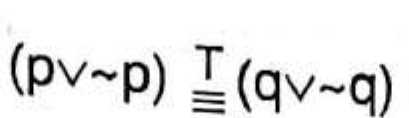 is
- (a) True
- (b) False
- (c) Undetermined
- (d) None of the above
उत्तर देखें
उत्तर: (a)
40. (p ∨ ~ p) is a/an ______ statement.
- (a) Analytic
- (b) Synthetic
- (c) Tautologous
- (d) Contingent
उत्तर देखें
उत्तर: (c)
41. (p . ~ p) is a
- (a) Contradiction
- (b) Tautology
- (c) Contingent
- (d) Contrary
उत्तर देखें
उत्तर: (a)
42. The following mathematician and logician is known for his theorem on logical equivalence
- (a) Leibnitz
- (b) B.Russel
- (c) A.N.Whitehead
- (d) Augustus de Morgan
उत्तर देखें
उत्तर: (d)
43. ~ ( p . q ) is logically equivalent to
- (a) (~ p ∨ ~ q)
- (b) ~ p ∨ q
- (c) (p ∨ ~ q)
- (d) (p ∨ q)
उत्तर देखें
उत्तर: (a)
44. According to the principle of ______ no statement can be both true and false.
- (a) Identity
- (b) Excluded middle
- (c) Difference
- (d) Contradiction
उत्तर देखें
उत्तर: (d)
45. p ⊃ q ∴ p ⊃ (p . q) The above is the rule of
- (a) Absorption
- (b) Conjunction
- (c) Addition
- (d) Simplification
उत्तर देखें
उत्तर: (a)
46. Logic is a sub-branch coming under the branch of philosophy namely
- (a) Ontology
- (b) Epistemology
- (c) Axiology
- (d) Sociology
उत्तर देखें
उत्तर: (c)
47. The argument which appears to be correct but is proved to be incorrect on closer examination is called
- (a) Conversion
- (b) Eduction
- (c) Obversion
- (d) A fallacy
उत्तर देखें
उत्तर: (d)
48. When a mother tells her child to wash up for dinner, her statement is said to be
- (a) Informative
- (b) Expressive
- (c) Directive
- (d) None of the above
उत्तर देखें
उत्तर: (c)
49. ______ furnishes the best example of expressive language.
- (a) Science
- (b) Poetry
- (c) Commands of an army officer
- (d) None of the above
उत्तर देखें
उत्तर: (b)
50. In the statement “We should not speak ill of our students”, if the word ‘our’ is overstressed, we commit the fallacy of
- (a) Accent
- (b) Ascent
- (c) Descent
- (d) Amphiboly
उत्तर देखें
उत्तर: (a)
51. 1. A ⊃ B 2. C ⊃ D 3. B ∨ C/∴ A ∨ D If the above argument be invalid, what truth values can be assigned to A, B, C and D ?
- (a) False, True, False and False
- (b) True, True, False and False
- (c) False, False, False and False
- (d) True, True, True and False
उत्तर देखें
उत्तर: (a)
52. The term ‘Philosophy’ was popularised by
- (a) Thales
- (b) Anaximander
- (c) Socrates
- (d) Pythagoras
उत्तर देखें
उत्तर: (d)
53. The truth value of a statement is
- (a) false only
- (b) true only
- (c) doubtful only
- (d) either true or false
उत्तर देखें
उत्तर: (d)
54. The exclusive sense of p ∨ q is
- (a) Either p or q
- (b) Either p or q but not both
- (c) Either p or q but both
- (d) None of the above
उत्तर देखें
उत्तर: (b)
55. The alternative version of material implication is
- (a) (p ⊃ q) ≡ (~p ∨ q)
- (b) (p ⊃ ~q) ≡ (~p ∨ ~q)
- (c) ~(p ⊃ q) ≡ (p . ~ q)
- (d) (~p ⊃ q) ≡ (p . q)
उत्तर देखें
उत्तर: (c)
56. In traditional logic, if one of the premises is particular, the conclusion must be
- (a) Negative
- (b) Affirmative
- (c) Universal
- (d) Particular
उत्तर देखें
उत्तर: (d)
57. A categorical proposition talks of relationship between
- (a) two or more propositions
- (b) two facts
- (c) two classes
- (d) two arguments
उत्तर देखें
उत्तर: (c)
58. A propositional function must have
- (a) at least one quantifier
- (b) at least one bound variable
- (c) at least one free variable
- (d) at most two free variables
उत्तर देखें
उत्तर: (c)
59. (A. B) ⊃ C (A . B) ∴ C The above argument
- (a) is valid
- (b) involves the fallacy of affirming the consequent
- (c) involves the fallacy of denying the antecedent
- (d) is doubtful
उत्तर देखें
उत्तर: (a)
60. The obverse of the statement “All leaves are green” is
- (a) No non-leaves are non-green
- (b) Some leaves are non-green
- (c) All leaves are non-green
- (d) No leaves are non-green
उत्तर देखें
उत्तर: —
61. Which one of the following is not a valid mood of first figure ?
- (a) Baroco
- (b) Darii
- (c) Celarent
- (d) Barbara
उत्तर देखें
उत्तर: (a)
62. Match the following : List – I (Mood) a. Dimaris b. Felapton c. Baroco d. Barbara List – II (Figure) i. I Figure ii. III Figure iii. IV Figure iv. II Figure Codes :
- (a) a-i, b-ii, c-iii, d-iv
- (b) a-iii, b-ii, c-iv, d-i
- (c) a-ii, b-iv, c-i, d-iii
- (d) a-ii, b-i, c-iv, d-iii
उत्तर देखें
उत्तर: (b)
63. The Logical process of deriving a statement on the basis of one or more statements is called
- (a) Proposition
- (b) Inherence
- (c) Inference
- (d) Propositional function
उत्तर देखें
उत्तर: (c)
64. The given statements which serve as the logical basis of conclusion are called
- (a) Judgements
- (b) Premises
- (c) Explanations
- (d) Elucidations
उत्तर देखें
उत्तर: (b)
65. A statement which doesnot contain any other statement in it is called ______ statement.
- (a) Simple
- (b) Simplified
- (c) Compound
- (d) Complex
उत्तर देखें
उत्तर: (a)
66. The book “The Mathematical Analysis of Logic” is attributed to
- (a) Leibnitz
- (b) George Boole
- (c) Augustus de Morgan
- (d) Bertrand Russell
उत्तर देखें
उत्तर: (b)
67. In a hypothetical statement, the part which states a condition is called
- (a) Consequent
- (b) Antecedent
- (c) Affirmation
- (d) Negation
उत्तर देखें
उत्तर: (b)
68. “No man is a fool” is a ______ statement.
- (a) S I P
- (b) S A P
- (c) S O P
- (d) S E P
उत्तर देखें
उत्तर: (d)
69. In which of the following statements both subject (S) and predicate (P) are undistributed ?
- (a) Some men are not reliable
- (b) All men are reliable
- (c) Some men are reliable
- (d) No man is reliable
उत्तर देखें
उत्तर: (c)
70. A and E are
- (a) Contraries
- (b) Sub-contraries
- (c) Contradictories
- (d) Sub-alterns
उत्तर देखें
उत्तर: (a)
71. E and O are ______ in quality.
- (a) Affirmative
- (b) Universal
- (c) Particular
- (d) Negative
उत्तर देखें
उत्तर: (d)
72. The logical process or deducing a conclusion directly from a single proposition is called
- (a) Immediate inference
- (b) Induction
- (c) Inference
- (d) Mediate inference
उत्तर देखें
उत्तर: (a)
73. The categorical statement which cannot be converted is
- (a) A
- (b) E
- (c) I
- (d) O
उत्तर देखें
उत्तर: (d)
74. The obverse of S O P is
- (a) S E P
- (b) S A P
- (c) S O P
- (d) S I P
उत्तर देखें
उत्तर: (d)
75. The process of deducing a conclusion on the basis of atleast two statements having a common term is called
- (a) Immediate inference
- (b) Mediate inference or syllogism
- (c) Perfect induction
- (d) Imperfect induction
उत्तर देखें
उत्तर: (b)
76. In a deductive argument
- (a) premises are general statements
- (b) conclusion is a particular statement
- (c) conclusion is supported conclusively by the premises
- (d) conclusion is an affirmative statement
उत्तर देखें
उत्तर: (c)
77. If the major term is undistributed in the major premise but gets distributed in the conclusion, a fallacy arises called the fallacy of
- (a) Illicit major
- (b) Illicit minor
- (c) Undistributed middle
- (d) Four terms
उत्तर देखें
उत्तर: (a)
78. If the major and minor premises are MOP and SOM respectively, the conclusion cannot be possible because both the premises are
- (a) Universal
- (b) Particular
- (c) Affirmative
- (d) Negative
उत्तर देखें
उत्तर: (d)
79. The argument in which the middle term occupies the place of predicate in both the premises is called ______ figure.
- (a) Second
- (b) First
- (c) Fourth
- (d) Third
उत्तर देखें
उत्तर: (a)
80. What is the minimum number of premises that an inference must have ?
- (a) Two
- (b) One
- (c) Three
- (d) Four
उत्तर देखें
उत्तर: (b)
81. The mood E A E in the third figure commits the fallacy of illicit
- (a) Conversion
- (b) Major
- (c) Minor
- (d) Middle
उत्तर देखें
उत्तर: (c)
82. All musicians are baseball players. No musician is an astronaut. ∴ No astronaut is a baseball player. The above argument involves the fallacy of
- (a) Four terms
- (b) Illicit major
- (c) Illicit minor
- (d) Negative premises
उत्तर देखें
उत्तर: (b)
83. SP̄ = O represents
- (a) A proposition
- (b) E proposition
- (c) I proposition
- (d) O proposition
उत्तर देखें
उत्तर: (a)
84. Which of the following is not a basic function of language ?
- (a) informing
- (b) imagining
- (c) expressing
- (d) directing
उत्तर देखें
उत्तर: (b)
85. Conversion is fully valid for
- (a) A proposition
- (b) I proposition
- (c) O proposition
- (d) None of the above
उत्तर देखें
उत्तर: (b)
86. Organon is the work on traditional logic attributed to
- (a) Thales
- (b) Pythagoras
- (c) Aristotle
- (d) Socrates
उत्तर देखें
उत्तर: (c)
87. Validity is used in the context of
- (a) Proposition
- (b) Induction
- (c) Deduction
- (d) Sentence
उत्तर देखें
उत्तर: (c)
88. ______ syllogism has a conditional statement as major premise and categorical statement as minor premise and conclusion.
- (a) Hypothetical
- (b) Pure hypothetical
- (c) Mixed hypothetical
- (d) None of the above
उत्तर देखें
उत्तर: (c)
89. The simple parts of a conjunction are called
- (a) Disjuncts
- (b) Antecedents
- (c) Consequents
- (d) Conjuncts
उत्तर देखें
उत्तर: (d)
90. A Statement that contains another statement as its component is called ______ statement.
- (a) Compound
- (b) Simple
- (c) Unitary
- (d) Truth functional
उत्तर देखें
उत्तर: (a)
91. Which is not a basic Law of Thought ?
- (a) Principle of identity
- (b) Principle of validity
- (c) Principle of noncontradiction
- (d) Principle of excluded middle
उत्तर देखें
उत्तर: (b)
92. The statement “It is false that all humans are immortal” is an example for
- (a) Negation
- (b) Disjunction
- (c) Conjunction
- (d) Implication
उत्तर देखें
उत्तर: (a)
93. The symbolic form of the statement “It is not the case that either Egypt’s food shortage worsens or Jordan requests more American aid” is
- (a) ~ E ∨ J
- (b) E ∨ ~ J
- (c) E ∨ J
- (d) ~ (E ∨ J)
उत्तर देखें
उत्तर: (d)
94. If A, B and C are true, and X, Y and Z are false, which of the following is false?
- (a) ~ A ∨ B
- (b) ~ B ∨ X
- (c) ~ Y ∨ C
- (d) ~ Z ∨ X
उत्तर देखें
उत्तर: (b)
95. The statement “If the blue litmus paper is immersed in acid, then it will turn red” is an example for
- (a) Conjunction
- (b) Disjunction
- (c) Implication
- (d) Negation
उत्तर देखें
उत्तर: (c)
96. The alternative version of distribution is
- (a) [p ∨ (q.r)] ≡ [(p ∨ q). (p ∨ r)]
- (b) [p.(q ∨ r)] ≡ [(p.q) ∨ (p.r)]
- (c) [p ⊃ (q.r)] ≡ [(p ⊃ q).(p ⊃ r)]
- (d) [(p.q) ⊃ r] ≡ [p ⊃ (q ⊃ r)]
उत्तर देखें
उत्तर: (c)
97. If A, B and C are true and X, Y and Z are false, which of the following is true ?
- (a) X ⊃ ( Y ⊃ Z)
- (b) A ⊃ (B ⊃ Z)
- (c) (A ⊃ B) ⊃ Z
- (d) A ⊃ X
उत्तर देखें
उत्तर: (a)
98. In the statement of existential instantiation, p should have
- (a) only one free occurrence of ν
- (b) no free occurrence of ν
- (c) no bound occurrence of ν
- (d) none of the above
उत्तर देखें
उत्तर: (b)
99. The symbolic form of an argument is called
- (a) Argument calculus
- (b) Argument form
- (c) Argument function
- (d) Propositional calculus
उत्तर देखें
उत्तर: (b)
100. If (p ∨ q) is to be true
- (a) Both p and q must be true
- (b) p must be true and q must be false
- (c) p must be false and q must be true
- (d) All the above
उत्तर देखें
उत्तर: (d)
101. Which one is the condition for being true of the truth-function of the material equivalence ?
- (a) The truth-value of both propositions must either be true or false
- (b) The truth-value of one proposition must be false
- (c) The truth-value of one proposition must be true
- (d) The truth-value of both propositions must be neither true nor false
उत्तर देखें
उत्तर: (a)
102. A statement form that has only true substitution instances is called
- (a) Contradiction
- (b) Contingent
- (c) Tautology
- (d) Analytic statement
उत्तर देखें
उत्तर: (c)
103. A statement form that has only false substitution instances is said to be
- (a) Contingent
- (b) A contradiction
- (c) A tautology
- (d) Synthetic
उत्तर देखें
उत्तर: (b)
104. Which one of the following thinkers has considered that the central problem of logic is to classify the arguments as good or bad ?
- (a) P.T. Geach
- (b) Charles Peirce
- (c) J.M. Baldwin
- (d) Gary Leach
उत्तर देखें
उत्तर: (b)
105. ~ ( p ∨ q ) is logically equivalent to
- (a) ~ p ∨ q
- (b) p ∨ ~ q
- (c) (~ p .~ q)
- (d) (p . q)
उत्तर देखें
उत्तर: (c)
106. Which one of the following statement-forms is contingent ?
- (a) P ⊃~P
- (b) P ⊃ (P ⊃ P)
- (c) (P ⊃~P).(~P ⊃ P)
- (d) P.~P
उत्तर देखें
उत्तर: (a)
107. In the case of universal generalisation, (μ) (ϕμ) should
- (a) have only one free occurrence of ν
- (b) have only one bound occurrence of ν
- (c) have no free occurrence of ν
- (d) none of the above
उत्तर देखें
उत्तर: (c)
108. Which one of the following constitutes the rule of addition ?
- (a) p ⊃ q / p / ∴ q
- (b) p / ∴ p ∨ q
- (c) p / q / ∴ p . q
- (d) p . q / ∴ p
उत्तर देखें
उत्तर: (b)
109. The conclusion of analogy is
- (a) Certain
- (b) Probable
- (c) More probable than that of induction
- (d) More probable than that of deduction
उत्तर देखें
उत्तर: (b)
110. “Arguments, like men, are often pretenders”. This statement is attributed to
- (a) Plato
- (b) Aristotle
- (c) Pythagoras
- (d) Zeno
उत्तर देखें
उत्तर: (a)
111. The type of language which serves the purpose of communicating information is called ______ language.
- (a) Informative
- (b) Communicative
- (c) Expressive
- (d) Directive
उत्तर देखें
उत्तर: (a)
112. Which one of the following statement forms is materially equivalent ?
- (a) (P ⊃ Q) ≡ (~P ⊃ ~Q)
- (b) (P ⊃ Q) ≡ (~Q ⊃ ~P)
- (c) P ≡ [P.(Q ⊃ P)]
- (d) (P ⊃ Q) ≡ (P ∨ Q)
उत्तर देखें
उत्तर: —
113. It cannot be such that a valid argument can have
- (a) true premises and a true conclusion
- (b) true premises and a false conclusion
- (c) false premise and a true conclusion
- (d) false premise and a false conclusion
उत्तर देखें
उत्तर: (b)
114. Logic being a sub-branch of philosophy, the term ‘Philosophy’ means
- (a) Love
- (b) Wisdom
- (c) Ignorance
- (d) Love of wisdom
उत्तर देखें
उत्तर: (d)
115. The contradictory of the statement “No animals with horns are carnivores” is
- (a) All animals with horns are carnivores.
- (b) Some animals with horns are carnivores.
- (c) Some animals with horns are not carnivores.
- (d) No carnivore is an animal with horns.
उत्तर देखें
उत्तर: (b)
116. According to modern logic following statements do not have existential import
- (a) A and E
- (b) E and I
- (c) I and O
- (d) O and A
उत्तर देखें
उत्तर: (a)
117. p ⊃ q p ∴ q The above argument can be expressed as
- (a) [(p ⊃ q). p ] ⊃ q
- (b) [p ⊃ (q . p) ] ⊃ q
- (c) (p ⊃ q) . (p ⊃ q)
- (d) p ⊃ [(q . (p ⊃ q)]
उत्तर देखें
उत्तर: (a)
118. In introduced logic, conclusion cannot be possible if both premises are i. Affirmative ii. Negative iii. Universal iv. Particular
- (a) i, iii
- (b) ii, iv
- (c) i, ii
- (d) ii, iii
उत्तर देखें
उत्तर: (b)
119. The symbol p ≡ q implies
- (a) Tautology
- (b) Contradiction
- (c) Contingent
- (d) Equivalence
उत्तर देखें
उत्तर: (d)
120. Consider the following propositions and choose the correct answer: “All judges are lawyers”. “Some judges are not lawyers”. In the above, the statements are
- (a) Same in quantity and differ in quality
- (b) Same in quality and differ in quantity
- (c) Same both in respect of quality and quantity
- (d) Differ both in respect of quality and quantity
उत्तर देखें
उत्तर: (d)
121. Mark the option which is not correct.
- (a) if both antecedent and consequent are true, the statement is true
- (b) if antecedent is true and consequent is false, the statement is true
- (c) if both the antecedent and consequent are false, then the statement is true
- (d) if the antecedent is true and consequent is false, the statement is false
उत्तर देखें
उत्तर: (b)
122. Choose the correct answer among the following.
- (a) A and E are contradictories
- (b) I and O are sub contraries
- (c) A and I are contraries
- (d) E and I are sub alterns
उत्तर देखें
उत्तर: (b)
123. Choose the correct rule of inference for the following argument. (A ⊃ B) · (C ⊃ D) ∴ A ⊃ B
- (a) Simplification
- (b) Absorption
- (c) Conjunction
- (d) Addition
उत्तर देखें
उत्तर: (a)
124. Match the following : List – I (Obvertend) a. All S is P b. No S is P c. Some S is P d. Some S is not P List – II (Obverse) i. Some S is non P ii. Some S is not non P iii. All S is non P iv. No S is non P Codes :
- (a) a-iv, b-iii, c-ii, d-i
- (b) a-iii, b-ii, c-iv, d-i
- (c) a-ii, b-iv, c-i, d-iii
- (d) a-ii, b-i, c-iv, d-iii
उत्तर देखें
उत्तर: (a)
125. All horses are four footed animals. No oxen are horses. ∴ No oxen are four footed animals. The above argument involves the fallacy of
- (a) Illicit Major
- (b) Illicit Minor
- (c) Undistributed Middle
- (d) Four terms
उत्तर देखें
उत्तर: (a)
उत्तर देखें
उत्तर कुंजी
उत्तर कुंजी इस परीक्षा की उत्तर प्रदेश माध्यमिक शिक्षा सेवा चयन बोर्ड की आधिकारिक उत्तर कुंजी से है। “—” का अर्थ है कि कुंजी में उत्तर नहीं दिया गया: प्रश्न हटाया गया।
Logic
- प्र. 1
- (b)
- प्र. 2
- (c)
- प्र. 3
- (c)
- प्र. 4
- (a)
- प्र. 5
- (c)
- प्र. 6
- (b)
- प्र. 7
- (a)
- प्र. 8
- (c)
- प्र. 9
- (b)
- प्र. 10
- (c)
- प्र. 11
- —
- प्र. 12
- (a)
- प्र. 13
- (c)
- प्र. 14
- (d)
- प्र. 15
- (b)
- प्र. 16
- (c)
- प्र. 17
- (c)
- प्र. 18
- (c)
- प्र. 19
- (d)
- प्र. 20
- (a)
- प्र. 21
- (d)
- प्र. 22
- (a)
- प्र. 23
- (b)
- प्र. 24
- (a)
- प्र. 25
- (c)
- प्र. 26
- (a)
- प्र. 27
- (a)
- प्र. 28
- (c)
- प्र. 29
- (b)
- प्र. 30
- (a)
- प्र. 31
- (a)
- प्र. 32
- (b)
- प्र. 33
- (a)
- प्र. 34
- (c)
- प्र. 35
- (b)
- प्र. 36
- (d)
- प्र. 37
- (a)
- प्र. 38
- (b)
- प्र. 39
- (a)
- प्र. 40
- (c)
- प्र. 41
- (a)
- प्र. 42
- (d)
- प्र. 43
- (a)
- प्र. 44
- (d)
- प्र. 45
- (a)
- प्र. 46
- (c)
- प्र. 47
- (d)
- प्र. 48
- (c)
- प्र. 49
- (b)
- प्र. 50
- (a)
- प्र. 51
- (a)
- प्र. 52
- (d)
- प्र. 53
- (d)
- प्र. 54
- (b)
- प्र. 55
- (c)
- प्र. 56
- (d)
- प्र. 57
- (c)
- प्र. 58
- (c)
- प्र. 59
- (a)
- प्र. 60
- —
- प्र. 61
- (a)
- प्र. 62
- (b)
- प्र. 63
- (c)
- प्र. 64
- (b)
- प्र. 65
- (a)
- प्र. 66
- (b)
- प्र. 67
- (b)
- प्र. 68
- (d)
- प्र. 69
- (c)
- प्र. 70
- (a)
- प्र. 71
- (d)
- प्र. 72
- (a)
- प्र. 73
- (d)
- प्र. 74
- (d)
- प्र. 75
- (b)
- प्र. 76
- (c)
- प्र. 77
- (a)
- प्र. 78
- (d)
- प्र. 79
- (a)
- प्र. 80
- (b)
- प्र. 81
- (c)
- प्र. 82
- (b)
- प्र. 83
- (a)
- प्र. 84
- (b)
- प्र. 85
- (b)
- प्र. 86
- (c)
- प्र. 87
- (c)
- प्र. 88
- (c)
- प्र. 89
- (d)
- प्र. 90
- (a)
- प्र. 91
- (b)
- प्र. 92
- (a)
- प्र. 93
- (d)
- प्र. 94
- (b)
- प्र. 95
- (c)
- प्र. 96
- (c)
- प्र. 97
- (a)
- प्र. 98
- (b)
- प्र. 99
- (b)
- प्र. 100
- (d)
- प्र. 101
- (a)
- प्र. 102
- (c)
- प्र. 103
- (b)
- प्र. 104
- (b)
- प्र. 105
- (c)
- प्र. 106
- (a)
- प्र. 107
- (c)
- प्र. 108
- (b)
- प्र. 109
- (b)
- प्र. 110
- (a)
- प्र. 111
- (a)
- प्र. 112
- —
- प्र. 113
- (b)
- प्र. 114
- (d)
- प्र. 115
- (b)
- प्र. 116
- (a)
- प्र. 117
- (a)
- प्र. 118
- (b)
- प्र. 119
- (d)
- प्र. 120
- (d)
- प्र. 121
- (b)
- प्र. 122
- (b)
- प्र. 123
- (a)
- प्र. 124
- (a)
- प्र. 125
- (a)