ExamBharo · SSC MTS 2021 — 8 July 2022, Shift 1 · exambharo.com/ssc-mts/previous-year-papers/ssc-mts-2021-8-jul-shift-1/
Question paper · SSC MTS & Havaldar
SSC MTS 2021 — 8 July 2022, Shift 1
8 July 2022 · 9:00 AM–10:30 AM96 of the paper’s 100 questions1 per correct answer
Questions from the Staff Selection Commission’s paper of 8 July 2022, 9:00 AM–10:30 AM.
Preparing for SSC MTS & Havaldar? Get more, free
Daily previous-year questions as quizzes, and every SSC MTS & Havaldar notice the day it is out.
General English
1. Select the option that will improve the underlined part of the sentence. In case no improvement is needed, select ‘No improvement required’. The scientists have so far focused on improve cropped yields.
- (a) improving crop
- (b) improvement crop
- (c) No improvement required
- (d) improve cropping
Show answer
Answer: (a)
2. The following sentence has been split into four segments. Identify the segment that contains a grammatical error. The brightest stars / can be 30,000 times / most luminous / than the Sun
- (a) The brightest stars
- (b) most luminous
- (c) can be 30,000 times
- (d) than the Sun
Show answer
Answer: (b)
3. Select the most appropriate option to fill in the blank. He persuaded other towns near Amman to send ______ soldiers to help him.
- (a) its
- (b) there
- (c) their
- (d) they
Show answer
Answer: (c)
4. Select the most appropriate synonym of the given word. Callous
- (a) Brutal
- (b) Problematic
- (c) Large
- (d) Humane
Show answer
Answer: (a)
5. Select the most appropriate synonym of the given word. Caustic
- (a) Acidic
- (b) Photogenic
- (c) Basic
- (d) Soothing
Show answer
Answer: (a)
6. Select the most appropriate option to fill in the blank. Could you spell your name _______________, please?
- (a) weakly
- (b) never
- (c) again
- (d) forever
Show answer
Answer: (c)
7. Select the option that will improve the underlined part of the given sentence. In case no improvement is needed, select 'No improvement required'. The courses provided by the training institute were more than enough .
- (a) more then enough
- (b) more enough
- (c) most enough
- (d) No improvement required
Show answer
Answer: (d)
8. Select the most appropriate meaning of the given idiom. To walk the tight rope
- (a) Be an expert
- (b) Be very cautious
- (c) Be well trained
- (d) Be very nervous
Show answer
Answer: (b)
9. The following sentence has been divided into parts. One of them may contain an error. Select the part that contains the error from the given options. If you don’t find any error, mark ‘No error’ as your answer. Land revenue was one of the / major source of income / for Britishers in India.
- (a) No error
- (b) Land revenue was one of the
- (c) major source of income
- (d) for Britishers in India
Show answer
Answer: (c)
10. Select the most appropriate option to fill in the blank. Pilots must be ______ at all times to keep their passengers safe during the flight.
- (a) thirsty
- (b) distant
- (c) vigilant
- (d) forceful
Show answer
Answer: (c)
11. Select the most appropriate option to fill in the blank. If she likes something, she'll buy it _______________ much it costs.
- (a) however
- (b) whatever
- (c) also
- (d) very
Show answer
Answer: (a)
12. Select the sentence in which a word is INCORRECTLY spelt.
- (a) He hoped that he had won the prestigious award.
- (b) I could never be as talented as him.
- (c) His breathe smelled of garlic.
- (d) A woman gasped in horror at the sight of him.
Show answer
Answer: (c)
13. Select the most appropriate ANTONYM of the given word. Wicked
- (a) Evil
- (b) Sinful
- (c) Errant
- (d) Moral
Show answer
Answer: (d)
14. Select the most appropriate synonym of the underlined word. Medicines should be ordered by the generic name, not by the proprietary or trade name.
- (a) Exclusive
- (b) General
- (c) Indidual
- (d) Specific
Show answer
Answer: (b)
15. Select the most appropriate option to fill in the blank. Ms. Gupta expressed her ______ for my political understanding.
- (a) admiration
- (b) location
- (c) strength
- (d) compassion
Show answer
Answer: (a)
16. Select the most appropriate meaning of the underlined idiom. When those thugs come near you, run at the drop of a hat.
- (a) Be dressed for a party
- (b) With all your belongings
- (c) Go on a short trip
- (d) Without delay
Show answer
Answer: (d)
17. Select the option that can be used as a one-word substitute for the given group of words. A person who makes maps
- (a) Sinecure
- (b) Anarchist
- (c) Cartographer
- (d) Polyglot
Show answer
Answer: (c)
18. The following sentence has been divided into parts. One of them may contain an error. Select the part that contains the error from the given options. If you don’t find any error, mark ‘No error’ as your answer. He is / struggling to make / a honest living.
- (a) struggling to make
- (b) No error
- (c) a honest living
- (d) He is
Show answer
Answer: (c)
19. Select the correctly spelt word.
- (a) Institute
- (b) Insitute
- (c) Instute
- (d) Insetute
Show answer
Answer: (a)
20. Select the option that will improve the underlined part of the given sentence. In case no improvement is needed, select 'No improvement required'. While travelling, one comes across the larger number of people.
- (a) the large number off
- (b) No improvement required
- (c) an larger number of
- (d) a large number of
Show answer
Answer: (d)
PassageFor questions 21–25
In the following passage, some words have been deleted. Read the passage carefully and select the most appropriate option to fill in each blank.
In Delhi, while the bigger schools transport their students in their own or hired buses; others rely on vans, autos and e-rickshaws where many reckless drivers pack in too many children and drive (1) ______, often causing accidents. Many parents take time off their daily (2) ______ to do school-runs. Some use vehicles while others just walk their children to school. Two months ago, it was reported how in the (3) ______ of road-crossing facilities near schools, a bunch of parents were taking turns to play traffic marshals. Not so long ago, children could just walk or cycle to their schools, private tuition classes or sports practice. In fact, school authorities (4) ______ to admit students living within walkable distances so that they wouldn’t have to take the school bus or public transport. As Delhi grew, its children (5) ______ not only traffic, broken infrastructure but also violence, air-pollution and overcrowded living conditions.
21. Select the most appropriate option to fill in blank number 1.
- (a) humbly
- (b) decisively
- (c) rashly
- (d) commonly
Show answer
Answer: (c)
22. Select the most appropriate option to fill in blank number 2.
- (a) habit
- (b) routines
- (c) problems
- (d) task
Show answer
Answer: (b)
23. Select the most appropriate option to fill in blank number 3.
- (a) absence
- (b) non-compliance
- (c) defiance
- (d) reference
Show answer
Answer: (a)
24. Select the most appropriate option to fill in blank number 4.
- (a) rescued
- (b) guided
- (c) added
- (d) preferred
Show answer
Answer: (d)
25. Select the most appropriate option to fill in blank number 5.
- (a) faced
- (b) replied
- (c) called
- (d) relied
Show answer
Answer: (a)
General Intelligence and Reasoning
1. In a certain code language, 'VIOLET' is written as 'TJMMCU', and 'MARKET' is written as 'KBPLCU'. How will 'ROCKET' be written in that language?
- (a) PPALCU
- (b) UCALTP
- (c) GGSJAL
- (d) PAPPLU
Show answer
Answer: (a)
2. Select the option in which the two numbers are related in the same way as are the numbers in the given number-pair. 416 : 614 :: ?
- (a) 384 : 843
- (b) 286 : 682
- (c) 483 : 843
- (d) 592 : 925
Show answer
Answer: (b)
3. Select the number from among the given options that can replace the question mark (?) in the following series. 12, 25, 51, 103, 207, ?
- (a) 415
- (b) 413
- (c) 416
- (d) 414
Show answer
Answer: (a)
4. In a certain code language, if bread is called butter, butter is called blood, blood is called water, water is called cheese, and cheese is called toner, then what is red in colour?
- (a) Water
- (b) Butter
- (c) Toner
- (d) Blood
Show answer
Answer: (a)
5.

- (a)

- (b)

- (c)

- (d)

Show answer
Answer: (c)
- (a)
6. In a certain code language, 'READS' is written as 'IVZWH', and 'FRIBC' is written as 'UIRYX'. How will 'GHKTX' be written in that language?
- (a) TSPCG
- (b) TSPGD
- (c) TSPGC
- (d) TTPGC
Show answer
Answer: (c)
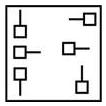
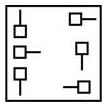
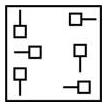
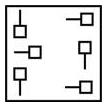
7.

- (a)
- (b)
- (c)
- (d)
Show answer
Answer: (c)
- (a)
8. Which number will replace the question mark (?) in the following series? 40, 80, 200, 600, 2100, ?
- (a) 10500
- (b) 9600
- (c) 8400
- (d) 6300
Show answer
Answer: (c)
9. Seven girls G1, G2, G3, G4, G5, G6 and G7 sit in a row facing towards the north (not necessarily in the same order). G4 sits fifth to the right of G1. G4 does not sit at any of the extreme ends. G6 sits exactly in the middle of the row. G6 sits third to the left of G2. Only two girls sit between G7 and G5. G7 is not an immediate neighbour of G6. Who are the immediate neighbours of G3?
- (a) G4 and G2
- (b) G5 and G7
- (c) G6 and G7
- (d) G1 and G2
Show answer
Answer: (c)
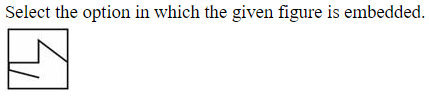
10.
- (a)

- (b)

- (c)

- (d)

Show answer
Answer: (c)
- (a)
11. Select the option that is related to the fifth alphanumeric-cluster in the same way as the second alphanumeric-cluster is related to the first alphanumeric-cluster and the fourth alphanumeric-cluster is related to the third alphanumeric-cluster. P4 : N9 :: M16 : K25 :: G49 : ?
- (a) H55
- (b) F64
- (c) I72
- (d) E64
Show answer
Answer: (d)
12. Select the option that is related to the third letter-cluster in the same way as the second letter-cluster is related to the first letter-cluster. BAL : ODE :: AGR : ?
- (a) UKD
- (b) UJE
- (c) VJD
- (d) UJD
Show answer
Answer: (d)
13. In a certain code language, 'TOPICS' is written as 'QAGONS' and 'GREATH' is written as 'FRYDQF'. How will 'BANDEF' be written in that language?
- (a) DCCMZA
- (b) DCBMZA
- (c) DCBMYA
- (d) DCBNYA
Show answer
Answer: (b)
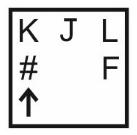
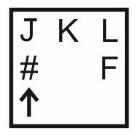
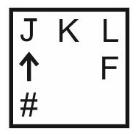
14.

- (a)
- (b)
- (c)
- (d)
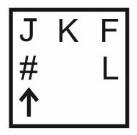
Show answer
Answer: (b)
- (a)
15. After interchanging the two signs + and ×, what will be the value of the given equation? 25 × 5 + 4 ÷ 2 – 10 = ?
- (a) 35
- (b) 20
- (c) 30
- (d) 25
Show answer
Answer: (d)
16.
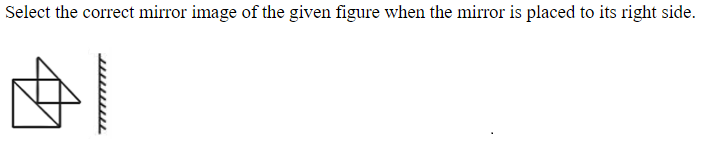
- (a)

- (b)

- (c)

- (d)

Show answer
Answer: (d)
- (a)
17. The ages of seven boys B1, B2, B3, B4, B5, B6 and B7 are compared. All boys have different ages. The age of B4 is less than three boys. The age of B1 is only greater than B7 and B3. The age of B5 is greater than B6 but less than B2. The age of how many boys is less than B6?
- (a) 2
- (b) 1
- (c) 3
- (d) 4
Show answer
Answer: (d)
18. 6 persons A, B, C, D, E and F are sitting around a rectangular table facing the centre (not necessarily in the same order). Two persons are sitting on each larger side and one person is sitting on each shorter side. D is sitting opposite to F. A and E are sitting on the same side. Neither B nor E is sitting just next to D. C sits to the right of D. Which of the following statements is correct? I. C is the second to the left of F. II. E is sitting opposite to C.
- (a) Only I
- (b) Only II
- (c) Both I and II
- (d) Neither I nor II
Show answer
Answer: (a)
19. Select the option that is related to the fifth number in the same way as the second number is related to the first number and the fourth number is related to the third number. NOTE: Operations should be performed on the whole numbers, without breaking down the numbers into its constituent digits. E.g. 13 – Operations on 13 such as adding /deleting /multiplying etc. to 13 can be performed. Breaking down 13 into 1 and 3 and then performing mathematical operations on 1 and 3 is not allowed) 21 : 9261 :: 17 : 4913 :: 8 : ?
- (a) 1024
- (b) 488
- (c) 512
- (d) 2356
Show answer
Answer: (c)
20. Read the given statements and conclusions carefully. Assuming that the information given in the statements is true, even if it appears to be at variance with commonly known facts, decide which of the given conclusions logically follow(s) from the statements. Statements: I. No car is red. II. All reds are blues. Conclusions: I. Some blues are not cars. II. No red is a car.
- (a) Both conclusions I and II follow
- (b) Neither conclusion I nor II follows
- (c) Only conclusion I follows
- (d) Only conclusion II follows
Show answer
Answer: (a)
21. Read the given statements and conclusions carefully. Assuming that the information given in the statements is true, even if it appears to be at variance with commonly known facts, decide which of the given conclusions logically follow(s) from the statements. Statements: Some blankets are pillows. All pillows are cushions. Conclusions: I. Some blankets are cushions is a possibility. II. Some cushions are pillows.
- (a) Only conclusion II follows
- (b) Only conclusion I follows
- (c) Neither conclusion I nor II follows
- (d) Both conclusions I and II follow
Show answer
Answer: (d)
22. Select the option that is related to the fifth letter-cluster in the same way as the second letter-cluster is related to the first letter-cluster and the fourth letter-cluster is related to the third letter-cluster. AZBZ : CYDY :: EXFX : GWHW :: IVJV : ?
- (a) IJKV
- (b) KVLV
- (c) IUJU
- (d) KULU
Show answer
Answer: (d)
23. By interchanging the given two signs and two numbers (not digits), which of the following equations will NOT be correct? × and –, 27 and 35 I. 27 ÷ 7 – 6 × 5 + 35 = 53 II. 11 – 7 + 35 × 420 ÷ 27 = 93
- (a) Neither I nor II
- (b) Only II
- (c) Both I and II
- (d) Only I
Show answer
Answer: (c)
24.
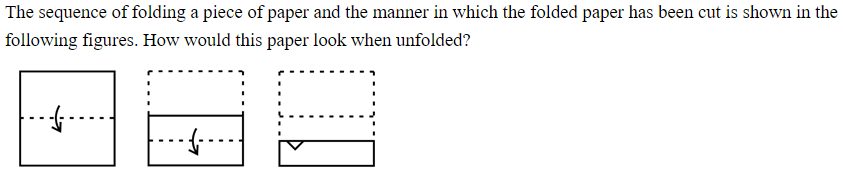
- (a)

- (b)

- (c)

- (d)
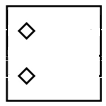
Show answer
Answer: (d)
- (a)
25. Select the letter-cluster from among the given options that can replace the question mark (?) in the following series. RN, NP, JR, ?, BV
- (a) ER
- (b) ET
- (c) FS
- (d) FT
Show answer
Answer: (d)
Numerical Aptitude
1.

- (a)

- (b)

- (c)

- (d)

Show answer
Answer: (a)
- (a)
2.

- (a)

- (b)

- (c)

- (d)

Show answer
Answer: (d)
- (a)
3.

- (a)

- (b)

- (c)

- (d)

Show answer
Answer: (c)
- (a)
4.

- (a)

- (b)

- (c)

- (d)

Show answer
Answer: (c)
- (a)
5.

- (a)

- (b)

- (c)

- (d)

Show answer
Answer: (d)
- (a)
6.

- (a)

- (b)

- (c)

- (d)

Show answer
Answer: (b)
- (a)
7.

- (a)

- (b)

- (c)

- (d)

Show answer
Answer: (b)
- (a)
8.

- (a)

- (b)

- (c)

- (d)

Show answer
Answer: (b)
- (a)
9.

- (a)

- (b)

- (c)

- (d)

Show answer
Answer: (c)
- (a)
10.

- (a)

- (b)

- (c)

- (d)

Show answer
Answer: (b)
- (a)
13.

- (a)

- (b)

- (c)

- (d)

Show answer
Answer: (b)
- (a)
14.

- (a)

- (b)

- (c)

- (d)

Show answer
Answer: (b)
- (a)
15.

- (a)

- (b)

- (c)

- (d)

Show answer
Answer: (d)
- (a)
16.

- (a)

- (b)

- (c)

- (d)

Show answer
Answer: (a)
- (a)
18.

- (a)

- (b)

- (c)

- (d)

Show answer
Answer: (a)
- (a)
20.

- (a)

- (b)
- (c)
- (d)

Show answer
Answer: (b)
- (a)
21.

- (a)

- (b)

- (c)

- (d)

Show answer
Answer: (a)
- (a)
22.
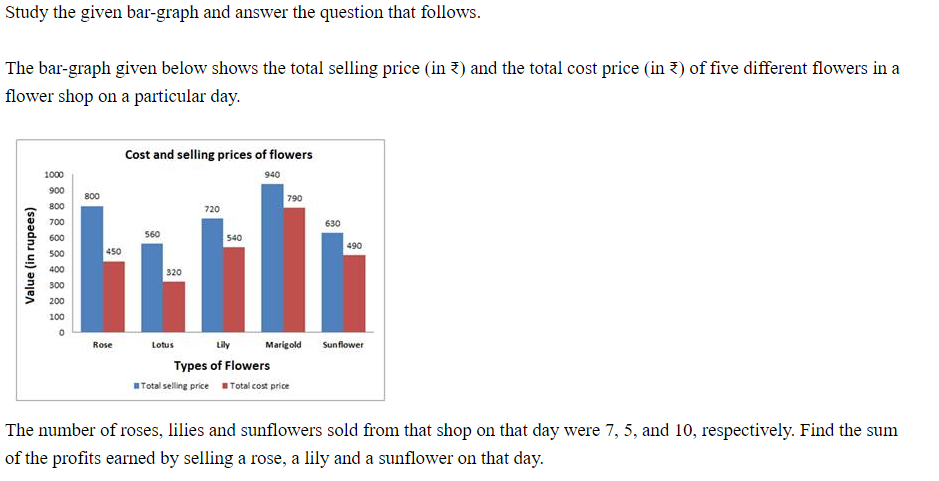
- (a)
- (b)

- (c)

- (d)

Show answer
Answer: (d)
- (a)
23.

- (a)

- (b)

- (c)

- (d)

Show answer
Answer: (c)
- (a)
24.

- (a)

- (b)

- (c)

- (d)

Show answer
Answer: (a)
- (a)
25.

- (a)

- (b)

- (c)

- (d)

Show answer
Answer: (d)
- (a)
General Awareness
1. ‘Loor’ is a folk dance of which state of India?
- (a) Haryana
- (b) Manipur
- (c) Karnataka
- (d) Kerala
Show answer
Answer: (a)
2. The Congress split took place in ______.
- (a) 1905
- (b) 1903
- (c) 1907
- (d) 1908
Show answer
Answer: (c)
3. Poverty line measures poverty on the basis of:
- (a) expenditure only
- (b) income level and literacy rate
- (c) savings only
- (d) income level or consumption expenditure
Show answer
Answer: (d)
4. As on Jan 2022, who among the following has been appointed as the new Chairman of ISRO?
- (a) BN Suresh
- (b) S Somanath
- (c) K Sivan
- (d) ASK Kumar
Show answer
Answer: (b)
5. The Indian National Congress was established in ______.
- (a) 1879
- (b) 1877
- (c) 1875
- (d) 1885
Show answer
Answer: (d)
6. In which of the following grounds did Yuvraj Singh hit 6 sixes in an over of a T20 International match?
- (a) Wanderers Stadium
- (b) Kingsmead Stadium
- (c) Mabhida Stadium
- (d) Newlands Cricket Ground
Show answer
Answer: (b)
7. Which of the following Articles of the Indian Constitution talks about joint sitting of both Houses in certain cases?
- (a) Article 110
- (b) Article 128
- (c) Article 75
- (d) Article 108
Show answer
Answer: (d)
8. ‘The Diary of a Young Girl’ is an autobiography of:
- (a) Anne Frank
- (b) Agatha Christie
- (c) Michelle Obama
- (d) Jessica Simpson
Show answer
Answer: (a)
9. Which feature of the Indian Constitution is borrowed from the Constitution of Britain?
- (a) Fundamental duties
- (b) Parliamentary government
- (c) Judicial review
- (d) Fundamental rights
Show answer
Answer: (b)
10. Which of the given statements is correct regarding properties of suspension? I. Suspension is a heterogeneous mixture. II. The particles of a suspension can be seen by the naked eye.
- (a) Only I
- (b) Neither I nor II
- (c) Both I and II
- (d) Only II
Show answer
Answer: (c)
11. Spirogyra belongs to which group of plant kingdom?
- (a) Bryophyta
- (b) Angiosperms
- (c) Pteridophyta
- (d) Thallophyta
Show answer
Answer: (d)
12. Kamala Narayan is known for which classical dance form?
- (a) Bharatanatyam
- (b) Kathakali
- (c) Odissi
- (d) Kathak
Show answer
Answer: (a)
13. Kardang Monastery which is a Buddhist Pilgrimage is situated in which state of India?
- (a) Jharkhand
- (b) Goa
- (c) Himachal Pradesh
- (d) Kerala
Show answer
Answer: (c)
14. In February 2022, which Indian state government announced that ‘Hope Express’ would be launched in the state to prevent cancer?
- (a) Odisha
- (b) Maharashtra
- (c) Karnataka
- (d) Chhattisgarh
Show answer
Answer: (b)
15. Who will co-host the ICC Men’s T20 World Cup 2024?
- (a) Australia
- (b) The United Kingdom
- (c) The United States of America (USA)
- (d) Sri Lanka
Show answer
Answer: (c)
16. Which of the following crops takes almost a year to grow?
- (a) Sugarcane
- (b) Peas
- (c) Cucumber
- (d) Rice
Show answer
Answer: (a)
17. In 1526, ______ was defeated by Babur at Panipat.
- (a) Sikander Lodi
- (b) Rana Lodi
- (c) Bahlul Lodi
- (d) Ibrahim Lodi
Show answer
Answer: (d)
18. How many countries share land boundaries with India?
- (a) Seven
- (b) Ten
- (c) Eight
- (d) Five
Show answer
Answer: (a)
19. Which of the following is an example of sedimentary rocks?
- (a) Sandstone
- (b) Granite
- (c) Slate
- (d) Marble
Show answer
Answer: (a)
20. Pongal is a harvest festival of which state of India?
- (a) Tamil Nadu
- (b) Mizoram
- (c) Rajasthan
- (d) Manipur
Show answer
Answer: (a)
21. Which of the following is a young fold mountain?
- (a) The Alps
- (b) The Appalachians
- (c) Aravalli Range
- (d) The Vosges
Show answer
Answer: (a)
22. Dharmasutras contain:
- (a) tricks to capture an empire
- (b) norms for women only
- (c) techniques to recite shlokas
- (d) norms for rulers
Show answer
Answer: (d)
23. With which of the following was Kadri Gopalnath associated?
- (a) Sitar
- (b) Saxophone
- (c) Tabla
- (d) Flute
Show answer
Answer: (b)
24. Which of the following bodies publishes the Human Development Report?
- (a) United Nations Food Organization
- (b) United Nations Human Resource Development
- (c) World Health Organization
- (d) United Nations Development Programme
Show answer
Answer: (d)
25. When the litmus solution is neither acidic nor basic then its colour is ______.
- (a) purple
- (b) red
- (c) yellow
- (d) blue
Show answer
Answer: (a)
Show answers
Answer key
Answer key as marked in the Staff Selection Commission’s response sheet. “—” means the sheet did not show it clearly.
General English
- Q 1
- (a)
- Q 2
- (b)
- Q 3
- (c)
- Q 4
- (a)
- Q 5
- (a)
- Q 6
- (c)
- Q 7
- (d)
- Q 8
- (b)
- Q 9
- (c)
- Q 10
- (c)
- Q 11
- (a)
- Q 12
- (c)
- Q 13
- (d)
- Q 14
- (b)
- Q 15
- (a)
- Q 16
- (d)
- Q 17
- (c)
- Q 18
- (c)
- Q 19
- (a)
- Q 20
- (d)
- Q 21
- (c)
- Q 22
- (b)
- Q 23
- (a)
- Q 24
- (d)
- Q 25
- (a)
General Intelligence and Reasoning
- Q 1
- (a)
- Q 2
- (b)
- Q 3
- (a)
- Q 4
- (a)
- Q 5
- (c)
- Q 6
- (c)
- Q 7
- (c)
- Q 8
- (c)
- Q 9
- (c)
- Q 10
- (c)
- Q 11
- (d)
- Q 12
- (d)
- Q 13
- (b)
- Q 14
- (b)
- Q 15
- (d)
- Q 16
- (d)
- Q 17
- (d)
- Q 18
- (a)
- Q 19
- (c)
- Q 20
- (a)
- Q 21
- (d)
- Q 22
- (d)
- Q 23
- (c)
- Q 24
- (d)
- Q 25
- (d)
Numerical Aptitude
- Q 1
- (a)
- Q 2
- (d)
- Q 3
- (c)
- Q 4
- (c)
- Q 5
- (d)
- Q 6
- (b)
- Q 7
- (b)
- Q 8
- (b)
- Q 9
- (c)
- Q 10
- (b)
- Q 13
- (b)
- Q 14
- (b)
- Q 15
- (d)
- Q 16
- (a)
- Q 18
- (a)
- Q 20
- (b)
- Q 21
- (a)
- Q 22
- (d)
- Q 23
- (c)
- Q 24
- (a)
- Q 25
- (d)
General Awareness
- Q 1
- (a)
- Q 2
- (c)
- Q 3
- (d)
- Q 4
- (b)
- Q 5
- (d)
- Q 6
- (b)
- Q 7
- (d)
- Q 8
- (a)
- Q 9
- (b)
- Q 10
- (c)
- Q 11
- (d)
- Q 12
- (a)
- Q 13
- (c)
- Q 14
- (b)
- Q 15
- (c)
- Q 16
- (a)
- Q 17
- (d)
- Q 18
- (a)
- Q 19
- (a)
- Q 20
- (a)
- Q 21
- (a)
- Q 22
- (d)
- Q 23
- (b)
- Q 24
- (d)
- Q 25
- (a)