ExamBharo · SSC MTS 2021 — 11 July 2022, Shift 3 · exambharo.com/ssc-mts/previous-year-papers/ssc-mts-2021-11-jul-shift-3/
Question paper · SSC MTS & Havaldar
SSC MTS 2021 — 11 July 2022, Shift 3
11 July 2022 · 5:00 PM–6:30 PM95 of the paper’s 100 questions1 per correct answer
Questions from the Staff Selection Commission’s paper of 11 July 2022, 5:00 PM–6:30 PM.
Preparing for SSC MTS & Havaldar? Get more, free
Daily previous-year questions as quizzes, and every SSC MTS & Havaldar notice the day it is out.
General English
1. Select the option that can be used as a one-word substitute for the given group of words. One who is unable to pay his debts
- (a) Debonair
- (b) Novice
- (c) Fatalist
- (d) Bankrupt
Show answer
Answer: (d)
2. Select the most appropriate synonym of the given word. Dissolve
- (a) Emerge
- (b) Consolidate
- (c) Fade
- (d) Repair
Show answer
Answer: (c)
3. Select the option that will improve the underlined part of the given sentence. In case no improvement is needed, select 'No improvement required'. Adam and I are planning a grand party at our office.
- (a) me are planning
- (b) I is planning
- (c) me is planning
- (d) No improvement required
Show answer
Answer: (d)
4. Select the most appropriate meaning of the underlined idiom in the given sentence. Samuel accused Jane of stealing the thunder on the capital punishment issue.
- (a) Get praise for doing something before someone
- (b) Go on a futile search
- (c) Fail miserably at something
- (d) Pass wrong judgments
Show answer
Answer: (a)
5. Select the option that will improve the underlined part of the given sentence. In case no improvement is needed, select 'No improvement required'. I would agreed that these programs can be good for learning things that nobody else will teach you.
- (a) I agree that these programs
- (b) No improvement required
- (c) I will have agreed that these programs
- (d) I will have to agreed that these program
Show answer
Answer: (a)
6. Select the most appropriate ANTONYM of the given word. Stormy
- (a) Ferocious
- (b) Sporadic
- (c) Serene
- (d) Rough
Show answer
Answer: (c)
7. Select the option that can be used as a one-word substitute for the given group of words. One who does not tire easily
- (a) Indefatigable
- (b) Pedantic
- (c) Recluse
- (d) Libertine
Show answer
Answer: (a)
8. Parts of the following sentence have been given as options. One of them may contain an error. Select the part that contains the error from the given options. If you don’t find any error, mark ‘No error’ as your answer. Over the years, the threat of cyberattacks on satellites has gotten more direr.
- (a) No error
- (b) has gotten more direr
- (c) threat of cyberattacks on satellites
- (d) Over the years, the
Show answer
Answer: (b)
9. Select the option that rectifies the incorrectly spelt words in the given sentence. The young worms are fedd tendar leaves.
- (a) The young worms are fed tander leaves.
- (b) The young worms are fed tender leaves.
- (c) The young worms are fed tendor leaves.
- (d) The young worms are feid tendre leaves.
Show answer
Answer: (b)
10. Select the most appropriate option to fill in the blank. You need to put the baby very _____ on the bed.
- (a) much gently
- (b) gently
- (c) more gentle
- (d) gentle
Show answer
Answer: (b)
11. Select the option that can be used as a one-word substitute for the given group of words. A person who looks at the bright side of things
- (a) Oculist
- (b) Optimist
- (c) Pessimist
- (d) Atheist
Show answer
Answer: (b)
12. Select the most appropriate option to fill in the blank. A person must speak eloquently and ______ while making a speech.
- (a) rudely
- (b) politely
- (c) hurriedly
- (d) disrespectfully
Show answer
Answer: (b)
13. Select the option that will improve the underlined part of the sentence. In case no improvement is needed, select ‘No improvement required’. Either Supriya or Nikunj are lying off this situation.
- (a) is lying in relation to
- (b) has lie on
- (c) No improvement required
- (d) were lying to
Show answer
Answer: (a)
14. Select the most appropriate synonym of the bracketed word in the given sentence. They saw fit to (banish) him from the party and exclude him from the election campaign.
- (a) persevere
- (b) revolt
- (c) distress
- (d) exile
Show answer
Answer: (d)
15. The following sentence has been divided into parts. One of them may contain an error. Select the part that contains the error from the given options. If you don’t find any error, mark ‘No error’ as your answer. Wind is one / of biggest factors / in the spread of fire.
- (a) of biggest factors
- (b) No error
- (c) in the spread of fire
- (d) Wind is one
Show answer
Answer: (a)
16. The following sentence has been divided into parts. One of them may contain an error. Select the part that contains the error from the given options. If you don’t find any error, mark ‘No error’ as your answer. The new media / is more faster / and more popular.
- (a) No error
- (b) is more faster
- (c) and more popular
- (d) The new media
Show answer
Answer: (b)
17. Select the option that will improve the underlined part of the given sentence. In case no improvement is needed, select 'No improvement required'. As a young girl, Mary lived in France, where she have married the king of France, Francis II.
- (a) she has married
- (b) No improvement required
- (c) she married
- (d) she did married
Show answer
Answer: (c)
18. Select the most appropriate synonym of the underlined word in the given sentence. The laws are strong but never enforced.
- (a) Diluted
- (b) Abandoned
- (c) Imposed
- (d) Disregarded
Show answer
Answer: (c)
19. Select the correctly spelt word.
- (a) Concsent
- (b) Concent
- (c) Conscent
- (d) Consent
Show answer
Answer: (d)
20. Select the most appropriate meaning of the given idiom. To smell a rat
- (a) To suspect something
- (b) To catch someone during a crime
- (c) To leave things undisturbed
- (d) To detect a dead rat
Show answer
Answer: (a)
PassageFor questions 21–25
In the following passage, some words have been deleted. Read the passage carefully and select the most appropriate option to fill in each blank.
The Small Indian Mongoose, (1) ______ its little round ears, is an (2) ______ hunter and has a long snout-like face and short legs that have sharp claws. It (3) ______ brown or greygrizzly fur and (4) ______ in abandoned burrows or tunnels. (5) ______ the rat-like appearance, mongooses are not rodents.
21. Select the most appropriate option to fill in blank number 1.
- (a) of
- (b) to
- (c) from
- (d) with
Show answer
Answer: (d)
22. Select the most appropriate option to fill in blank number 2.
- (a) alive
- (b) alike
- (c) awake
- (d) agile
Show answer
Answer: (d)
23. Select the most appropriate option to fill in blank number 3.
- (a) has
- (b) had
- (c) have
- (d) having
Show answer
Answer: (a)
24. Select the most appropriate option to fill in blank number 4.
- (a) learns
- (b) leans
- (c) leaves
- (d) lives
Show answer
Answer: (d)
25. Select the most appropriate option to fill in blank number 5.
- (a) Instead
- (b) Apart
- (c) Often
- (d) Despite
Show answer
Answer: (d)
General Intelligence and Reasoning
1. Select the option that is related to the fifth number in the same way as the second number is related to the first number and the fourth number is related to the third number. 196: 226:: 256: 290:: 324: ?
- (a) 362
- (b) 358
- (c) 352
- (d) 372
Show answer
Answer: (a)
2.
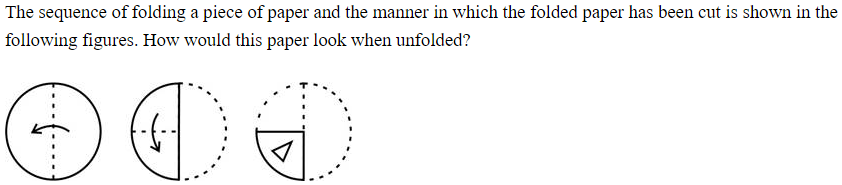
- (a)

- (b)

- (c)

- (d)

Show answer
Answer: (c)
- (a)
3. In a certain code language, if February is called March, March is called April, April is called June, June is called September, and September is called November, then which month will have the most number of days?
- (a) September
- (b) March
- (c) April
- (d) June
Show answer
Answer: (c)
5. The ages of seven students of a tuition class, Prem, Qazi, Rishav, Subham, Tania, Urvashi and Vinita, are as follows: Prem is the second oldest. Vinita is older than only one person in the class. Subham is older than Tania but younger than Prem. Three students are older than Tania and three are younger than Tania. Neither Rishav nor Qazi is the youngest. Given that no two students have the same age, who is the youngest?
- (a) Subham
- (b) Urvashi
- (c) Vinita
- (d) Tania
Show answer
Answer: (b)
6. In a certain code language, ‘Toys are hard’ is coded as ‘# % @’, and ‘Games magnet is toys’ is coded as ‘fr lm ag #’. What is the code for ‘Toys’ in that language?
- (a) @
- (b) #
- (c) %
- (d) fr
Show answer
Answer: (b)
7. Select the option that is related to the fifth letter-cluster in the same way as the second letter-cluster is related to the first letter-cluster and the fourth letter-cluster is related to the third letter-cluster. METHOD : OIZPYP :: SAFETY : UELMDK :: YELLOW : ?
- (a) AIRTXI
- (b) AIRTYJ
- (c) AIRTXJ
- (d) AIRTYI
Show answer
Answer: (d)
8.
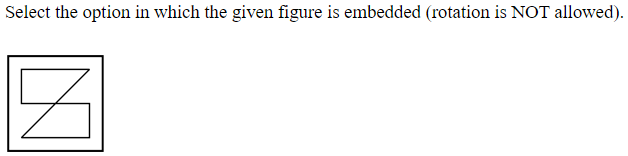
- (a)
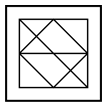
- (b)
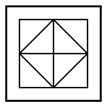
- (c)
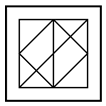
- (d)
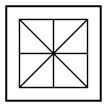
Show answer
Answer: (d)
- (a)
9. Five people I, II, III, IV and V standing in a line facing north. V and II are standing together. V and III are standing together. I is at the extreme left. II is second from the extreme right.Who is standing at the extreme right?
- (a) II
- (b) V
- (c) IV
- (d) III
Show answer
Answer: (c)
10. Which two signs should be interchanged in the given equation to make it mathematically correct? 26 ÷ 24 + 6 × 27 − 105 = 29
- (a) × and ÷
- (b) + and ÷
- (c) + and ×
- (d) × and −
Show answer
Answer: (b)
11.
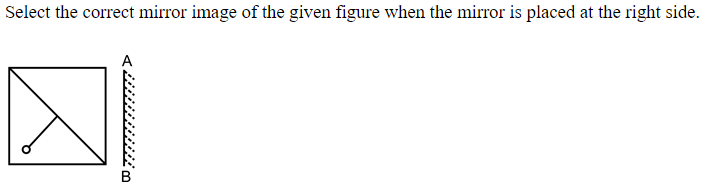
- (a)
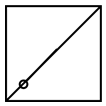
- (b)

- (c)

- (d)

Show answer
Answer: (c)
- (a)
12. Five people, I, J, K, L, and M, are sitting in a straight row, facing north. K sits to the immediate right of L. Only two people sit between L and I. M sits to the immediate right of I and to the immediate left of J. Who sits in the middle of the row?
- (a) J
- (b) L
- (c) M
- (d) K
Show answer
Answer: (a)
13.
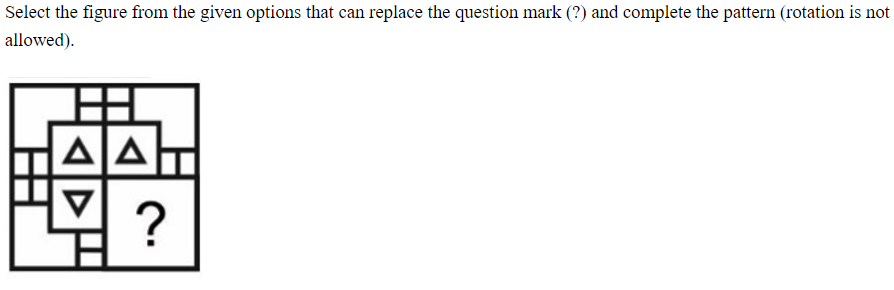
- (a)

- (b)
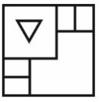
- (c)
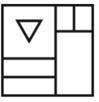
- (d)
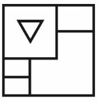
Show answer
Answer: (b)
- (a)
14. Read the given statements and conclusions carefully. Assuming that the information given in the statements is true, even if it appears to be at variance with commonly known facts, decide which of the given conclusions logically follow(s) from the statements. Statements: Some pilots are cutes. All ballers are cutes. Conclusions: I. All cutes are ballers. II. Some pilots are ballers.
- (a) Neither conclusion I nor II follows.
- (b) Only conclusion I follows.
- (c) Only conclusion II follows.
- (d) Both conclusions I and II follow.
Show answer
Answer: (a)
15. Select the number from among the given options that can replace the question mark (?) in the following series. 16, 23, 31, 40, 50, ?
- (a) 60
- (b) 62
- (c) 61
- (d) 63
Show answer
Answer: (c)
16. Select the option that is related to the third letter-cluster in the same way as the second letter-cluster is related to the first letter-cluster. GMP : IKS :: FOL : ?
- (a) HMP
- (b) HNP
- (c) HMO
- (d) HNO
Show answer
Answer: (c)
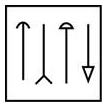
17.

- (a)
- (b)
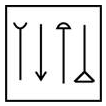
- (c)
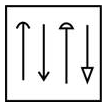
- (d)
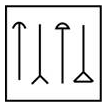
Show answer
Answer: (c)
- (a)
18. Select the option that can replace the question mark (?) in the following series. E, H, K, N, Q, ?
- (a) V
- (b) T
- (c) U
- (d) S
Show answer
Answer: (b)
19.
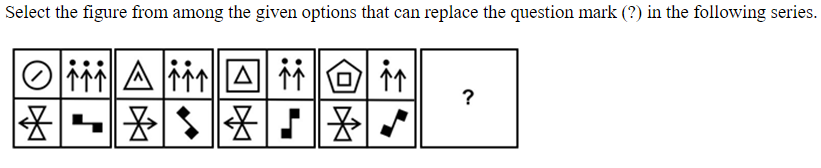
- (a)

- (b)

- (c)

- (d)

Show answer
Answer: (c)
- (a)
20. Read the given statements and conclusions carefully. Assuming that the information given in the statements is true, even if it appears to be at variance with commonly known facts, decide which of the given conclusions logically follow(s) from the statements. Statements: All chips are lays. Some lays are snacks. Conclusions: I. All lays are chips. II. All chips are snacks.
- (a) Both conclusions I and II follow.
- (b) Only conclusion II follows.
- (c) Neither conclusion I nor II follow.
- (d) Only conclusion I follows.
Show answer
Answer: (c)
21. Select the option that is related to the fifth term in the same way as the second term is related to the first term and the fourth term is related to the third term. ERA : ETA :: HONEST : JOPEUV :: GRAIN : ?
- (a) GTCIN
- (b) ITCIP
- (c) IRAKP
- (d) ITAIP
Show answer
Answer: (d)
22. In a certain code language, 'WATER' is written as 'RETAW', 'CERTAIN' is written as 'NIATREC', and 'GENERAL' is written as 'LARENEG'. How will 'LOVELY' be written in that language?
- (a) LOVELY
- (b) YLEVOL
- (c) YOVELL
- (d) YLVEOL
Show answer
Answer: (b)
23. Select the number from among the given options that can replace the question mark (?) in the following series. 31, 62, 65, 260, 265, ?
- (a) 860
- (b) 1240
- (c) 555
- (d) 1590
Show answer
Answer: (d)
24. In a certain code language, 'TEAM' is coded as '41', and 'FEAD' is coded as '18'. How will 'GROW' be coded in that language?
- (a) 67
- (b) 63
- (c) 65
- (d) 61
Show answer
Answer: (c)
25. What will be the value of the following expression, if ‘+’ and ‘–’ are interchanged and ‘×’ and ‘÷’ are interchanged? 5 − 3 ÷ 4 + 6 × 2 = ?
- (a) 16
- (b) 14
- (c) 12
- (d) 18
Show answer
Answer: (b)
Numerical Aptitude
1.

- (a)

- (b)

- (c)

- (d)

Show answer
Answer: (b)
- (a)
2.

- (a)

- (b)

- (c)

- (d)

Show answer
Answer: (a)
- (a)
3.

- (a)

- (b)

- (c)

- (d)

Show answer
Answer: (a)
- (a)
4.

- (a)

- (b)

- (c)

- (d)

Show answer
Answer: (b)
- (a)
5.

- (a)

- (b)

- (c)

- (d)

Show answer
Answer: (d)
- (a)
6.

- (a)

- (b)

- (c)

- (d)

Show answer
Answer: (d)
- (a)
9.

- (a)

- (b)

- (c)

- (d)

Show answer
Answer: (c)
- (a)
10.

- (a)

- (b)

- (c)

- (d)

Show answer
Answer: (a)
- (a)
12.

- (a)

- (b)

- (c)

- (d)

Show answer
Answer: (c)
- (a)
13.
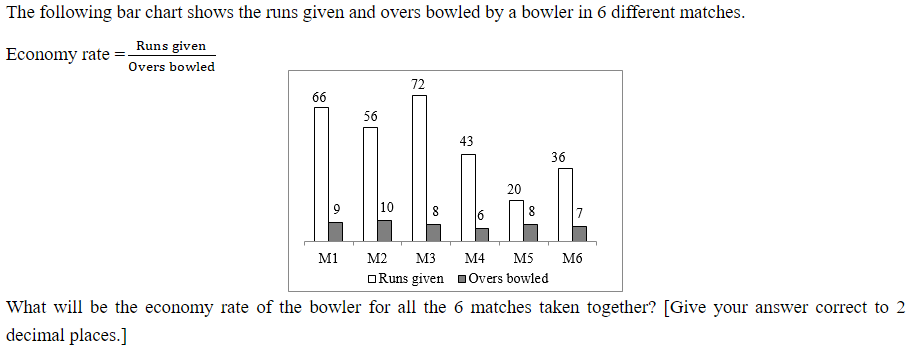
- (a)

- (b)

- (c)

- (d)

Show answer
Answer: (d)
- (a)
14.

- (a)

- (b)

- (c)

- (d)

Show answer
Answer: (b)
- (a)
15.

- (a)

- (b)

- (c)

- (d)

Show answer
Answer: (d)
- (a)
16.

- (a)

- (b)

- (c)

- (d)

Show answer
Answer: (c)
- (a)
17.

- (a)

- (b)

- (c)

- (d)

Show answer
Answer: (b)
- (a)
18.

- (a)

- (b)

- (c)

- (d)

Show answer
Answer: (b)
- (a)
20.

- (a)

- (b)

- (c)

- (d)

Show answer
Answer: (c)
- (a)
21.

- (a)

- (b)

- (c)

- (d)

Show answer
Answer: (c)
- (a)
22.
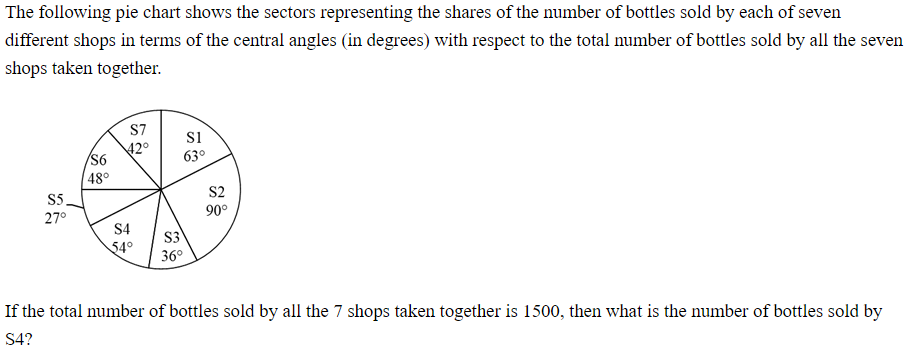
- (a)

- (b)

- (c)

- (d)

Show answer
Answer: (b)
- (a)
23.

- (a)

- (b)

- (c)

- (d)

Show answer
Answer: (a)
- (a)
24.

- (a)

- (b)

- (c)

- (d)

Show answer
Answer: (c)
- (a)
25.

- (a)

- (b)

- (c)

- (d)

Show answer
Answer: (c)
- (a)
General Awareness
1. Qutub-ud-din Aibak founded which of the following dynasties?
- (a) Tughluq Dynasty
- (b) Sayyid Dynasty
- (c) Khilji Dynasty
- (d) Slave Dynasty
Show answer
Answer: (d)
2. Which of the following types of agriculture is known as Jhum in Assam?
- (a) Intensive Farming
- (b) Plantation Agriculture
- (c) Subsistence Farming
- (d) Shifting Agriculture
Show answer
Answer: (d)
3. Pradhan Mantri Kaushal Vikas Yojana was introduced in 2015 under the _____________.
- (a) Ministry of Rural development
- (b) Ministry of Housing and Urban Affairs
- (c) Ministry of Finance
- (d) Ministry of Skill Development and Entrepreneurship
Show answer
Answer: (d)
4. Loudness of sound is proportional to the ______ of the amplitude of the vibration producing the sound.
- (a) cube root
- (b) Cube
- (c) Square
- (d) square root
Show answer
Answer: (c)
5. Who among the following was a famous Indian choreographer?
- (a) Kajol
- (b) Saroj Khan
- (c) Shreya Ghoshal
- (d) Madhuri Dixit
Show answer
Answer: (b)
6. The Annual Financial Statement shows the receipts and payments of Government in the form of ___________.
- (a) Contingency Fund, Public Account, and Capital Projects
- (b) Contingency Fund, Public Account, and Consolidated Funds
- (c) Public Account and Consolidate Funds
- (d) Contingency Fund and Consolidated Funds
Show answer
Answer: (b)
7. Which British governor ended the Dual System of Government in Bengal?
- (a) Robert Clive
- (b) Warren Hastings
- (c) John Shore
- (d) William Bentinck
Show answer
Answer: (b)
8. Which of the following is the world's largest inland sea?
- (a) Azov Sea
- (b) Red Sea
- (c) Mediterranean Sea
- (d) Caspian Sea
Show answer
Answer: (d)
9. Name the PETA India Person of the Year for 2021.
- (a) Anushka Sharma
- (b) Alia Bhatt
- (c) Deepika Padukone
- (d) Kiara Advani
Show answer
Answer: (b)
10. Which of the following contains ascorbic acid (vitamin C) in the highest quantity?
- (a) Dates
- (b) Wheat
- (c) Guava
- (d) Peanut
Show answer
Answer: (c)
11. How many players are there in a Field Hockey team?
- (a) 7
- (b) 11
- (c) 15
- (d) 19
Show answer
Answer: (b)
12. Who is the first trans woman to win a Padma Shri award for Bharatanatyam?
- (a) Bishesh Huirem
- (b) Narthaki Nataraj
- (c) Sruthy Sithara
- (d) Sadhana Mishra
Show answer
Answer: (b)
13. Which of the following fundamental rights implies the prohibition of traffic in human beings, begar and other forms of forced labour?
- (a) Right against Exploitation
- (b) Cultural and Educational Rights
- (c) Right to Constitutional Remedies
- (d) Right to Freedom of Religion
Show answer
Answer: (a)
14. Who among the following led the Battle of Buxar on behalf of British East India Company?
- (a) Charles Stuart
- (b) Robert Clive
- (c) Hector Munro
- (d) John William Fortescue
Show answer
Answer: (c)
15. Which of the following sports was NOT played at the 2020 Summer Olympic Games (played in 2021)?
- (a) Boxing
- (b) Wrestling
- (c) Weightlifting
- (d) Wushu
Show answer
Answer: (d)
16. Which of the following minerals is responsible for synthesis of thyroxine hormone?
- (a) Iron
- (b) Cobalt
- (c) Calcium
- (d) Iodine
Show answer
Answer: (d)
17. Assam and most of the Peninsular states have _____ population densities.
- (a) high to very high
- (b) very low
- (c) moderate
- (d) moderate to high
Show answer
Answer: (c)
18. The Governor of a state is appointed by the ______.
- (a) Chief Minister of that state
- (b) President of India
- (c) Advocate General of India
- (d) Prime Minister of India
Show answer
Answer: (b)
19. Freedom in Exile is the autobiography of ________.
- (a) Nelson Mandela
- (b) APJ Abdul Kalam
- (c) Dalai Lama
- (d) Mahatma Gandhi
Show answer
Answer: (c)
20. To which state of India is the Hornbill festival related?
- (a) Kerala
- (b) Karnataka
- (c) Nagaland
- (d) Bihar
Show answer
Answer: (c)
21. Dr N Rajam is known for playing the ________.
- (a) veena
- (b) guitar
- (c) violin
- (d) flute
Show answer
Answer: (c)
22. The Delhi Municipal Corporation (Amendment) Bill, 2022, was introduced In Lok Sabha on 25th March 2022 by ____________.
- (a) Ramesh Bidhuri
- (b) Narendra Modi
- (c) Amit Shah
- (d) Nirmala Sitharaman
Show answer
Answer: (c)
23. The ancient Neemrana Baori is located in which of the following districts of Rajasthan?
- (a) Ajmer
- (b) Alwar
- (c) Bikaner
- (d) Jaipur
Show answer
Answer: (b)
24. The iron implement site of Hastinapur was found in which present day state of India?
- (a) Bihar
- (b) Uttar Pradesh
- (c) Haryana
- (d) Madhya Pradesh
Show answer
Answer: (b)
25. Which winds are also known by the name of 'Roaring Forties'?
- (a) Polar easterlies
- (b) westerly winds
- (c) Polar winds
- (d) Trade winds
Show answer
Answer: (b)
Show answers
Answer key
Answer key as marked in the Staff Selection Commission’s response sheet. “—” means the sheet did not show it clearly.
General English
- Q 1
- (d)
- Q 2
- (c)
- Q 3
- (d)
- Q 4
- (a)
- Q 5
- (a)
- Q 6
- (c)
- Q 7
- (a)
- Q 8
- (b)
- Q 9
- (b)
- Q 10
- (b)
- Q 11
- (b)
- Q 12
- (b)
- Q 13
- (a)
- Q 14
- (d)
- Q 15
- (a)
- Q 16
- (b)
- Q 17
- (c)
- Q 18
- (c)
- Q 19
- (d)
- Q 20
- (a)
- Q 21
- (d)
- Q 22
- (d)
- Q 23
- (a)
- Q 24
- (d)
- Q 25
- (d)
General Intelligence and Reasoning
- Q 1
- (a)
- Q 2
- (c)
- Q 3
- (c)
- Q 5
- (b)
- Q 6
- (b)
- Q 7
- (d)
- Q 8
- (d)
- Q 9
- (c)
- Q 10
- (b)
- Q 11
- (c)
- Q 12
- (a)
- Q 13
- (b)
- Q 14
- (a)
- Q 15
- (c)
- Q 16
- (c)
- Q 17
- (c)
- Q 18
- (b)
- Q 19
- (c)
- Q 20
- (c)
- Q 21
- (d)
- Q 22
- (b)
- Q 23
- (d)
- Q 24
- (c)
- Q 25
- (b)
Numerical Aptitude
- Q 1
- (b)
- Q 2
- (a)
- Q 3
- (a)
- Q 4
- (b)
- Q 5
- (d)
- Q 6
- (d)
- Q 9
- (c)
- Q 10
- (a)
- Q 12
- (c)
- Q 13
- (d)
- Q 14
- (b)
- Q 15
- (d)
- Q 16
- (c)
- Q 17
- (b)
- Q 18
- (b)
- Q 20
- (c)
- Q 21
- (c)
- Q 22
- (b)
- Q 23
- (a)
- Q 24
- (c)
- Q 25
- (c)
General Awareness
- Q 1
- (d)
- Q 2
- (d)
- Q 3
- (d)
- Q 4
- (c)
- Q 5
- (b)
- Q 6
- (b)
- Q 7
- (b)
- Q 8
- (d)
- Q 9
- (b)
- Q 10
- (c)
- Q 11
- (b)
- Q 12
- (b)
- Q 13
- (a)
- Q 14
- (c)
- Q 15
- (d)
- Q 16
- (d)
- Q 17
- (c)
- Q 18
- (b)
- Q 19
- (c)
- Q 20
- (c)
- Q 21
- (c)
- Q 22
- (c)
- Q 23
- (b)
- Q 24
- (b)
- Q 25
- (b)