ExamBharo · SSC MTS 2021 — 7 July 2022, Shift 2 · exambharo.com/ssc-mts/previous-year-papers/ssc-mts-2021-7-jul-shift-2/
Question paper · SSC MTS & Havaldar
SSC MTS 2021 — 7 July 2022, Shift 2
7 July 2022 · 1:00 PM–2:30 PM94 of the paper’s 100 questions1 per correct answer
Questions from the Staff Selection Commission’s paper of 7 July 2022, 1:00 PM–2:30 PM.
Preparing for SSC MTS & Havaldar? Get more, free
Daily previous-year questions as quizzes, and every SSC MTS & Havaldar notice the day it is out.
General English
1. Parts of the following sentence have been given as options. One of them may contain an error. Select the part that contains the error from the given options. If you don’t find any error, mark ‘No error’ as your answer. At seven began the education that was to making the young boy a citizen and a soldier.
- (a) No error
- (b) At seven began the education
- (c) boy a citizen and a soldier
- (d) that was to making the young
Show answer
Answer: (d)
2. Select the most appropriate ANTONYM of the given word. Steady
- (a) Tabular
- (b) Shaky
- (c) Dedicate
- (d) Constant
Show answer
Answer: (b)
3. Select the most appropriate option to fill in the blank. He admonished his listeners _________ their wicked ways.
- (a) changes
- (b) changed
- (c) to change
- (d) change
Show answer
Answer: (c)
4. Select the most appropriate meaning of the underlined idiom in the given sentence. I want you to give me this contract in black and white.
- (a) in writing
- (b) quickly
- (c) in the morning
- (d) at night
Show answer
Answer: (a)
5. Select the most appropriate option to fill in the blank. I am not going to buy ______ toys for you.
- (a) them
- (b) these
- (c) they
- (d) this
Show answer
Answer: (b)
6. Select the correctly spelt word.
- (a) Suddenly
- (b) Sudenly
- (c) Sudenlly
- (d) Suddenlly
Show answer
Answer: (a)
7. Select the INCORRECTLY spelt word.
- (a) Nascent
- (b) Malleable
- (c) Dissiminate
- (d) Obsequious
Show answer
Answer: (c)
8. Select the most appropriate word for the given group of words. A cage for small animals
- (a) Cave
- (b) Hutch
- (c) Shed
- (d) Hut
Show answer
Answer: (b)
9. Select the option that will improve the underlined part of the sentence. In case no improvement is needed, select ‘No improvement required’. Getting a good night’s sleep has a positively effect on our wellbeing.
- (a) have a positively affect
- (b) has a positive effect
- (c) No improvement required
- (d) has a positive affects
Show answer
Answer: (b)
10. Select the most appropriate option to fill in the blank. My sister treats me well in the morning but at night she becomes ______.
- (a) eloquent
- (b) awful
- (c) exemplary
- (d) acceptable
Show answer
Answer: (b)
11. Select the most appropriate synonym of the given word. Gloomy
- (a) Depressing
- (b) Comfortable
- (c) Bright
- (d) Intrepid
Show answer
Answer: (a)
12. Select the option that will improve the underlined part of the given sentence. In case no improvement is needed, select 'No improvement required'. Many an old story were retold, and ancient conundrum repeated.
- (a) Many an old story was retold
- (b) Many old story were retold
- (c) Many an old stories were retold
- (d) No improvement required
Show answer
Answer: (a)
13. Select the most appropriate meaning of the given idiom. Long in the tooth
- (a) Too uncomfortable for words
- (b) Too old to do something
- (c) Too wise for people
- (d) Extremely dangerous
Show answer
Answer: (b)
14. Select the option that can be used as a one-word substitute for the given group of words. One who is not sure about God’s existence
- (a) Agnostic
- (b) Anchor
- (c) Pantheist
- (d) Haggard
Show answer
Answer: (a)
15. Select the option that will improve the underlined part of the given sentence. In case no improvement is needed, select 'No improvement required'. Scientific discoveries is often result of hard work by many people.
- (a) No improvement required
- (b) is often resulting
- (c) are often resulted
- (d) are often the result
Show answer
Answer: (d)
16. Select the most appropriate option to fill in the blank. The US has become far more ______ to people with all kinds of food sensitivities and diet regimens.
- (a) deviated
- (b) lodging
- (c) selective
- (d) accommodating
Show answer
Answer: (d)
17. The following sentence has been divided into parts. One of them may contain an error. Select the part that contains the error from the given options. If you don’t find any error, mark ‘No error’ as your answer. Frank has being making / the rounds, advancing a theory / that I believe is not without merit.
- (a) the rounds, advancing a theory
- (b) No error
- (c) Frank has being making
- (d) that I believe is not without merit
Show answer
Answer: (c)
18. The following sentence has been divided into parts. One of them may contain an error. Select the part that contains the error from the given options. If you don’t find any error, mark ‘No error’ as your answer. Whatever a writer puts / into a story probably comes with / his own life experience.
- (a) with his own life experience
- (b) No error
- (c) into a story probably comes
- (d) Whatever a writer puts
Show answer
Answer: (a)
19. Select the most appropriate synonym of the underlined word in the given sentence. He was critically injured in the accident.
- (a) Favourably
- (b) severely
- (c) trivially
- (d) Confidently
Show answer
Answer: (b)
20. Select the most appropriate option to fill in the blank. All of my efforts to save her life have gone in ______.
- (a) vain
- (b) vein
- (c) van
- (d) vane
Show answer
Answer: (a)
PassageFor questions 21–25
In the following passage, some words have been deleted. Read the passage carefully and select the most appropriate option to fill in each blank.
In its 47 years of history, ISRO (1) ______ breakthrough work in the field of technology and even (2) ______ many vehicles into space. (3) ______ the last 47 years, ISRO has improvised and developed technology, launching (4) ______ indigenously created vehicles into space (5) ______ form a part of the Indian space journey.
21. Select the most appropriate option to fill in blank number 1.
- (a) done
- (b) do
- (c) has done
- (d) does
Show answer
Answer: (c)
22. Select the most appropriate option to fill in blank number 2.
- (a) blocked
- (b) stocked
- (c) launched
- (d) shared
Show answer
Answer: (c)
23. Select the most appropriate option to fill in blank number 3.
- (a) Across
- (b) Over
- (c) Along
- (d) Among
Show answer
Answer: (b)
24. Select the most appropriate option to fill in blank number 4.
- (a) much
- (b) lots
- (c) very
- (d) several
Show answer
Answer: (d)
25. Select the most appropriate option to fill in blank number 5.
- (a) when
- (b) that
- (c) how
- (d) who
Show answer
Answer: (b)
General Intelligence and Reasoning
1.
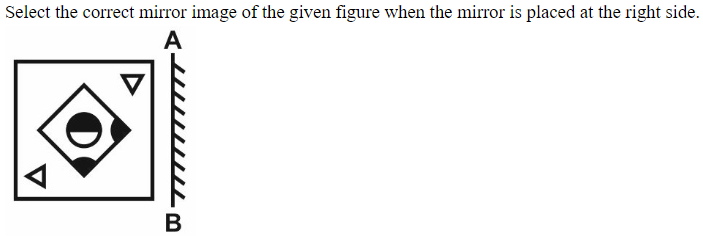
- (a)

- (b)

- (c)

- (d)

Show answer
Answer: (c)
- (a)
2.
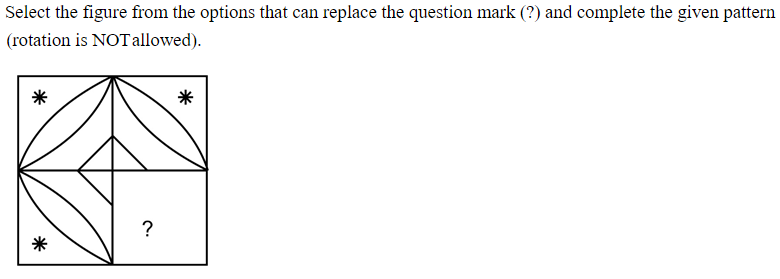
- (a)

- (b)

- (c)

- (d)

Show answer
Answer: (d)
- (a)
3. 6 girls J, K, L, A, B and C are sitting around a square table facing the centre (not necessarily in the same order). 4 girls are sitting in the corners and 2 girls are sitting one each in the middle of two opposite sides of the square. L and C are sitting opposite each other. L is the immediate neighbour of A and B. C is not sitting on the corner. Who are the immediate neighbours of C?
- (a) K and B
- (b) K and A
- (c) J and K
- (d) J and B
Show answer
Answer: (c)
4. In a certain code language, 'TOIR' is coded as '62', and 'HATE' is coded as '34'. How will 'GAYL' be coded in that language?
- (a) 43
- (b) 46
- (c) 45
- (d) 44
Show answer
Answer: (c)
5.
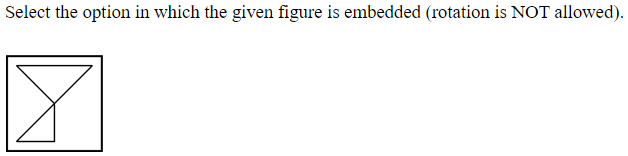
- (a)
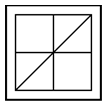
- (b)
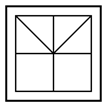
- (c)
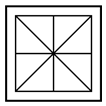
- (d)

Show answer
Answer: (c)
- (a)
6. Two statements are given, followed by two conclusions numbered I and II. Assuming the statements to be true, even if they seem to be at variance with commonly known facts, decide which of the conclusions logically follow(s) from the statements. Statements: All Books are Pens. All Pens are Pencils. Conclusions: I. All Books are Pencils. II. All Pencils are Books.
- (a) Both conclusions I and II follow.
- (b) Only conclusion II follows.
- (c) Only conclusion I follows.
- (d) Neither conclusion I nor II follows.
Show answer
Answer: (c)
7. Read the given statements and conclusions carefully. Assuming that the information given in the statements is true, even if it appears to be at variance with commonly known facts, decide which of the given conclusions logically follow(s) from the statements. Statement I: Some teeth are noses and some noses are hands. Statement II: Some hands are feet. Conclusion I: Some teeth are feet. Conclusion II: All hands are noses.
- (a) Only conclusion I follows.
- (b) Both conclusions I and II follow.
- (c) Only conclusion II follows.
- (d) Neither conclusion I nor II follow.
Show answer
Answer: (d)
8. Select the number from among the given options that can replace the question mark (?) in the following series. 1703, 1668, 1633, 1598, 1563, ?
- (a) 1526
- (b) 1533
- (c) 1528
- (d) 1530
Show answer
Answer: (c)
9. Select the letter-cluster from among the given options that can replace the question mark (?) in the following series. LAS, IYR, FWQ, CUP, ?
- (a) ZSO
- (b) ZSQ
- (c) ZRP
- (d) YSO
Show answer
Answer: (a)
10. In a certain code language, 'This is my brother' is written as 'Bo UvZs Mn', 'That is my dog' is written as 'Zs Pt Uv Ga', 'This is your father' is written as 'Bo Uv Ex Yz'. How will 'brother' be written in that language?
- (a) Zs
- (b) Uv
- (c) Bo
- (d) Mn
Show answer
Answer: (d)
11. Select the set in which the numbers are related in the same way as are the numbers of the following sets. (15, 135, 6)(12, 84, 5)
- (a) (21, 315, 6)
- (b) (9, 89, 3)
- (c) (24, 145, 18)
- (d) (17, 165, 7)
Show answer
Answer: (a)
12. Select the option that is related to the fifth letter-cluster in the same way as the second letter-cluster is related to the first letter-cluster and the fourth letter-cluster is related to the third letter-cluster. ACT : KCD :: EAR : OAB :: EYE : ?
- (a) OZO
- (b) OYE
- (c) OYN
- (d) OYO
Show answer
Answer: (d)
13. In a certain code language, ‘mould soft gel’ is written as ‘8 6 4’, ‘gel is not hard’ is written as ‘pr kc 8 3’ and ‘hard is grey mould’ is written as ‘kc 3 4 9’. How will ‘grey soft’ be written in that language?
- (a) 9 6
- (b) 9 4
- (c) lm 6
- (d) lm 4
Show answer
Answer: (a)
14. In a certain code language, if wall is called door, door is called window, window is called roof, roof is called ventilator and ventilator is called floor, then what makes a way to a room?
- (a) window
- (b) ventilator
- (c) roof
- (d) floor
Show answer
Answer: (a)
15.
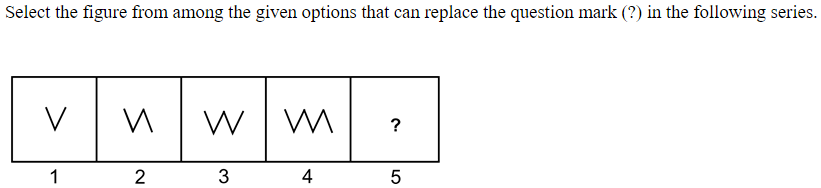
- (a)

- (b)

- (c)

- (d)

Show answer
Answer: (b)
- (a)
16. No two of the six friends U, V, W, X, Y and Z, are of the same height. V is taller than only three other friends. Z is only taller than X. W is shorter than U only. Find who is the third shortest among all the friends.
- (a) U
- (b) Z
- (c) Y
- (d) V
Show answer
Answer: (c)
17. Select the option that is related to the third letter-cluster in the same way as the second letter-cluster is related to the first letter-cluster. GROW : ITQY :: MATE : ?
- (a) OCVH
- (b) OCVG
- (c) OCUG
- (d) OBVG
Show answer
Answer: (b)
18. Select the option that is related to the fifth number in the same way as the second number is related to the first number and the fourth number is related to the third number. 15 : 36 :: 25 : 56 :: 35 : ?
- (a) 86
- (b) 76
- (c) 96
- (d) 66
Show answer
Answer: (b)
19. Which two numbers (not digits) need to be interchanged to make the given equation correct? 10 × 18 + 216 ÷ 5 – 41 = 21
- (a) 216 and 18
- (b) 10 and 41
- (c) 5 and 10
- (d) 18 and 5
Show answer
Answer: (d)
20. What will come in the place of ‘?’ in the following equation, if ‘+’ and ‘ – ‘ are interchanged and also ‘×’ and ‘÷’ are interchanged? 20 × 5 − 10 + 5 ÷ 2 = ?
- (a) 6
- (b) 2
- (c) 4
- (d) 8
Show answer
Answer: (c)
21.
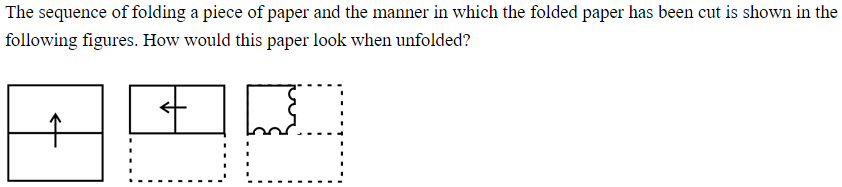
- (a)
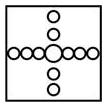
- (b)
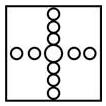
- (c)
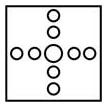
- (d)
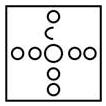
Show answer
Answer: (c)
- (a)
22. Select the option that is related to the fifth letter-cluster in the same way as the second letter-cluster is related to the first letter-cluster and the fourth letter-cluster is related to the third letter-cluster. MARS : NLBZSQTR :: PLUTO : QOMKVTUSPN :: EARTH : ?
- (a) FDBZSQUSIG
- (b) QUIESEDILA
- (c) FDZBQSSUIG
- (d) QOSFDDIUAS
Show answer
Answer: (a)
23.
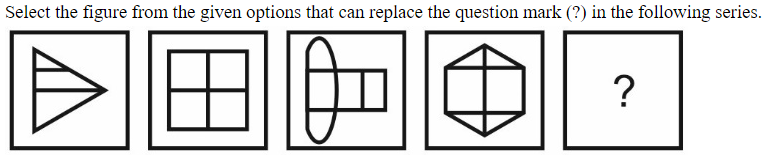
- (a)

- (b)

- (c)

- (d)

Show answer
Answer: (b)
- (a)
24. Six people Sumit, Aamish, Saif, Ashutosh, Anubhav and Piyush are sitting in a straight row facing North. Only one person was sitting left to Piyush. Aamish is not sitting in either corner. Anubhav is sitting immediate left to Saif. Only one person is sitting in between Piyush and Ashutosh. Who is sitting to the immediate left of Ashutosh?
- (a) Saif
- (b) Sumit
- (c) Aamish
- (d) Anubhav
Show answer
Answer: (c)
25. Which number will replace the question mark (?) in the following series? 819, 829, 840, 852, ?
- (a) 864
- (b) 858
- (c) 880
- (d) 865
Show answer
Answer: (d)
Numerical Aptitude
1.

- (a)

- (b)

- (c)

- (d)

Show answer
Answer: (c)
- (a)
2.

- (a)

- (b)

- (c)

- (d)

Show answer
Answer: (c)
- (a)
3.

- (a)

- (b)

- (c)

- (d)

Show answer
Answer: (d)
- (a)
4.

- (a)

- (b)

- (c)

- (d)

Show answer
Answer: (a)
- (a)
5.

- (a)

- (b)

- (c)

- (d)

Show answer
Answer: (a)
- (a)
6.

- (a)

- (b)

- (c)

- (d)

Show answer
Answer: (a)
- (a)
7.

- (a)

- (b)

- (c)

- (d)

Show answer
Answer: (b)
- (a)
11.

- (a)

- (b)

- (c)

- (d)

Show answer
Answer: (c)
- (a)
12.
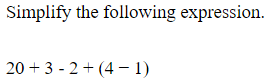
- (a)

- (b)

- (c)

- (d)

Show answer
Answer: (b)
- (a)
13.

- (a)

- (b)

- (c)

- (d)

Show answer
Answer: (b)
- (a)
14.
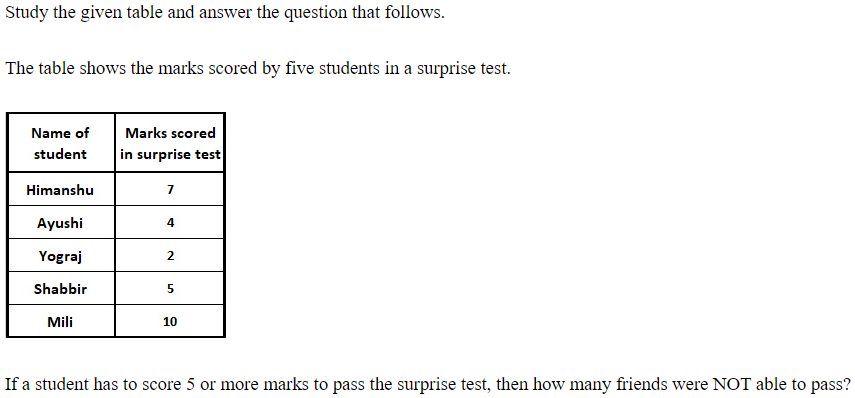
- (a)

- (b)

- (c)

- (d)

Show answer
Answer: (b)
- (a)
15.

- (a)

- (b)

- (c)

- (d)

Show answer
Answer: (a)
- (a)
17.

- (a)

- (b)

- (c)

- (d)

Show answer
Answer: (d)
- (a)
19.
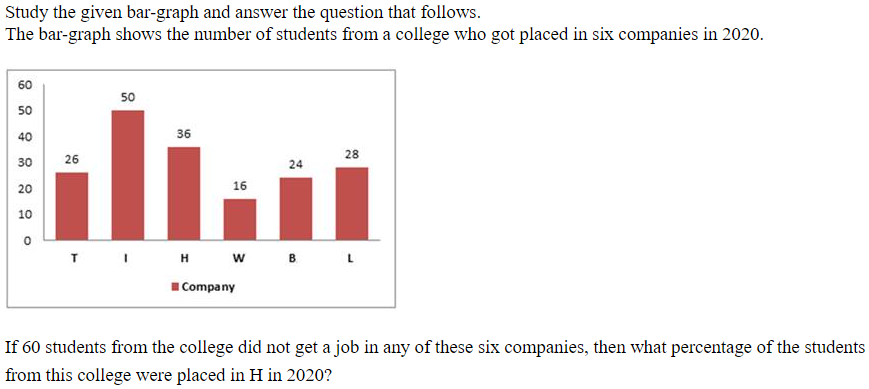
- (a)

- (b)

- (c)

- (d)

Show answer
Answer: (d)
- (a)
20.

- (a)

- (b)

- (c)

- (d)

Show answer
Answer: (b)
- (a)
21.

- (a)

- (b)

- (c)

- (d)

Show answer
Answer: (a)
- (a)
22.

- (a)

- (b)

- (c)

- (d)

Show answer
Answer: (c)
- (a)
23.

- (a)

- (b)

- (c)

- (d)

Show answer
Answer: (d)
- (a)
24.

- (a)

- (b)

- (c)

- (d)

Show answer
Answer: (a)
- (a)
25.

- (a)

- (b)

- (c)

- (d)

Show answer
Answer: (b)
- (a)
General Awareness
2. What is the chemical name of battery acid?
- (a) Sulfuric acid
- (b) Barium sulphate
- (c) Hypochlorous acid
- (d) Boric acid
Show answer
Answer: (a)
3. Who took oath as Chief Minister of Uttar Pradesh for the second consecutive term in March 2022?
- (a) Harish Rawat
- (b) Yogi Adityanath
- (c) Akhilesh Yadav
- (d) Mohan Prakash
Show answer
Answer: (b)
4. Harishena was a court poet of ______.
- (a) Bindusara
- (b) Samudragupta
- (c) Bimbisara
- (d) Ashoka
Show answer
Answer: (b)
5. Which of the following separates Little Andaman from South Andaman of India?
- (a) Amindivi Islands
- (b) Duncan passage
- (c) Reunion Hotspot
- (d) Minicoy island
Show answer
Answer: (b)
6. Amit wants to contest for Lok Sabha elections in India. What is the maximum limit of constituencies that he can contest?
- (a) Infinite
- (b) Two
- (c) Three
- (d) One
Show answer
Answer: (b)
7. Which of the following Articles of the Indian Constitution states about the application of the Directive Principles?
- (a) 37
- (b) 45
- (c) 42
- (d) 31
Show answer
Answer: (a)
8. Which of the following is the largest stupa in India?
- (a) Kesariya
- (b) Dhamekh
- (c) Amaravati
- (d) Bharhut
Show answer
Answer: (a)
9. Which of the following political parties led the Punjabi Suba movement in India?
- (a) Bharatiya Janata Party
- (b) Ghadar Party
- (c) Shiromani Akali Dal
- (d) Indian National Congress
Show answer
Answer: (c)
10. Which player won the Man of the Series award for cricket test series on the Sri Lanka tour of India, 2022?
- (a) KL Rahul
- (b) Rishabh Pant
- (c) Shreyas Iyer
- (d) Rohit Sharma
Show answer
Answer: (b)
11. With which musical instrument was Ali Akbar Khan associated?
- (a) Sarangi
- (b) Manjira
- (c) Sarod
- (d) Veena
Show answer
Answer: (c)
12. Which of the following acids is found in spinach?
- (a) Formic acid
- (b) Lactic acid
- (c) Citric acid
- (d) Oxalic acid
Show answer
Answer: (d)
13. Who among the following is the first Odissi dancer from Odisha to have received the ‘Padma Vibhushan’ in the year 2000?
- (a) Rukmini Devi Arundale
- (b) Kelucharan Mohapatra
- (c) Uday Shankar
- (d) Ileana Citaristi
Show answer
Answer: (b)
14. As of March 2022, which of the following is the highest motorable pass in India?
- (a) Umling La
- (b) Chang-La
- (c) Lanak La
- (d) Khardung La
Show answer
Answer: (d)
15. The Constitution (Scheduled Tribes) Order (Amendment) Bill, 2022, was introduced in Lok Sabha on 7 February 2022 by ____________.
- (a) Arjun Munda
- (b) Ramesh Bidhuri
- (c) Amit Shah
- (d) Rajnath Singh
Show answer
Answer: (a)
16. Which of the given statements is correct? I. When Alivardi Khan died in 1756, Siraj-ud-daulah became the nawab of Bengal. II. In 1757, Robert Clive led the company’s army against Siraj-ud-daulah at Plassey.
- (a) Only II
- (b) Neither I nor II
- (c) Only I
- (d) Both I and II
Show answer
Answer: (d)
17. Before being replaced by NITI Aayog, which organisation was responsible for collecting data about unemployment using Lakdawala Formula?
- (a) Pay Commission
- (b) Finance Commission
- (c) Labour Commission
- (d) Planning Commission
Show answer
Answer: (d)
18. Hojagiri is a folk dance of which state of India?
- (a) Goa
- (b) Karnataka
- (c) Tripura
- (d) Uttar Pradesh
Show answer
Answer: (c)
19. The headquarters of the Eastern Railway Zone is located at ___________.
- (a) Kolkata
- (b) Bhubaneswar
- (c) Patna
- (d) Durgapur
Show answer
Answer: (a)
20. According to the 2011 Census of India, which state is the least populous state in the country?
- (a) Jharkhand
- (b) Sikkim
- (c) Assam
- (d) Bihar
Show answer
Answer: (b)
21. Mahavir Jayanti is celebrated in the month of __________.
- (a) May
- (b) April
- (c) September
- (d) December
Show answer
Answer: (b)
22. Which of the following is an Indian martial art that originated in modern-day Kerala?
- (a) Kalaripayattu
- (b) Muay Thai
- (c) Karate
- (d) Gatka
Show answer
Answer: (a)
23. Raziya Sultan was the daughter of __________.
- (a) Babur
- (b) Qutubuddin Aibak
- (c) Iltutmish
- (d) Akbar
Show answer
Answer: (c)
24. ______ was established in 1948 with 23 countries as a global trade organisation to administer all multilateral trade agreements.
- (a) World Trade Organization
- (b) International Reciprocal Trade Association
- (c) General Agreement on Tariffs and Trade
- (d) World Chamber of Commerce
Show answer
Answer: (c)
25. ________ is a technique in which cancer cells are damaged with radiations, while limiting the harm to nearby healthy tissue.
- (a) Radiotherapy
- (b) Physiotherapy
- (c) Surgery
- (d) Chemotherapy
Show answer
Answer: (a)
Show answers
Answer key
Answer key as marked in the Staff Selection Commission’s response sheet. “—” means the sheet did not show it clearly.
General English
- Q 1
- (d)
- Q 2
- (b)
- Q 3
- (c)
- Q 4
- (a)
- Q 5
- (b)
- Q 6
- (a)
- Q 7
- (c)
- Q 8
- (b)
- Q 9
- (b)
- Q 10
- (b)
- Q 11
- (a)
- Q 12
- (a)
- Q 13
- (b)
- Q 14
- (a)
- Q 15
- (d)
- Q 16
- (d)
- Q 17
- (c)
- Q 18
- (a)
- Q 19
- (b)
- Q 20
- (a)
- Q 21
- (c)
- Q 22
- (c)
- Q 23
- (b)
- Q 24
- (d)
- Q 25
- (b)
General Intelligence and Reasoning
- Q 1
- (c)
- Q 2
- (d)
- Q 3
- (c)
- Q 4
- (c)
- Q 5
- (c)
- Q 6
- (c)
- Q 7
- (d)
- Q 8
- (c)
- Q 9
- (a)
- Q 10
- (d)
- Q 11
- (a)
- Q 12
- (d)
- Q 13
- (a)
- Q 14
- (a)
- Q 15
- (b)
- Q 16
- (c)
- Q 17
- (b)
- Q 18
- (b)
- Q 19
- (d)
- Q 20
- (c)
- Q 21
- (c)
- Q 22
- (a)
- Q 23
- (b)
- Q 24
- (c)
- Q 25
- (d)
Numerical Aptitude
- Q 1
- (c)
- Q 2
- (c)
- Q 3
- (d)
- Q 4
- (a)
- Q 5
- (a)
- Q 6
- (a)
- Q 7
- (b)
- Q 11
- (c)
- Q 12
- (b)
- Q 13
- (b)
- Q 14
- (b)
- Q 15
- (a)
- Q 17
- (d)
- Q 19
- (d)
- Q 20
- (b)
- Q 21
- (a)
- Q 22
- (c)
- Q 23
- (d)
- Q 24
- (a)
- Q 25
- (b)
General Awareness
- Q 2
- (a)
- Q 3
- (b)
- Q 4
- (b)
- Q 5
- (b)
- Q 6
- (b)
- Q 7
- (a)
- Q 8
- (a)
- Q 9
- (c)
- Q 10
- (b)
- Q 11
- (c)
- Q 12
- (d)
- Q 13
- (b)
- Q 14
- (d)
- Q 15
- (a)
- Q 16
- (d)
- Q 17
- (d)
- Q 18
- (c)
- Q 19
- (a)
- Q 20
- (b)
- Q 21
- (b)
- Q 22
- (a)
- Q 23
- (c)
- Q 24
- (c)
- Q 25
- (a)