ExamBharo · SSC MTS 2021 — 26 July 2022, Shift 2 · exambharo.com/ssc-mts/previous-year-papers/ssc-mts-2021-26-jul-shift-2/
Question paper · SSC MTS & Havaldar
SSC MTS 2021 — 26 July 2022, Shift 2
26 July 2022 · 1:00 PM–2:30 PM92 of the paper’s 100 questions1 per correct answer
Questions from the Staff Selection Commission’s paper of 26 July 2022, 1:00 PM–2:30 PM.
Preparing for SSC MTS & Havaldar? Get more, free
Daily previous-year questions as quizzes, and every SSC MTS & Havaldar notice the day it is out.
General English
1. Select the most appropriate meaning of the underlined idiom in the given sentence. I tried to tell him to think of the good times, that every cloud has a silver lining.
- (a) Doing something with thoroughness and passion
- (b) Don’t cry over what has happened as it cannot be fixed
- (c) Treat people the same way as you want to be treated
- (d) Every difficult situation has a hopeful aspect to it
Show answer
Answer: (d)
2. Select the most appropriate synonym of the given word. Expository
- (a) Illustrative
- (b) Temperamental
- (c) Obligatory
- (d) Dubious
Show answer
Answer: (a)
3. Select the most appropriate option to fill in the blank. The first printed ______ of this book came in 1933.
- (a) excretion
- (b) insertion
- (c) addition
- (d) edition
Show answer
Answer: (d)
4. Select the most appropriate meaning of the given idiom. Pull someone’s legs
- (a) To tease someone
- (b) To protect someone
- (c) To wish someone luck
- (d) To make someone angry
Show answer
Answer: (a)
5. Select the option that can be used as a one-word substitute for the given group of words. A person who produces beautiful handwriting
- (a) stenographer
- (b) Philosopher
- (c) Calligrapher
- (d) Typographer
Show answer
Answer: (c)
6. Select the most appropriate ANTONYM of the underlined word. He certainly failed to console the new king.
- (a) Agitate
- (b) Coordinate
- (c) Satiate
- (d) Gratify
Show answer
Answer: (a)
7. Select the correctly spelt word.
- (a) Simultanous
- (b) Simultenaous
- (c) Simultaneous
- (d) Simulteneous
Show answer
Answer: (c)
8. The following sentence has been divided into parts. One of them may contain an error. Select the part that contains the error from the given options. If you don’t find any error, mark ‘No error’ as your answer. His successful as a lawyer / grew so fast that he soon had / enough money to buy a house.
- (a) No error
- (b) grew so fast that he soon had
- (c) enough money to buy a house
- (d) His successful as a lawyer
Show answer
Answer: (d)
9. Select the option that can be used as a one-word substitute for the given group of words. A state of perfect balance
- (a) Equilibrium
- (b) Extempore
- (c) Medieval
- (d) Irrelevant
Show answer
Answer: (a)
10. Select the most appropriate ANTONYM of the given word. Admirable
- (a) Blameworthy
- (b) Practical
- (c) Reasonable
- (d) Tolerant
Show answer
Answer: (a)
11. Parts of the following sentence have been given as options. One of them may contain an error. Select the part that contains the error from the given options. If you don’t find any error, mark ‘No error’ as your answer. My sister called me for my lunch hours to tell me that she was getting married.
- (a) was getting married
- (b) No error
- (c) My sister called me for my
- (d) lunch hours to tell me that she
Show answer
Answer: (c)
12. Select the option that will improve the underlined part of the given sentence. In case no improvement is needed, select 'No improvement required'. The enemies have cross the border, treading the soil on which they are to be conquered.
- (a) No improvement required
- (b) have crossed
- (c) has crossed
- (d) have crossing
Show answer
Answer: (b)
13. Select the correctly spelt word.
- (a) Interview
- (b) Intrvew
- (c) Intreview
- (d) Interveiw
Show answer
Answer: (a)
14. Select the most appropriate option to fill in the blank. Consumers are not ready to purchase this citrus fruit at such a ______ price.
- (a) higher
- (b) highest
- (c) highly
- (d) high
Show answer
Answer: (d)
15. The following sentence has been divided into parts. One of them may contain an error. Select the part that contains the error from the given options. If you don’t find any error, mark ‘No error’ as your answer. Other South African cities only / had one venue for staging exhibitions or / internationals events at highly standard.
- (a) No error
- (b) internationals events at highly standard
- (c) Other South African cities only
- (d) had one venue for staging exhibitions or
Show answer
Answer: (b)
16. Select the most appropriate option to fill in the blank. I ______ home before she arrived.
- (a) left
- (b) had left
- (c) has left
- (d) have left
Show answer
Answer: (b)
17. Select the most appropriate synonym of the given word. Sparkling
- (a) Dismal
- (b) Muffled
- (c) Gleaming
- (d) Unexciting
Show answer
Answer: (c)
18. Select the most appropriate option to fill in the blank. Please don’t ______ anyone that I came to your birthday party.
- (a) told
- (b) said
- (c) tell
- (d) say
Show answer
Answer: (c)
19. Select the most appropriate ANTONYM of the given word. Seclude
- (a) Blink
- (b) socialize
- (c) Confine
- (d) Isolate
Show answer
Answer: (b)
20. Select the most appropriate option to fill in the blank. A sustained decline in Chinese consumption would be even more ______ than the current US-China trade dispute.
- (a) worrying
- (b) imagining
- (c) delaying
- (d) mobilising
Show answer
Answer: (a)
PassageFor questions 21–25
In the following passage, some words have been deleted. Read the passage carefully and select the most appropriate option to fill in each blank.
In a significant find, the Epigraphy Branch of the Archaeological Survey of India (1) ______ discovered the earliest epigraphic evidence so far for the Saptamatrika cult. It is also (2) ______ earliest Sanskrit inscription to have been discovered (3) ______ South India as of date. Saptamatrikas are a group of seven female deities worshipped in Hinduism as personifying the energy of their respective consorts. The inscription is in Sanskrit and in Brahmi characters and was (4) ______ by Satavahana King Vijaya in 207 A.D. The inscription came to light when some local villagers informed the authorities of the presence of a pillar with some engravings when they were restoring and (5) ______ the local Bheemeshwara temple.
21. Select the most appropriate option to fill in blank number 1.
- (a) have
- (b) has
- (c) is
- (d) are
Show answer
Answer: (b)
22. Select the most appropriate option to fill in blank number 2.
- (a) an
- (b) the
- (c) a
- (d) one
Show answer
Answer: (b)
23. Select the most appropriate option to fill in blank number 3.
- (a) upon
- (b) on
- (c) In
- (d) at
Show answer
Answer: (c)
24. Select the most appropriate option to fill in blank number 4.
- (a) refused
- (b) chased
- (c) issued
- (d) denied
Show answer
Answer: (c)
25. Select the most appropriate option to fill in blank number 5.
- (a) repairing
- (b) removing
- (c) healing
- (d) praying
Show answer
Answer: (a)
General Intelligence and Reasoning
1. Select the number from among the given options that can replace the question mark (?) in the following series. 864, 432, 216, 108,?
- (a) 72
- (b) 36
- (c) 54
- (d) 12
Show answer
Answer: (c)
2. In a certain code language, 'PAR' is coded as ‘35' and 'GAT' is coded as ‘28'. How will 'FOM' be coded in that language?
- (a) 33
- (b) 34
- (c) 35
- (d) 32
Show answer
Answer: (b)
3. Select the option that is related to the fifth number in the same way as the second number is related to the first number and the fourth number is related to the third number. 25 : 125 :: 32 : 160 :: 73 : ?
- (a) 383
- (b) 195
- (c) 365
- (d) 173
Show answer
Answer: (c)
4. Select the option in which the numbers are related in the same way as are the numbers of the following sets. (36, 2, 3)(108, 6, 3)
- (a) (120, 5, 5)
- (b) (48, 4, 2)
- (c) (102, 3, 6)
- (d) (28, 4, 2)
Show answer
Answer: (b)
5. Select the option that is related to the fifth letter-cluster in the same way as the second letter-cluster is related to the first letter-cluster and the fourth letter-cluster is related to the third letter-cluster. CET : ZBQ :: KVO : HSL :: QRS : ?
- (a) NPS
- (b) NOP
- (c) NPO
- (d) NOS
Show answer
Answer: (b)
6.

- (a)
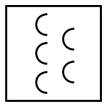
- (b)
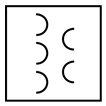
- (c)

- (d)

Show answer
Answer: (d)
- (a)
7. Read the given statements and conclusions carefully. Assuming that the information given in the statements is true, even if it appears to be at variance with commonly known facts, decide which of the given conclusions logically follow(s) from the statements. Statement I: An IT employee working in XYZ company has two children. Statement II: No other employee in XYZ has two children. Conclusion I: Every employee in the company has at least one child. Conclusion II: Some of the employees have more than two children.
- (a) Only conclusion II follows.
- (b) Only conclusion I follows.
- (c) Neither conclusion I nor II follow.
- (d) Both conclusions I and II follow.
Show answer
Answer: (c)
8.
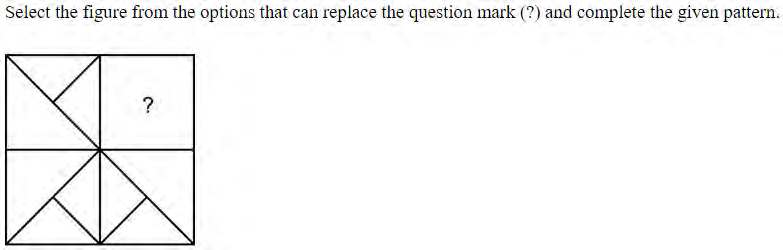
- (a)

- (b)

- (c)

- (d)

Show answer
Answer: (b)
- (a)
9. What will be the value of the following expression, if ‘+’ and ‘×’ are interchanged and ‘−’ and ‘÷’ are interchanged? 8 × 10 + 3 − 5 ÷ 6 = ?
- (a) 4
- (b) 6
- (c) 12
- (d) 8
Show answer
Answer: (d)
10.
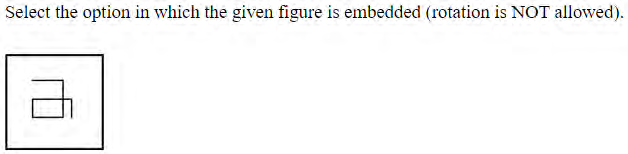
- (a)
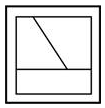
- (b)
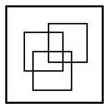
- (c)

- (d)
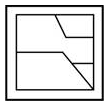
Show answer
Answer: (b)
- (a)
11. Select the option in which the pair of letter-clusters share the same relationship as that shared by the given letter-clusters. RS : IH
- (a) TM : GN
- (b) BX : CY
- (c) RS : IT
- (d) AJ : ZK
Show answer
Answer: (a)
12. Select the number from among the given options that can replace the question mark (?) in the following series. 72, 66, 63, 57, 54, 48, ?
- (a) 58
- (b) 39
- (c) 45
- (d) 43
Show answer
Answer: (c)
13. In a certain code language, 'SEAT' is written as '2' and 'CHARGE' is written as '4'. How will 'ONLINE' be written in that language?
- (a) 3
- (b) 6
- (c) 2
- (d) 5
Show answer
Answer: (a)
14. Six friends, Kushal, Keshav, Kishan, Kamal, Kanan and Kishore, are of different heights. Keshav is taller than only three other friends. Kishore is taller than Kamal only. Kishan is shorter than Kushal only.Who is the third shortest among all the friends?
- (a) Kushal
- (b) Keshav
- (c) Kishore
- (d) Kanan
Show answer
Answer: (d)
15.
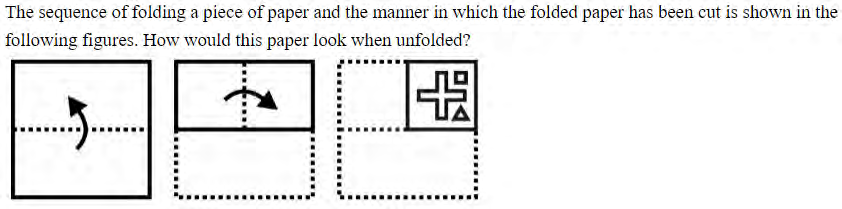
- (a)

- (b)

- (c)

- (d)

Show answer
Answer: (c)
- (a)
16. Five men O1, O2, O3, O4 and O5 are sitting around a circular table facing opposite to the centre (not necessarily in the same order). Only one man is sitting between O4 and O5 in clockwise direction. Only one man is sitting between O3 and O4 in clockwise direction. O1 is sitting to the immediate left of O3. Who is sitting third from the left of O2?
- (a) O5
- (b) O3
- (c) O1
- (d) O4
Show answer
Answer: (c)
17. In a certain code language, '254' means 'You are intelligent', '153' means 'Nikhil is intelligent', '398' means 'Naina and Nikhil', then what is the code for 'is' in the same code language?
- (a) 1
- (b) 3
- (c) 5
- (d) 8
Show answer
Answer: (a)
18. Read the given statements and conclusions carefully. Assuming that the information given in the statements is true, even if it appears to be at variance with commonly known facts, decide which of the given conclusions logically follow(s) from the statements. Statements: Some peas are pineapples. No pineapple is a broccoli. All broccolis are potatoes. Conclusions: I. Some peas being potatoes is a possibility. II. All pineapples being potatoes is a possibility.
- (a) Only conclusion I follows
- (b) Both conclusions I and II follow
- (c) Only conclusion II follows
- (d) Neither conclusion I nor II follows
Show answer
Answer: (b)
19.

- (a)
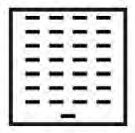
- (b)

- (c)
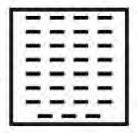
- (d)

Show answer
Answer: (b)
- (a)
20. Select the letter-cluster from among the given options that can replace the question mark (?) in the following series. GA, MU, SO, ?, EC
- (a) ZI
- (b) ZJ
- (c) YI
- (d) YJ
Show answer
Answer: (c)
21. In a certain code language, ‘pinch of salt grey’ is written as ‘ab tr # kp’, ‘grey colour is black’ is written as ‘# jm bk if’ and ‘colour are of track’ is written as ‘gt if ab fr’. How will ‘grey of’ be written in that language?
- (a) ab #
- (b) gt #
- (c) ab if
- (d) gt fr
Show answer
Answer: (a)
22. By interchanging the two signs ÷ and + and two numbers 9 and 12 (NOT digits), which of the following equations will NOT be correct? I. 12 × 2 – 72 + 9 ÷ 57 = 69 II. 169 + 13 × 12 ÷ 3 – 9 = 108
- (a) Neither I nor II
- (b) Both I and II
- (c) Only II
- (d) Only I
Show answer
Answer: (a)
23.
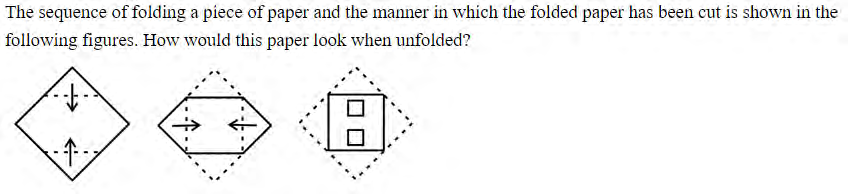
- (a)

- (b)

- (c)

- (d)

Show answer
Answer: (b)
- (a)
24. Ajay, Priti, Rakesh, Mehak, Saloni and Yogesh are sitting in a row facing north. Saloni and Yogesh are sitting in the centre. Ajay and Priti are at the ends. Rakesh is sitting to the immediate left of Ajay.Who is sitting to the immediate right of Priti?
- (a) Yogesh
- (b) Saloni
- (c) Mehak
- (d) Rakesh
Show answer
Answer: (c)
25. Select the option that is related to the fifth word in the same way as the second word is related to the first word and the fourth word is related to the third word. Vehicle : Car :: Food : Pizza :: Crockery : ?
- (a) Language
- (b) Plate
- (c) Table
- (d) Stove
Show answer
Answer: (b)
Numerical Aptitude
1.

- (a)

- (b)

- (c)

- (d)

Show answer
Answer: (d)
- (a)
2.
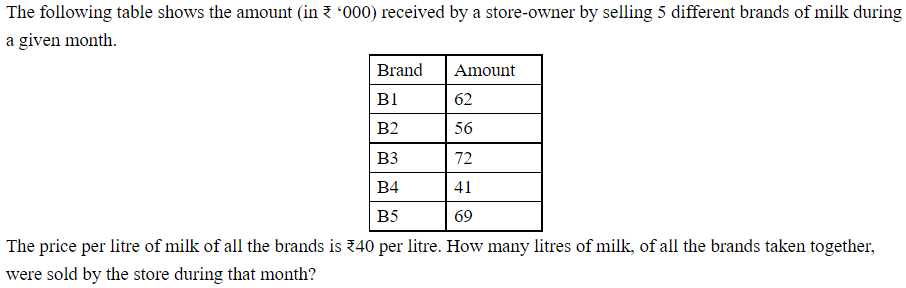
- (a)

- (b)

- (c)

- (d)

Show answer
Answer: (b)
- (a)
3.
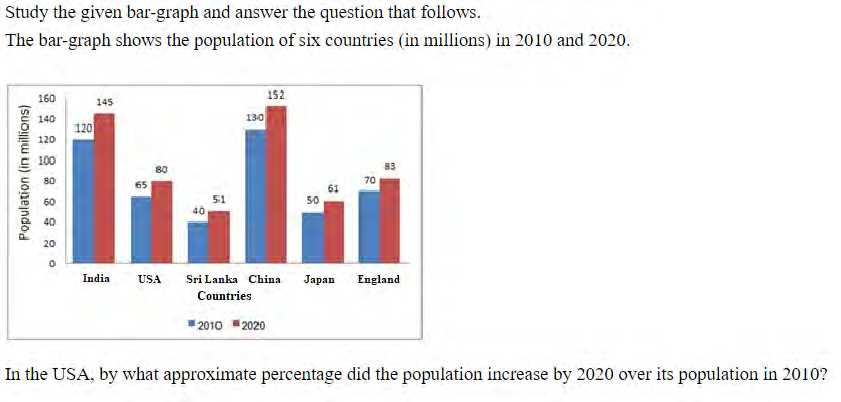
- (a)

- (b)

- (c)

- (d)

Show answer
Answer: (b)
- (a)
5.

- (a)

- (b)

- (c)

- (d)

Show answer
Answer: (d)
- (a)
9.

- (a)

- (b)

- (c)

- (d)

Show answer
Answer: (b)
- (a)
10.

- (a)

- (b)

- (c)

- (d)

Show answer
Answer: (d)
- (a)
11.

- (a)

- (b)

- (c)

- (d)

Show answer
Answer: (c)
- (a)
12.

- (a)

- (b)

- (c)

- (d)

Show answer
Answer: (d)
- (a)
13.

- (a)

- (b)

- (c)

- (d)

Show answer
Answer: (a)
- (a)
14.

- (a)

- (b)

- (c)

- (d)

Show answer
Answer: (d)
- (a)
17.

- (a)

- (b)

- (c)

- (d)

Show answer
Answer: (b)
- (a)
18.

- (a)

- (b)

- (c)

- (d)

Show answer
Answer: (a)
- (a)
19.

- (a)

- (b)

- (c)

- (d)

Show answer
Answer: (d)
- (a)
20.

- (a)

- (b)

- (c)

- (d)

Show answer
Answer: (b)
- (a)
21.

- (a)

- (b)

- (c)

- (d)

Show answer
Answer: (a)
- (a)
22.

- (a)

- (b)

- (c)

- (d)

Show answer
Answer: (b)
- (a)
23.

- (a)

- (b)

- (c)

- (d)

Show answer
Answer: (c)
- (a)
General Awareness
1. ____________, popularly known as Punjab Kesari took his last breath on November 17th, 1928
- (a) Dadabhai Naoroji
- (b) Swami Vivekananda
- (c) Lala Lajpat Rai
- (d) Bal Gangadhar Tilak
Show answer
Answer: (c)
2. Which of the following Constitutional Amendment incorporated Dadra, Nagar and Haveli in the Union of India as a Union Territory?
- (a) 19th
- (b) 14th
- (c) 12th
- (d) 10th
Show answer
Answer: (d)
3. Guru Bipin Singh received ‘Sangeet Natak Akademi Award’ in the year 1966. He was a teacher of _______ dance.
- (a) Manipuri
- (b) Kathak
- (c) Odissi
- (d) Bharatanatyam
Show answer
Answer: (a)
4. Smart cities and Academia Towards Action and Research (SAAR) scheme was launched by the ______.
- (a) Ministry of Commerce and Industry
- (b) Ministry of Culture
- (c) Ministry of Housing and Urban Affairs
- (d) Ministry of External Affairs
Show answer
Answer: (c)
5. In which state of India is the Moatsu festival celebrated every year?
- (a) Tamil Nadu
- (b) Karnataka
- (c) Nagaland
- (d) Jharkhand
Show answer
Answer: (c)
6. Which of the following pair of ‘Name of Ruler – Empire’ is correctly matched? I. Mahapadma Nanda – Magadha Empire II. Ajatasattu – Maurya Empire
- (a) Only II
- (b) Neither I nor II
- (c) Both I and II
- (d) Only I
Show answer
Answer: (d)
7. How many types of igneous rocks are there?
- (a) Four
- (b) Two
- (c) Six
- (d) Five
Show answer
Answer: (b)
8. Which of the following terms is NOT associated with hockey?
- (a) Scoop
- (b) Flick
- (c) Hit
- (d) Run out
Show answer
Answer: (d)
9. In which state of India is the Gulbarga Fort situated?
- (a) Karnataka
- (b) Himachal Pradesh
- (c) Assam
- (d) Uttar Pradesh
Show answer
Answer: (a)
10. Which of the following formulas is correct for Gross Value Added?
- (a) Gross Value Added = Gross National Product – Subsidies + Taxes
- (b) Gross Value Added = Gross Domestic Product – Subsidies + Taxes
- (c) Gross Value Added = Gross National Product + Subsidies – Taxes
- (d) Gross Value Added = Gross Domestic Product + Subsidies – Taxes
Show answer
Answer: (d)
11. ______ is used to get rid of indigestion.
- (a) Antibiotic
- (b) Analgesic
- (c) Antiseptic
- (d) Antacid
Show answer
Answer: (d)
12. Which of the following countries had a higher average population density than India in 2020 as per Food and Agriculture Organization and World Bank population estimates?
- (a) Russia
- (b) Sri Lanka
- (c) Bangladesh
- (d) China
Show answer
Answer: (c)
13. ‘Waiting for a Visa’ is a 20-page autobiography written by _____________.
- (a) Ram Mohan Roy
- (b) Jawaharlal Nehru
- (c) Bhimrao Ramji Ambedkar
- (d) Mahatma Gandhi
Show answer
Answer: (c)
14. AR Rahman won the Grammy Awards for which movie?
- (a) Slumdog Millionaire
- (b) Roja
- (c) Lagaan
- (d) Dil Se
Show answer
Answer: (a)
15. Shovana Narayan is associated with which classical dance of India?
- (a) Sattriya
- (b) Mohiniyattam
- (c) Kathak
- (d) Bharatnatyam
Show answer
Answer: (c)
16. Which Constitutional Amendment Act included Fundamental Duties in the Indian Constitution?
- (a) Twenty-second Amendment Act
- (b) Forty-second Amendment Act
- (c) Fifty-second Amendment Act
- (d) Thirty-second Amendment Act
Show answer
Answer: (b)
17. Queen Rudramadevi belonged to which dynasty of India?
- (a) Chola
- (b) Kakatiya
- (c) Chalukya
- (d) Chera
Show answer
Answer: (b)
18. The SI unit of work is ______.
- (a) Decibel
- (b) Joule
- (c) Pascal
- (d) Hertz
Show answer
Answer: (b)
19. Which of the following is a rabi crop?
- (a) Groundnut
- (b) Maize
- (c) Paddy
- (d) Gram
Show answer
Answer: (d)
20. Which of the following persons was conferred with the 57th Jnanpith Award?
- (a) Krishna Sobti
- (b) Damodar Mauzo
- (c) Kedarnath Singh
- (d) Amitav Ghosh
Show answer
Answer: (b)
21. The distribution of the population according to different types of occupation is known as __________.
- (a) occupational structure
- (b) age composition
- (c) adolescent population
- (d) migration
Show answer
Answer: (a)
22. _______________ is commonly known as imperfect fungi because only the asexual or vegetative phases of these fungi are known.
- (a) Phycomycetes
- (b) Basidiomycetes
- (c) Deuteromycetes
- (d) Ascomycetes
Show answer
Answer: (c)
23. ______________ is broadly divided into Western Ghats and Eastern Ghats.
- (a) Himalayan mountains
- (b) Northern plains
- (c) Deccan plateau
- (d) Central highlands
Show answer
Answer: (c)
24. When Alivardi Khan died in 1756, ______ became the nawab of Bengal.
- (a) Mir Jafar
- (b) Siraj-ud-daulah
- (c) Murshed Quli Khan
- (d) Mir Qasim
Show answer
Answer: (b)
25. Which Indian Olympian is associated with golf?
- (a) Abhinav Bindra
- (b) Neeraj Chopra
- (c) Ravi Kumar Dahiya
- (d) Aditi Ashok
Show answer
Answer: (d)
Show answers
Answer key
Answer key as marked in the Staff Selection Commission’s response sheet. “—” means the sheet did not show it clearly.
General English
- Q 1
- (d)
- Q 2
- (a)
- Q 3
- (d)
- Q 4
- (a)
- Q 5
- (c)
- Q 6
- (a)
- Q 7
- (c)
- Q 8
- (d)
- Q 9
- (a)
- Q 10
- (a)
- Q 11
- (c)
- Q 12
- (b)
- Q 13
- (a)
- Q 14
- (d)
- Q 15
- (b)
- Q 16
- (b)
- Q 17
- (c)
- Q 18
- (c)
- Q 19
- (b)
- Q 20
- (a)
- Q 21
- (b)
- Q 22
- (b)
- Q 23
- (c)
- Q 24
- (c)
- Q 25
- (a)
General Intelligence and Reasoning
- Q 1
- (c)
- Q 2
- (b)
- Q 3
- (c)
- Q 4
- (b)
- Q 5
- (b)
- Q 6
- (d)
- Q 7
- (c)
- Q 8
- (b)
- Q 9
- (d)
- Q 10
- (b)
- Q 11
- (a)
- Q 12
- (c)
- Q 13
- (a)
- Q 14
- (d)
- Q 15
- (c)
- Q 16
- (c)
- Q 17
- (a)
- Q 18
- (b)
- Q 19
- (b)
- Q 20
- (c)
- Q 21
- (a)
- Q 22
- (a)
- Q 23
- (b)
- Q 24
- (c)
- Q 25
- (b)
Numerical Aptitude
- Q 1
- (d)
- Q 2
- (b)
- Q 3
- (b)
- Q 5
- (d)
- Q 9
- (b)
- Q 10
- (d)
- Q 11
- (c)
- Q 12
- (d)
- Q 13
- (a)
- Q 14
- (d)
- Q 17
- (b)
- Q 18
- (a)
- Q 19
- (d)
- Q 20
- (b)
- Q 21
- (a)
- Q 22
- (b)
- Q 23
- (c)
General Awareness
- Q 1
- (c)
- Q 2
- (d)
- Q 3
- (a)
- Q 4
- (c)
- Q 5
- (c)
- Q 6
- (d)
- Q 7
- (b)
- Q 8
- (d)
- Q 9
- (a)
- Q 10
- (d)
- Q 11
- (d)
- Q 12
- (c)
- Q 13
- (c)
- Q 14
- (a)
- Q 15
- (c)
- Q 16
- (b)
- Q 17
- (b)
- Q 18
- (b)
- Q 19
- (d)
- Q 20
- (b)
- Q 21
- (a)
- Q 22
- (c)
- Q 23
- (c)
- Q 24
- (b)
- Q 25
- (d)