ExamBharo · SSC MTS 2021 — 14 July 2022, Shift 1 · exambharo.com/ssc-mts/previous-year-papers/ssc-mts-2021-14-jul-shift-1/
Question paper · SSC MTS & Havaldar
SSC MTS 2021 — 14 July 2022, Shift 1
14 July 2022 · 9:00 AM–10:30 AM91 of the paper’s 100 questions1 per correct answer
Questions from the Staff Selection Commission’s paper of 14 July 2022, 9:00 AM–10:30 AM.
Preparing for SSC MTS & Havaldar? Get more, free
Daily previous-year questions as quizzes, and every SSC MTS & Havaldar notice the day it is out.
General English
1. Select the most appropriate synonym of the given word. Bulky
- (a) Airy
- (b) Soft
- (c) Massive
- (d) Scanty
Show answer
Answer: (c)
2. Select the option that will improve the underlined part of the given sentence. In case no improvement is needed, select 'No improvement required'. Hardly had he disappeared that her mother clomped down the steps, looking for him.
- (a) Hardly did he disappeared that her mother
- (b) Hardly had he disappear that her mother
- (c) No improvement required
- (d) Hardly had he disappeared when her mother
Show answer
Answer: (d)
3. Select the most appropriate option to fill in the blank. My friend is not ______ for this complicated assignment.
- (a) worthy
- (b) comfortable
- (c) suitable
- (d) entitled
Show answer
Answer: (c)
4. Select the most appropriate option to fill in the blank. But if you ______ to spare before you do catch the bus, be sure to pop in.
- (a) have a meeting
- (b) have a moment
- (c) have a nap
- (d) have a ride
Show answer
Answer: (b)
5. Select the option that will improve the underlined part of the given sentence.In case no improvement is needed, select ‘No improvement required’. Michael nodded and begun writing at his pad.
- (a) begun to write in
- (b) begin writing in
- (c) began writing on
- (d) No improvement required
Show answer
Answer: (c)
6. Select the most appropriate option to substitute the underlined segment in the given sentence. If there is no need to substitute it, select ‘No substitution required’. Just try and recall the poor people you saw on the streets, on local trains, and in slums on our way back.
- (a) have been seen on the
- (b) seen on the
- (c) have seeing on the
- (d) No substitution required
Show answer
Answer: (d)
7. Select the option that will improve the underlined part of the sentence. In case no improvement is needed, select ‘No improvement required’. An unidentified man on an bike dropped for the box outside the building.
- (a) a bike dropped off
- (b) a bike dropping for
- (c) a bike drop of
- (d) No improvement required
Show answer
Answer: (a)
8. Select the most appropriate synonym of the given word. Maestro
- (a) Genius
- (b) Senile
- (c) Slender
- (d) Novice
Show answer
Answer: (a)
9. The following sentence has been divided into parts. One of them may contain an error. Select the part that contains the error from the given options. If you don’t find any error, mark ‘No error’ as your answer. My mother exclaimed / at how fast / the days had pass.
- (a) at how fast
- (b) No error
- (c) My mother exclaimed
- (d) the days had pass
Show answer
Answer: (d)
10. Select the most appropriate meaning of the given idiom. To raise a dust
- (a) To meet one’s defeat
- (b) To be satisfied with what you have achieved
- (c) To be secretly or inwardly amused
- (d) To cause disruption or confusion
Show answer
Answer: (d)
12. Select the most appropriate option to fill in the blank. One day, the queen was painting when a messenger entered ____________ to convey the king's arrival.
- (a) comparably
- (b) relatively
- (c) enjoyably
- (d) breathlessly
Show answer
Answer: (d)
13. Parts of the following sentence have been given as options. One of them may contain an error. Select the part that contains the error from the given options. If you don’t find any error, mark ‘No error’ as your answer. Hundreds of migrants work in private firms in Erode.
- (a) firms in Erode
- (b) No error
- (c) Hundreds of migrants
- (d) work in private
Show answer
Answer: (b)
14. Select the option that will improve the underlined part of the sentence. In case no improvement is needed, select ‘No improvement required’. Can all us sleep in the same room, Mother?
- (a) May all we
- (b) Can we all
- (c) Should us all
- (d) No improvement required
Show answer
Answer: (b)
15. Parts of the given sentence have been given as options. One of them may contain an error. Select the part that contains the error from the given options. If you don’t find any error, mark ‘No error’ as your answer. Neither she not I am going to take part in the debate competition.
- (a) am going to take part
- (b) No error
- (c) Neither she not I
- (d) in the debate competition
Show answer
Answer: (c)
16. Select the correctly spelt word.
- (a) Hieght
- (b) Beleive
- (c) Fiery
- (d) Foriegn
Show answer
Answer: (c)
17. Select the INCORRECTLY spelt word.
- (a) Strangled
- (b) Dominion
- (c) Solitory
- (d) Persecution
Show answer
Answer: (c)
18. Select the most appropriate option to fill in the blank. You really need to exercise daily, if you want to live a long and ______ life.
- (a) marginal
- (b) shrieking
- (c) wealthy
- (d) healthy
Show answer
Answer: (d)
19. Select the most appropriate meaning of the underlined idiom in the given sentence. That lady must have an axe to grind that’s why she is not reporting your crime.
- (a) To have a tedious job
- (b) To have a crucial information
- (c) To delay one’s actions
- (d) To have an ulterior motive
Show answer
Answer: (d)
20. Select the most appropriate ANTONYM of the given word. Unfeigned
- (a) Sincere
- (b) Genuine
- (c) Pretended
- (d) Expressive
Show answer
Answer: (c)
PassageFor questions 21–25
In the following passage, some words have been deleted. Read the passage carefully and select the most appropriate option to fill in each blank.
When he died on 27 November 1953, Gladstone O'Neill was (1) ______ recognised as one of the major dramatists of the modern world. Four times a Pulitzer Prize-winner, he had also been (2) ______ the 1936 Nobel Prize for Literature. His plays have been translated into most major languages and read by more people than those of (3) ______ other playwright except W Shakespeare and maybe G Bernard Shaw. O'Neill was a puzzle to his friends – a genuinely shy, brooding, complicated man in whom (4) ______ alternated with touching kindness. He was both, naive and worldly. One biographer found him "sentimental one instant, hard as nails the next." His widow, after 26 years with O'Neill, said, "To (5) ______ his work you must understand the man, for the work and the man are one."
21. Select the most appropriate option to fill in blank number 1.
- (a) manically
- (b) universally
- (c) specifically
- (d) casually
Show answer
Answer: (b)
22. Select the most appropriate option to fill in blank number 2.
- (a) rewarded
- (b) awarded
- (c) unaided
- (d) crowded
Show answer
Answer: (b)
23. Select the most appropriate option to fill in blank number 3.
- (a) none
- (b) few
- (c) any
- (d) some
Show answer
Answer: (c)
24. Select the most appropriate option to fill in blank number 4.
- (a) failure
- (b) success
- (c) benefit
- (d) cruelty
Show answer
Answer: (d)
25. Select the most appropriate option to fill in blank number 5.
- (a) prepare
- (b) produce
- (c) understand
- (d) demonstrate
Show answer
Answer: (c)
General Intelligence and Reasoning
1. What will be the value of the following expression, if ‘×’ and ‘–’ are interchanged and ‘+’ and ‘÷’ are interchanged? 200 ÷ 100 × 300 ÷ 200 + 10 − 2 × 40 = ?
- (a) 200
- (b) 2
- (c) 40
- (d) 0
Show answer
Answer: (d)
2.
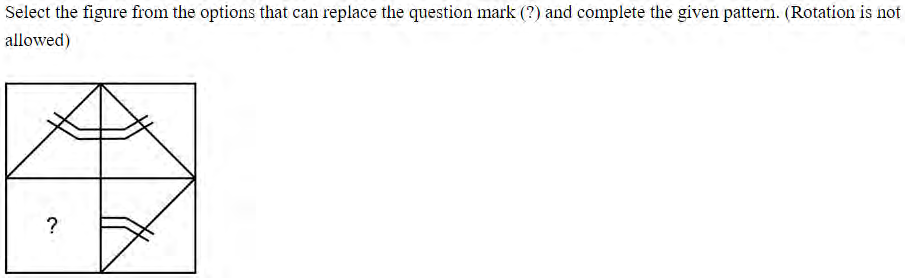
- (a)
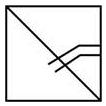
- (b)
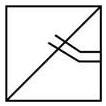
- (c)
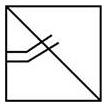
- (d)
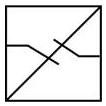
Show answer
Answer: (a)
- (a)
3. Which two numbers need to be interchanged to make the following equation correct? 27 − 8 × 4 − 3 ÷ 2 = 1
- (a) 2 and 8
- (b) 2 and 3
- (c) 3 and 4
- (d) 8 and 4
Show answer
Answer: (c)
4. In a certain code language, ‘heart black blue’ is written as ‘8 # ab’, ‘grey are blue’ is written as ‘# pr kt’. How will ‘blue’ be written in that language?
- (a) ab
- (b) pr
- (c) #
- (d) 8
Show answer
Answer: (c)
5. Select the option that is related to the fifth term in the same way as the second term is related to the first term and the fourth term is related to the third term. TACKLE : TCCMLG :: JACKET : JCCMEV :: NEPTUNE : ?
- (a) PEPTVOE
- (b) PERTWNG
- (c) NFGPVUP
- (d) NGPVUPE
Show answer
Answer: (d)
6. Select the option in which the numbers are related in the same way as are the numbers in the given set. (7, 49, 343)
- (a) (5, 25, 625)
- (b) (11, 121, 1321)
- (c) (13, 169, 2197)
- (d) (3, 9, 29)
Show answer
Answer: (c)
7.

- (a)

- (b)

- (c)

- (d)

Show answer
Answer: (d)
- (a)
8. Select the option that is related to the fifth word in the same way as the second word is related to the first word and the fourth word is related to the third word. Virat Kohli : Cricket :: Saina Nehwal : Badminton :: Viswanathan Anand : ?
- (a) Basketball
- (b) Chess
- (c) Tennis
- (d) Football
Show answer
Answer: (b)
9.

- (a)

- (b)

- (c)

- (d)

Show answer
Answer: (d)
- (a)
10. Select the option that is related to the third letter-cluster in the same way as the second letter-cluster is related to the first letter-cluster. LOB : DQN :: HER : ?
- (a) TGK
- (b) TGJ
- (c) JGU
- (d) JGT
Show answer
Answer: (b)
11. Select the number from among the given options that can replace the question mark (?) in the following series. 524, 533, 544, 557, ?
- (a) 574
- (b) 568
- (c) 572
- (d) 564
Show answer
Answer: (c)
12.

- (a)

- (b)

- (c)

- (d)

Show answer
Answer: (a)
- (a)
13. The marks of seven students A, B, C, D, E, F and G in a test were given as follows: A's score was exactly between E's and F's scores. B's score was more than only G's score. C's score was immediately more than B's score. F's score was more than E's score and F did not score the highest. Who scored the highest marks in the test?
- (a) A
- (b) G
- (c) E
- (d) D
Show answer
Answer: (d)
14. In a certain code language, 'GRSTB' is written as 'GYXWL', and 'HANDS' is written as 'XISFM'. How will 'MNDET' be written in that language?
- (a) YJITS
- (b) YJIRS
- (c) JIISR
- (d) YJISR
Show answer
Answer: (d)
15.

- (a)

- (b)

- (c)
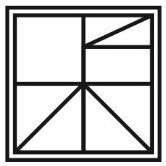
- (d)

Show answer
Answer: (d)
- (a)
16. In a certain code language, 'GEFS' is written as 'HFER' and ‘IBIS’ is written as ‘JCHR’. How will 'STIR' be written in that language?
- (a) RSHQ
- (b) TUJS
- (c) RUHS
- (d) TUHQ
Show answer
Answer: (d)
17. Read the given statements and conclusions carefully. Assuming that the information given in the statements is true, even if it appears to be at variance with commonly known facts, decide which of the given conclusions logically follow(s) from the statements. Statements: I. Some M are Q. II. All V are Q. Conclusions: I. Some Q are M. II. No M is V.
- (a) Both conclusions I and II follow
- (b) Only conclusion I follows
- (c) Neither conclusion I nor II follows
- (d) Only conclusion II follows
Show answer
Answer: (b)
18. Read the given statements and conclusions carefully. Assuming that the information given in the statements is true, even if it appears to be at variance with commonly known facts, decide which of the given conclusions logically follow(s) from the statements. Statements: All hexagons are pentagons. All pentagons are octagons. All octagons are decagons. Conclusions: I. All decagons are hexagons. II. All hexagons are octagons.
- (a) Both conclusions I and II follow
- (b) Neither conclusion I nor II follows
- (c) Only conclusion II follows
- (d) Only conclusion I follows
Show answer
Answer: (c)
19. Select the number from among the given options that can replace the question mark (?) in the following series. 28, 27, 31, 22, 38, 13, 49, ?
- (a) 42
- (b) 2
- (c) 0
- (d) 22
Show answer
Answer: (c)
20. In a certain code language, 'ACQUIRE' is written as 'QCAUERI', 'ADDRESS' is written as 'DDARSSE', and 'ABILITY' is written as 'IBALYTI'. How will 'ICEBERG' be written in that language?
- (a) GREBECI
- (b) GREBICE
- (c) ECIBGRE
- (d) ICEBGRE
Show answer
Answer: (c)
21. Five friends N, M, O, P and Q are sitting in a column facing east (but not necessarily in the same order) . O is sitting to the leftmost side. N is the immediate neighbour of M and Q. P is not sitting on any of the end seats. Who is the immediate neighbour of O?
- (a) M
- (b) Q
- (c) P
- (d) N
Show answer
Answer: (c)
22.
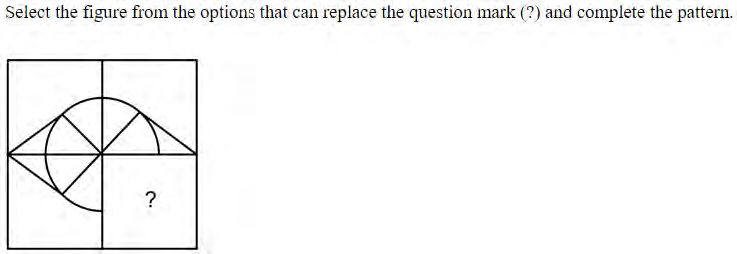
- (a)

- (b)
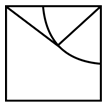
- (c)
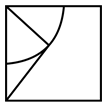
- (d)
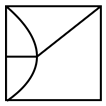
Show answer
Answer: (a)
- (a)
23. Select the letter-cluster from among the given options that can replace the question mark (?) in the following series. AEI, EIO, IOU, ?
- (a) UAE
- (b) AEI
- (c) OUA
- (d) AII
Show answer
Answer: (c)
24. Select the option that is related to the fifth number in the same way as the second number is related to the first number and the fourth number is related to the third number. 3 : 72 :: 21 : 504 :: 36 : ?
- (a) 480
- (b) 864
- (c) 632
- (d) 376
Show answer
Answer: (b)
25. Seven boys B1, B2, B3, B4, B5, B6 and B7 are sitting around a circular table facing towards the centre (not necessarily in the same order). B1 is third to the left of B7. B4 is to immediate left of B1. B2 is second to the left of B6. B6 is not an immediate neighbour of B5. Who are the immediate neighbours of B3?
- (a) B5 and B4
- (b) B6 and B7
- (c) B1 and B2
- (d) B4 and B6
Show answer
Answer: (d)
Numerical Aptitude
2.

- (a)

- (b)

- (c)

- (d)

Show answer
Answer: (d)
- (a)
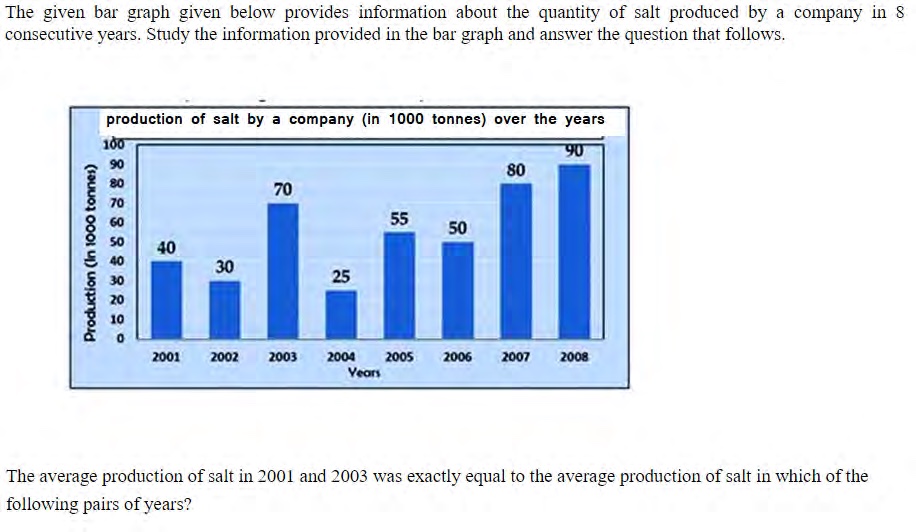
3.
- (a)

- (b)

- (c)

- (d)

Show answer
Answer: (c)
- (a)
4.

- (a)

- (b)

- (c)

- (d)

Show answer
Answer: (c)
- (a)
6.

- (a)

- (b)

- (c)

- (d)

Show answer
Answer: (b)
- (a)
7.

- (a)

- (b)

- (c)

- (d)

Show answer
Answer: (b)
- (a)
8.

- (a)

- (b)

- (c)

- (d)

Show answer
Answer: (b)
- (a)
11.

- (a)

- (b)

- (c)

- (d)

Show answer
Answer: (c)
- (a)
12.

- (a)

- (b)

- (c)

- (d)

Show answer
Answer: (c)
- (a)
15.

- (a)

- (b)

- (c)

- (d)

Show answer
Answer: (a)
- (a)
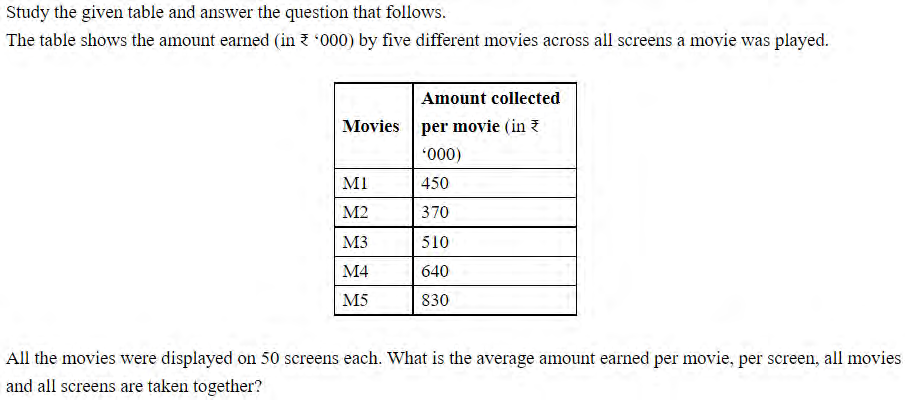
17.
- (a)

- (b)

- (c)

- (d)

Show answer
Answer: (b)
- (a)
18.

- (a)

- (b)

- (c)

- (d)

Show answer
Answer: (b)
- (a)
19.

- (a)

- (b)

- (c)

- (d)

Show answer
Answer: (a)
- (a)
21.

- (a)

- (b)

- (c)

- (d)

Show answer
Answer: (a)
- (a)
22.

- (a)

- (b)

- (c)

- (d)

Show answer
Answer: (a)
- (a)
23.

- (a)

- (b)

- (c)

- (d)

Show answer
Answer: (c)
- (a)
24.

- (a)

- (b)

- (c)

- (d)

Show answer
Answer: (a)
- (a)
25.

- (a)

- (b)

- (c)

- (d)

Show answer
Answer: (b)
- (a)
General Awareness
1. Which part of the Constitution of India talks about the Directive Principles of State Policy?
- (a) Part IV
- (b) Part V
- (c) Part III
- (d) Part II
Show answer
Answer: (a)
2. Who among the following was a famous Indian playback singer and an actor too?
- (a) Kashinath Ghanekar
- (b) Kishore Kumar
- (c) Pranab Mukherjee
- (d) Sunil Chhetri
Show answer
Answer: (b)
3. The Purple Revolution, which was launched in Jammu and Kashmir, is also known as ______.
- (a) Lavender Revolution
- (b) Indigo Revolution
- (c) Orchids Revolution
- (d) Lilac Revolution
Show answer
Answer: (a)
4. Who among the following founded Brahmo Samaj in Calcutta (Kolkata)?
- (a) Swami Vivekanand
- (b) Swami Dayanand Saraswati
- (c) Ishwar Chandra Vidyasagar
- (d) Raja Ram Mohan Roy
Show answer
Answer: (d)
5. Which of the following is NOT a cause of rural poverty in India?
- (a) Migration from rural areas
- (b) Lack of alternate employment opportunities other than agriculture
- (c) Illiteracy
- (d) Lack of capital
Show answer
Answer: (a)
6. Who is the Chairman of Financial Stability and Development Council (FSDC) of India?
- (a) Finance Minister
- (b) Human Resource Development Minister
- (c) Home Minister
- (d) Skill Development Minister
Show answer
Answer: (a)
7. The Great Indian Novel is written by the famous politician ________.
- (a) Varun Gandhi
- (b) Derek O'Brien
- (c) AK Antony
- (d) Shashi Tharoor
Show answer
Answer: (d)
8. Which of the given statements related to the temples of India is correct? I.The Nagara style of architecture is also known as the North Indian style II.The Dravidian style of architecture is also known as the South Indian style.
- (a) Neither I nor II
- (b) Both I and II
- (c) Only II
- (d) Only I
Show answer
Answer: (b)
9. The uplifted blocks of block mountains are called ______.
- (a) horsts
- (b) grabens
- (c) slopes
- (d) cones
Show answer
Answer: (a)
10. Dantidurga belonged to which dynasty of India?
- (a) Chalukya
- (b) Chola
- (c) Rashtrakuta
- (d) Chera
Show answer
Answer: (c)
11. Bagurumba is a folk dance of which Indian state?
- (a) Haryana
- (b) Karnataka
- (c) Assam
- (d) Goa
Show answer
Answer: (c)
12. The number of persons per unit area gives the measurement of _____.
- (a) population density
- (b) population sex ratio
- (c) population movements
- (d) population growth rate
Show answer
Answer: (a)
13. ‘Ambubachi’ festival of Assam is celebrated in the month of ______ every year.
- (a) March
- (b) December
- (c) January
- (d) June
Show answer
Answer: (d)
14. Harshavardhana (r. 606-647 CE) was a ruler of __________ dynasty.
- (a) Mughal
- (b) Maurya
- (c) Gupta
- (d) Pushyabhuti
Show answer
Answer: (d)
15. All India Muslim League was formed in ______.
- (a) 1906
- (b) 1910
- (c) 1905
- (d) 1908
Show answer
Answer: (a)
16. All the changes in the weather are driven by the ______.
- (a) moon
- (b) sun
- (c) stars
- (d) Jovian planets
Show answer
Answer: (b)
17. The HVJ gas pipeline from Hazira in Gujarat to Jagdishpur in Uttar Pradesh passes through which state?
- (a) Jharkhand
- (b) Madhya Pradesh
- (c) Himachal Pradesh
- (d) Uttarakhand
Show answer
Answer: (b)
18. Tapeworm belongs to which group of the animal kingdom?
- (a) Annelida
- (b) Platyhelminthes
- (c) Porifera
- (d) Coelenterata
Show answer
Answer: (b)
19. Which of the following is an Indian game of snake boat race?
- (a) Kho-Kho
- (b) Vallam kali
- (c) Mallakhamb
- (d) Field hockey
Show answer
Answer: (b)
20. The judiciary has the power to strike down particular laws passed by the Parliament if it believes that these are a violation of the basic structure of the Constitution. This is called ______.
- (a) judicial review
- (b) dispute resolution
- (c) judicial activism
- (d) public interest litigation
Show answer
Answer: (a)
21. Who among the following won a silver medal in the Summer Olympics 2020 (played in 2021)?
- (a) Ravi Kumar Dahiya
- (b) Bajrang Punia
- (c) Lovlina Borgohain
- (d) PV Sindhu
Show answer
Answer: (a)
22. Who became the new Chief Minister of Punjab in March 2022?
- (a) Navjot Singh Sidhu
- (b) Amarinder Singh
- (c) Bhagwant Mann
- (d) Arvind Kejriwal
Show answer
Answer: (c)
23. Which of the following gases shields the surface of earth from ultraviolet (UV) radiation from the sun?
- (a) Carbon monoxide
- (b) Ozone
- (c) Oxygen
- (d) Carbon dioxide
Show answer
Answer: (b)
24. Which of the following is an example of contact force?
- (a) Electrostatic force
- (b) Muscular force
- (c) Gravitational force
- (d) Magnetic force
Show answer
Answer: (b)
25. Kalamandalam Kalyanikutty Amma is known for which classical dance form?
- (a) Manipuri
- (b) Kuchipudi
- (c) Odissi
- (d) Mohiniyattam
Show answer
Answer: (d)
Show answers
Answer key
Answer key as marked in the Staff Selection Commission’s response sheet. “—” means the sheet did not show it clearly.
General English
- Q 1
- (c)
- Q 2
- (d)
- Q 3
- (c)
- Q 4
- (b)
- Q 5
- (c)
- Q 6
- (d)
- Q 7
- (a)
- Q 8
- (a)
- Q 9
- (d)
- Q 10
- (d)
- Q 12
- (d)
- Q 13
- (b)
- Q 14
- (b)
- Q 15
- (c)
- Q 16
- (c)
- Q 17
- (c)
- Q 18
- (d)
- Q 19
- (d)
- Q 20
- (c)
- Q 21
- (b)
- Q 22
- (b)
- Q 23
- (c)
- Q 24
- (d)
- Q 25
- (c)
General Intelligence and Reasoning
- Q 1
- (d)
- Q 2
- (a)
- Q 3
- (c)
- Q 4
- (c)
- Q 5
- (d)
- Q 6
- (c)
- Q 7
- (d)
- Q 8
- (b)
- Q 9
- (d)
- Q 10
- (b)
- Q 11
- (c)
- Q 12
- (a)
- Q 13
- (d)
- Q 14
- (d)
- Q 15
- (d)
- Q 16
- (d)
- Q 17
- (b)
- Q 18
- (c)
- Q 19
- (c)
- Q 20
- (c)
- Q 21
- (c)
- Q 22
- (a)
- Q 23
- (c)
- Q 24
- (b)
- Q 25
- (d)
Numerical Aptitude
- Q 2
- (d)
- Q 3
- (c)
- Q 4
- (c)
- Q 6
- (b)
- Q 7
- (b)
- Q 8
- (b)
- Q 11
- (c)
- Q 12
- (c)
- Q 15
- (a)
- Q 17
- (b)
- Q 18
- (b)
- Q 19
- (a)
- Q 21
- (a)
- Q 22
- (a)
- Q 23
- (c)
- Q 24
- (a)
- Q 25
- (b)
General Awareness
- Q 1
- (a)
- Q 2
- (b)
- Q 3
- (a)
- Q 4
- (d)
- Q 5
- (a)
- Q 6
- (a)
- Q 7
- (d)
- Q 8
- (b)
- Q 9
- (a)
- Q 10
- (c)
- Q 11
- (c)
- Q 12
- (a)
- Q 13
- (d)
- Q 14
- (d)
- Q 15
- (a)
- Q 16
- (b)
- Q 17
- (b)
- Q 18
- (b)
- Q 19
- (b)
- Q 20
- (a)
- Q 21
- (a)
- Q 22
- (c)
- Q 23
- (b)
- Q 24
- (b)
- Q 25
- (d)