ExamBharo · SSC MTS 2021 — 13 July 2022, Shift 2 · exambharo.com/ssc-mts/previous-year-papers/ssc-mts-2021-13-jul-shift-2/
Question paper · SSC MTS & Havaldar
SSC MTS 2021 — 13 July 2022, Shift 2
13 July 2022 · 1:00 PM–2:30 PM89 of the paper’s 100 questions1 per correct answer
Questions from the Staff Selection Commission’s paper of 13 July 2022, 1:00 PM–2:30 PM.
Preparing for SSC MTS & Havaldar? Get more, free
Daily previous-year questions as quizzes, and every SSC MTS & Havaldar notice the day it is out.
General English
1. Select the option that will improve the underlined part of the given sentence. In case no improvement is needed, select 'No improvement required'. One of the baby elephants broke off from the herd and lost its way.
- (a) No improvement required
- (b) in
- (c) down
- (d) away
Show answer
Answer: (d)
2. Select the most appropriate ANTONYM of the given word. Sturdy
- (a) Delicate
- (b) Dragging
- (c) Tiny
- (d) Drab
Show answer
Answer: (a)
3. Select the most appropriate option to fill in the blank. ______ is going to take the responsibility for this failure?
- (a) Whom
- (b) Who
- (c) Which
- (d) Whose
Show answer
Answer: (b)
4. Select the most appropriate synonym of the given word. Pleasant
- (a) Awful
- (b) Delightful
- (c) Faithful
- (d) Sorrowful
Show answer
Answer: (b)
5. Select the option that can be used as a one-word substitute for the given group of words. One who believes in fate
- (a) Fatalist
- (b) Optimist
- (c) Mercenary
- (d) Ascetic
Show answer
Answer: (a)
6. Select the most appropriate meaning of the given idiom. To take with a grain of salt
- (a) To take seriously
- (b) To have total disbelief
- (c) To believe with some scepticism
- (d) To accept wholeheartedly
Show answer
Answer: (c)
7. Parts of the following sentence have been given as options. One of them may contain an error. Select the part that contains the error from the given options. If you don’t find any error, mark ‘No error’ as your answer. We usually sleep in bedrooms with the door firmly shuted behind us.
- (a) We usually sleep in
- (b) bedrooms with the door
- (c) No error
- (d) firmly shuted
Show answer
Answer: (d)
8. The following sentence has been divided into parts. One of them may contain an error. Select the part that contains the error from the given options. If you don’t find any error, mark ‘No error’ as your answer. You have to constant consider how your personal behaviour is going to impact everyone around you.
- (a) You have to constant consider
- (b) No error
- (c) to impact everyone around you
- (d) how your personal behaviour is going
Show answer
Answer: (a)
9. Select the option that will improve the bracketed part of the sentence. In case no improvement is needed, select ‘No improvement required’.(Neither of the leading political parties have had much) success in the southern region.
- (a) No improvement required
- (b) Neither of the leading political parties has had much
- (c) Neither of the leading political party has had much
- (d) Neither of the leading political parties have had any
Show answer
Answer: (b)
10. Select the option that can be used as a one-word substitute for the given group of words. The collection and study of postage stamps
- (a) Philately
- (b) Ornithology
- (c) Philosophy
- (d) Philanthropy
Show answer
Answer: (a)
11. Select the INCORRECTLY spelt word.
- (a) Barricade
- (b) Prosperity
- (c) Bouket
- (d) Dissatisfied
Show answer
Answer: (c)
12. Select the option that corrects the misspelt words in the given sentence. He maintins the unity and fredom of the suol.
- (a) He maintains the unity and freedom of the soul.
- (b) He maintains the unity and freedomm of the soul.
- (c) He maintins the unitty and freedom of the soul.
- (d) He maintins the unity and fredom of the soul.
Show answer
Answer: (a)
13. Select the most appropriate meaning of the given idiom. Make a living
- (a) To abuse someone
- (b) To make excuses for everything
- (c) To earn enough money for things you need
- (d) To rely on corrupt money
Show answer
Answer: (c)
14. Select the option that can be used as a one-word substitute for the given group of words. A person who sells flowers
- (a) Florist
- (b) horticulturist
- (c) Chauffeur
- (d) Invigilator
Show answer
Answer: (a)
15. Select the most appropriate ANTONYM of the given word. Miniature
- (a) Teeny
- (b) Mammoth
- (c) Average
- (d) Miniscule
Show answer
Answer: (b)
16. Select the most appropriate option to fill in the blank. Most employers ______ the use of mobile phones during office hours.
- (a) prohibit
- (b) submerge
- (c) cultivate
- (d) spirit
Show answer
Answer: (a)
17. Select the option that can be used as a one-word substitute for the given group of words. A disturbed state of mind caused by an illness.
- (a) Delirium
- (b) Discrepancy
- (c) Dilemma
- (d) Depreciation
Show answer
Answer: (a)
18. Parts of the following sentence have been given as options. One of them may contain an error. Select the part that contains the error from the given options. If you don’t find any error, mark ‘No error’ as your answer. Your infidelity have given me too much pain in life.
- (a) given me too
- (b) much pain in life
- (c) No error
- (d) Your infidelity have
Show answer
Answer: (d)
19. Select the most appropriate option to substitute the underlined segment in the given sentence. If there is no need to substitute it, select ‘No substitution required’. His wise choice of men like Wolfe in Canada and Clive in India, and his vigorous measures in managing foreign affairs, made England respected in every part of the world.
- (a) wisely chosen
- (b) wisely choice
- (c) No substitution required
- (d) wise choose
Show answer
Answer: (c)
20. Select the most appropriate synonym of the underlined word in the given sentence. These colours add a vivacious and fairy-like effect to my dress.
- (a) repressed
- (b) impassive
- (c) sparky
- (d) gloomy
Show answer
Answer: (c)
PassageFor questions 21–25
In the following passage, some words have been deleted. Read the passage carefully and select the most appropriate option to fill in each blank.
In Andhra Pradesh, low rainfall and increased (1) ______ on borewells have led to soil aridity, while (2) ______ snow and more rainfall has (3) ______ the desertification crisis in Himachal Pradesh. On the other (4) ______, in Rajasthan, canals, tube-well irrigation and shelterbelts have (5) ______ to an increase in the green cover.
21. Select the most appropriate option to fill in blank number 1.
- (a) growth
- (b) support
- (c) addiction
- (d) dependence
Show answer
Answer: (d)
22. Select the most appropriate option to fill in blank number 2.
- (a) few
- (b) least
- (c) less
- (d) fewer
Show answer
Answer: (c)
23. Select the most appropriate option to fill in blank number 3.
- (a) deepen
- (b) deepened
- (c) deeper
- (d) deep
Show answer
Answer: (b)
24. Select the most appropriate option to fill in blank number 4.
- (a) half
- (b) hand
- (c) sides
- (d) case
Show answer
Answer: (b)
25. Select the most appropriate option to fill in blank number 5.
- (a) lead
- (b) led
- (c) leading
- (d) leads
Show answer
Answer: (b)
General Intelligence and Reasoning
1. Select the option that is related to the third number in the same way as the second number is related to the first number and the sixth number is related to the fifth number. 3856 : 8563 :: 4893 : ? :: 2873 : 8732
- (a) 8934
- (b) 3948
- (c) 3984
- (d) 8943
Show answer
Answer: (a)
2. Six people Ali, Parth, Roy, Minal, Sudhir and Zeeshan are sitting in a straight row facing North. Sudhir and Zeeshan are in the centre. Ali and Parth are at the corners. Roy is sitting to the immediate left of Ali. Who is sitting to the immediate right of Parth ?
- (a) Sudhir
- (b) Zeeshan
- (c) Roy
- (d) Minal
Show answer
Answer: (d)
3. In a certain code language, ‘Flames are bright’ is written as ‘@ # %’ and ‘Bright is sun flames’ is written as ‘* # 7 @’. Which one of the following is the possible code for ‘is’ in that code language?
- (a) %
- (b) @
- (c) #
- (d) *
Show answer
Answer: (d)
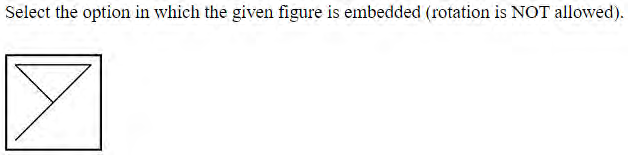
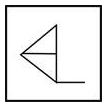
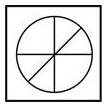
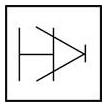
4.
- (a)
- (b)
- (c)
- (d)
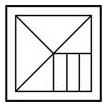
Show answer
Answer: (d)
- (a)
5. Read the given statements and conclusions carefully. Assuming that the information given in the statements is true, even if it appears to be at variance with commonly known facts, decide which of the given conclusions logically follow(s) from the statements. Statements: I. Some A are B. II. All C are B. Conclusions: I. Some B are A’s is a possibility. II. No C is A. III. All A are C.
- (a) None of the conclusions follow
- (b) Only conclusion I follows
- (c) All the conclusions follow
- (d) Only conclusion III follows
Show answer
Answer: (b)
6.
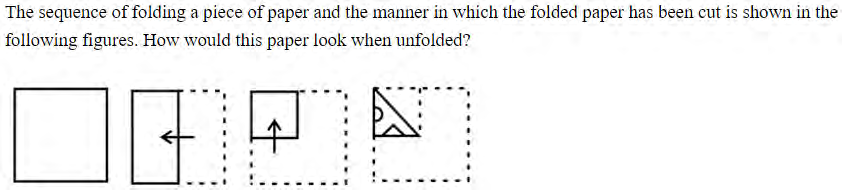
- (a)

- (b)
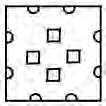
- (c)

- (d)
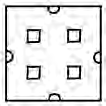
Show answer
Answer: (c)
- (a)
7.

- (a)

- (b)

- (c)

- (d)

Show answer
Answer: (c)
- (a)
8. In a certain code language, 'ri ti gi' is written as 'Usha playing cards', 'si ni gi' is written as 'Asha playing tennis' and 'ri si wi' is written as 'cards and tennis'. What is the code for the word 'tennis' in that language?
- (a) ni
- (b) ri
- (c) wi
- (d) si
Show answer
Answer: (d)
9. In a certain code language, 'PIZZA' is written as 'QJAAB' and 'BLACK' is written as ‘CMBDL’. How will 'BUZZY' be written in that language?
- (a) CVAZZ
- (b) CVAAZ
- (c) CVABZ
- (d) CTAAZ
Show answer
Answer: (b)
10. Which two signs need to be interchanged to make the following equation correct? 352 × 8 − 330 + 125 ÷ 4 = 214
- (a) + and ×
- (b) − and ÷
- (c) + and ÷
- (d) × and ÷
Show answer
Answer: (d)
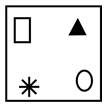
11.

- (a)
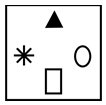
- (b)
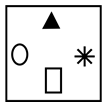
- (c)
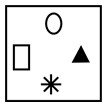
- (d)
Show answer
Answer: (c)
- (a)
12. A, B, C, D, E, F and G give a test. A scores more than B, C and D. G scores more than E and F. F scores more than A. Who scores the highest in the test?
- (a) F
- (b) A
- (c) E
- (d) G
Show answer
Answer: (d)
13. Select the option that is related to the third letter-cluster in the same way as the second letter-cluster is related to the first letter-cluster. DGP : WTK :: MOS : ?
- (a) NEH
- (b) MLH
- (c) NLT
- (d) NLH
Show answer
Answer: (d)
14. Select the option in which the numbers are related in the same way as are the numbers of the following sets. (2, 4, 36) (4, 6, 100)
- (a) (8, 4, 1020)
- (b) (12, 4, 230)
- (c) (4, 4, 64)
- (d) (14, 2, 75)
Show answer
Answer: (c)
15. Select the option that is related to the sixth number in the same way as the first number is related to the second number and the third number is related to the fourth number. 1503 : 3004 :: 871 : 1740 :: ? : 142
- (a) 98
- (b) 110
- (c) 72
- (d) 65
Show answer
Answer: (c)
16.

- (a)

- (b)

- (c)

- (d)

Show answer
Answer: (a)
- (a)
17. Nine people Asha, Bishal, Carol, Dinky, Emily, Farah, Golu, Harsh, and Itika are watching a movie in a theatre sitting in a straight row facing North. Bishal is at one end of the row. Harsh is seated adjacent to both Farah and Golu. Carol is to the immediate right of Dinky and in the third place to the right of Emily. Asha is on the immediate left of Farah. Farah is in the third place to the left of Bishal. Who are at the ends of the row?
- (a) Bishal and Dinky
- (b) Harsh and Itika
- (c) Carol and Emily
- (d) Emily and Bishal
Show answer
Answer: (d)
19. Select the number from among the given options that can replace the question mark (?) in the following series. 6, 9, 7, 10, 8, 11, ?
- (a) 12
- (b) 9
- (c) 11
- (d) 10
Show answer
Answer: (b)
20. Read the given statements and conclusions carefully. Assuming that the information given in the statements is true, even if it appears to be at variance with commonly known facts, decide which of the given conclusions logically follow(s) from the statements. Statements: No atom is a molecule. No molecule is an element. Conclusions: I. It is possible for some atoms to be elements. II. Some elements are molecules.
- (a) Only conclusion I follows
- (b) Both conclusions I and II follow
- (c) Only conclusion II follows
- (d) Neither conclusion I nor II follows
Show answer
Answer: (a)
21. What will come in the place of ‘?’ in the following equation, if ‘+’ and ‘–‘ are interchanged and also ‘×’ and ‘÷’ are interchanged? 40 × 10 − 20 + 10 ÷ 2 = ?
- (a) 4
- (b) 8
- (c) 6
- (d) 2
Show answer
Answer: (a)
22. Select the option that is related to the third letter-cluster in the same way as the second letter-cluster is related to the first letter-cluster. ROM : SRT :: PNA : ?
- (a) QQH
- (b) QQI
- (c) RQI
- (d) QRH
Show answer
Answer: (a)
23. Select the letter-cluster from among the given options that can replace the question mark (?) in the following series. TX, ZD, FJ, LP, ?
- (a) RU
- (b) SV
- (c) SU
- (d) RV
Show answer
Answer: (d)
24.
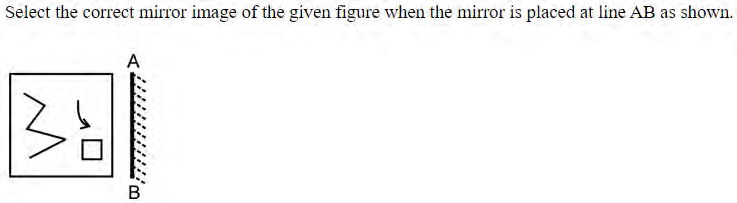
- (a)
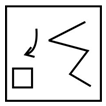
- (b)
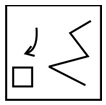
- (c)
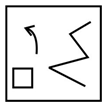
- (d)
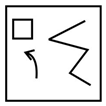
Show answer
Answer: (b)
- (a)
25. In a certain code language, 'POINT' is coded as '11', and 'GRANDST' is coded as '11'. How will 'HEMANT' be coded in that language?
- (a) 8
- (b) 4
- (c) 9
- (d) 7
Show answer
Answer: (d)
Numerical Aptitude
4.

- (a)

- (b)

- (c)

- (d)

Show answer
Answer: (c)
- (a)
5.

- (a)

- (b)

- (c)

- (d)

Show answer
Answer: (c)
- (a)
6.

- (a)

- (b)

- (c)

- (d)

Show answer
Answer: (d)
- (a)
7.

- (a)

- (b)

- (c)

- (d)

Show answer
Answer: (a)
- (a)
8.

- (a)

- (b)

- (c)

- (d)

Show answer
Answer: (c)
- (a)
9.

- (a)

- (b)

- (c)

- (d)

Show answer
Answer: (d)
- (a)
10.

- (a)

- (b)

- (c)

- (d)

Show answer
Answer: (c)
- (a)
11.

- (a)

- (b)

- (c)

- (d)

Show answer
Answer: (c)
- (a)
12.

- (a)

- (b)

- (c)

- (d)

Show answer
Answer: (a)
- (a)
14.

- (a)

- (b)

- (c)

- (d)

Show answer
Answer: (a)
- (a)
18.

- (a)

- (b)

- (c)

- (d)

Show answer
Answer: (b)
- (a)
20.

- (a)

- (b)

- (c)

- (d)

Show answer
Answer: (d)
- (a)
21.

- (a)

- (b)

- (c)

- (d)

Show answer
Answer: (b)
- (a)
24.

- (a)

- (b)

- (c)

- (d)

Show answer
Answer: (b)
- (a)
25.

- (a)

- (b)

- (c)

- (d)

Show answer
Answer: (b)
- (a)
General Awareness
1. In which state of India is the Iravatanesvara temple situated?
- (a) Tamil Nadu
- (b) West Bengal
- (c) Rajasthan
- (d) Telangana
Show answer
Answer: (a)
2. Which of the following cities existed in the Indus Valley Civilization?
- (a) Harappa
- (b) Sanchi
- (c) Muziris
- (d) Ayodhya
Show answer
Answer: (a)
3. What is the atomic number of Carbon as per Mendeleev's Periodic Table?
- (a) 3
- (b) 6
- (c) 1
- (d) 10
Show answer
Answer: (b)
4. The study of human populations including their size, composition and distribution across space and the process through which populations change is called ______.
- (a) ethnography
- (b) demography
- (c) topography
- (d) stenography
Show answer
Answer: (b)
5. Which of the following pairs of folk dance and the state associated with is INCORRECT?
- (a) Giddha - Punjab
- (b) Wancho - Arunachal Pradesh
- (c) Ghumar - Bihar
- (d) Nongkrem - Meghalaya
Show answer
Answer: (c)
6. Which of the following rivers rises in the Nepal Himalayas?
- (a) Betwa
- (b) Chenab
- (c) Chambal
- (d) Ghaghara
Show answer
Answer: (d)
7. How many different levels of courts are there in India?
- (a) Two
- (b) Four
- (c) Five
- (d) Three
Show answer
Answer: (d)
8. Aves are warm-blooded animals and have a ______ heart.
- (a) four-chambered
- (b) two-chambered
- (c) five-chambered
- (d) three-chambered
Show answer
Answer: (a)
9. Ustad Zakir Hussain is a famous Indian ______ player.
- (a) Violin
- (b) Guitar
- (c) Sitar
- (d) Table
Show answer
Answer: (d)
10. Joint sector industry is one of the classifications of industries on the basis of ______.
- (a) source of raw material
- (b) capital investment
- (c) bulk and weight of raw material
- (d) Ownership
Show answer
Answer: (d)
11. As per Census 2011, which of the following metro cities was the most populated in India?
- (a) Kolkata
- (b) Chennai
- (c) Delhi
- (d) Mumbai
Show answer
Answer: (d)
12. Which Indian state government launched Project Sadbhavana in February 2022?
- (a) Maharashtra
- (b) Assam
- (c) Tamil Nadu
- (d) Gujarat
Show answer
Answer: (b)
13. In which year did Tipu Sultan die defending his capital Seringapatam?
- (a) 1799
- (b) 1802
- (c) 1792
- (d) 1794
Show answer
Answer: (a)
14. In the Union Budget of India 2022, what percentage of tax has been levied on transfer of digital assets (cryptocurrency)?
- (a) 20 percentage
- (b) 5 percentage
- (c) 30 percentage
- (d) 10 percentage
Show answer
Answer: (c)
15. Ajit Kumar Doval is the fifth and current __________________ to the Prime Minister of India.
- (a) Private Secretary
- (b) Principal Secretary
- (c) National Security Advisor
- (d) Additional Secretary
Show answer
Answer: (c)
16. Which of the following teams won the ICC Women’s World Cup 2021/22?
- (a) Australia
- (b) South Africa
- (c) England
- (d) India
Show answer
Answer: (a)
17. Padma Subrahmanyam is known for which classical dance form?
- (a) Bharatanatyam
- (b) Kathak
- (c) Kuchipudi
- (d) Mohiniyattam
Show answer
Answer: (a)
18. Which of the following does NOT fall under Non-Chordates?
- (a) Annelida
- (b) Porifera
- (c) Vertebrata
- (d) Mollusca
Show answer
Answer: (c)
19. Which of the following is one of the key features of the Indian Constitution?
- (a) Autocratic government
- (b) Dependent Judiciary
- (c) Non-secular
- (d) Federalism
Show answer
Answer: (d)
20. ____________ was founded by the Dadoba Pandurang and his brother Atmaram Pandurang in 1863 when Keshub Chandra Sen visited Maharashtra, with an aim to make people believe in one God and worship only one God.
- (a) Prarthana Samaj
- (b) Satyashodhak Samaj
- (c) Arya Samaj
- (d) Brahmo Samaj
Show answer
Answer: (a)
21. Which planet in the solar system is considered as Earth’s twin?
- (a) Mercury
- (b) Saturn
- (c) Neptune
- (d) Venus
Show answer
Answer: (d)
22. Who among the following Chola rulers built Nishumbhasudini Goddess temple in Thanjavur?
- (a) Aditya I
- (b) Vijayalaya
- (c) Rajaraja I
- (d) Arinjaya
Show answer
Answer: (b)
23. What is the name of Mahatma Gandhi’s autobiography ?
- (a) Justice for the Judge
- (b) The Story of My Experiments with Truth
- (c) The Bandit Queen of India
- (d) My Music, My Life
Show answer
Answer: (b)
24. Who among the following is the first Indian Grandmaster to become Women's Chess World Rapid Champion?
- (a) Tania Sachdev
- (b) Koneru Humpy
- (c) Harika Dronavalli
- (d) Bhakti Kulkarni
Show answer
Answer: (b)
25. The International Sand Art festival is usually held in _______.
- (a) Kerala
- (b) Maharashtra
- (c) Tamil Nadu
- (d) Odisha
Show answer
Answer: (d)
Show answers
Answer key
Answer key as marked in the Staff Selection Commission’s response sheet. “—” means the sheet did not show it clearly.
General English
- Q 1
- (d)
- Q 2
- (a)
- Q 3
- (b)
- Q 4
- (b)
- Q 5
- (a)
- Q 6
- (c)
- Q 7
- (d)
- Q 8
- (a)
- Q 9
- (b)
- Q 10
- (a)
- Q 11
- (c)
- Q 12
- (a)
- Q 13
- (c)
- Q 14
- (a)
- Q 15
- (b)
- Q 16
- (a)
- Q 17
- (a)
- Q 18
- (d)
- Q 19
- (c)
- Q 20
- (c)
- Q 21
- (d)
- Q 22
- (c)
- Q 23
- (b)
- Q 24
- (b)
- Q 25
- (b)
General Intelligence and Reasoning
- Q 1
- (a)
- Q 2
- (d)
- Q 3
- (d)
- Q 4
- (d)
- Q 5
- (b)
- Q 6
- (c)
- Q 7
- (c)
- Q 8
- (d)
- Q 9
- (b)
- Q 10
- (d)
- Q 11
- (c)
- Q 12
- (d)
- Q 13
- (d)
- Q 14
- (c)
- Q 15
- (c)
- Q 16
- (a)
- Q 17
- (d)
- Q 19
- (b)
- Q 20
- (a)
- Q 21
- (a)
- Q 22
- (a)
- Q 23
- (d)
- Q 24
- (b)
- Q 25
- (d)
Numerical Aptitude
- Q 4
- (c)
- Q 5
- (c)
- Q 6
- (d)
- Q 7
- (a)
- Q 8
- (c)
- Q 9
- (d)
- Q 10
- (c)
- Q 11
- (c)
- Q 12
- (a)
- Q 14
- (a)
- Q 18
- (b)
- Q 20
- (d)
- Q 21
- (b)
- Q 24
- (b)
- Q 25
- (b)
General Awareness
- Q 1
- (a)
- Q 2
- (a)
- Q 3
- (b)
- Q 4
- (b)
- Q 5
- (c)
- Q 6
- (d)
- Q 7
- (d)
- Q 8
- (a)
- Q 9
- (d)
- Q 10
- (d)
- Q 11
- (d)
- Q 12
- (b)
- Q 13
- (a)
- Q 14
- (c)
- Q 15
- (c)
- Q 16
- (a)
- Q 17
- (a)
- Q 18
- (c)
- Q 19
- (d)
- Q 20
- (a)
- Q 21
- (d)
- Q 22
- (b)
- Q 23
- (b)
- Q 24
- (b)
- Q 25
- (d)