ExamBharo · SSC CGL 2023 Tier I — 26 July 2023, Shift 1 · exambharo.com/previous-year-papers/ssc-cgl-2023-tier-1-26-jul-shift-1/
Question paper · SSC CGL
SSC CGL 2023 Tier I — 26 July 2023, Shift 1
26 July 2023 · 9:00 AM–10:00 AM91 of the paper’s 100 questions+2 for a correct answer, −0.5 for a wrong one
9 questions of the original paper are not included: those that need a figure or formatting we cannot show, that have no answer in the response sheet, or that we could not check against a second copy of the paper.
Questions from the Staff Selection Commission’s paper of 26 July 2023, 9:00 AM–10:00 AM. Each question’s answer is under it, hidden until you open it, and the full answer key is at the end. Take the paper as a timed practice test to be scored.
General Intelligence and Reasoning
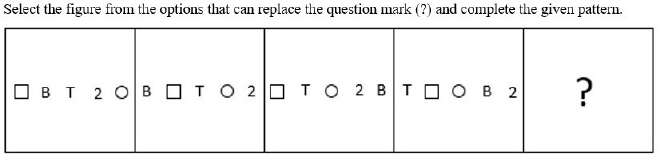
1.
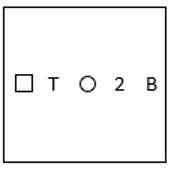
- (a)
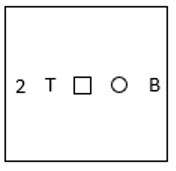
- (b)
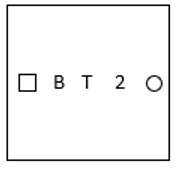
- (c)
- (d)
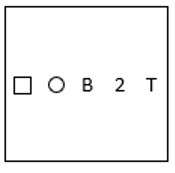
Show answer
Answer: (d)
- (a)
2. Which of the following numbers will replace the question mark (?) in the given series? 8, 14, ? , 44, 68, 98, 134
- (a) 20
- (b) 28
- (c) 36
- (d) 26
Show answer
Answer: (d)
3. Which two signs should be interchanged to make the given equation correct? 13 × 6 + 24 ÷ 6 – 17 = 91
- (a) ÷ and +
- (b) + and ×
- (c) ÷ and ×
- (d) + and –
Show answer
Answer: (d)
4. Select the option that is related to the third term in the same way as the second term is related to the first term and the sixth term is related to the fifth term. 5 : 127 :: 9 : ? :: 7 : 247
- (a) 470
- (b) 417
- (c) 407
- (d) 471
Show answer
Answer: (c)
5.
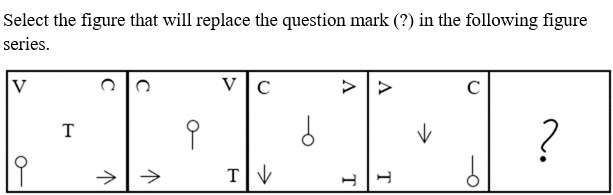
- (a)
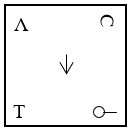
- (b)
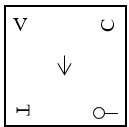
- (c)
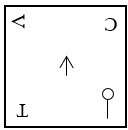
- (d)
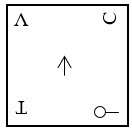
Show answer
Answer: (d)
- (a)
6. Which two numbers and two signs should be interchanged in the following equation to make it correct? 4 + 2 ÷ 7 + 8 × 9 = 25
- (a) 4 and 9, + and ×
- (b) 4 and 7, ÷ and ×
- (c) 4 and 9, ÷ and ×
- (d) 4 and 7, + and ×
Show answer
Answer: (c)
7. Which of the following letter-clusters will replace the question mark (?) in the given series to make it logically complete? ZXV, TRP, NLJ, HFD, ?
- (a) BZX
- (b) XZB
- (c) ZXB
- (d) BXZ
Show answer
Answer: (a)
8. In a certain code language, ‘BIND’ is coded as ‘9214’ and ‘DRIB’ is coded as ‘4109’. What is the code for ‘N’ in the given code language?
- (a) 4
- (b) 2
- (c) 1
- (d) 9
Show answer
Answer: (b)
9. Select the option that is related to the third word in the same way as the second word is related to the first word. (The words must be considered as meaningful English words and must not be related to each other based on the number of letters/number of consonants/vowels in the word.) X-Ray : Radiologist :: Skin : ?
- (a) Dermatologist
- (b) Radiologist
- (c) Physiotherapist
- (d) Ophthalmologist
Show answer
Answer: (a)
10. Select the set in which the numbers are related in the same way as are the numbers of the following sets. (NOTE : Operations should be performed on the whole numbers, without breaking down the numbers into its constituent digits. E.g. 13 – Operations on 13 such as adding/Subtracting/multiplying etc. to 13 can be performed. Breaking down 13 into 1 and 3 and then performing mathematical operations on 1 and 3 is not allowed) (50, 60, 2000) (20, 30, 200)
- (a) (31, 10, 48)
- (b) (21, 11, 11)
- (c) (80, 90, 6500)
- (d) (20, 10, 200)
Show answer
Answer: (b)
11. Select the option that is related to the fifth number in the same way as the second number is related to the first number and the fourth number is related to the third number. 3125 : 25 :: 1600 : 20 :: 675 : ?
- (a) 18
- (b) 10
- (c) 15
- (d) 20
Show answer
Answer: (c)
12.
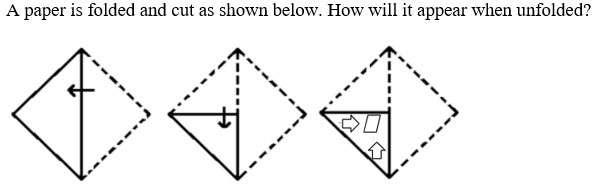
- (a)
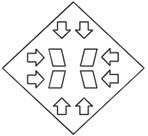
- (b)
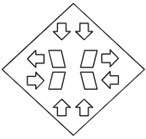
- (c)
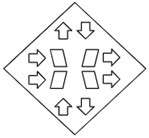
- (d)
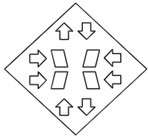
Show answer
Answer: (a)
- (a)
13. Select the option that represents the letters that, when sequentially placed from left to right in the blanks below, will complete the letter series. BUP_ESH_UPL_SHB_PLES_BU_LE_H
- (a) LBEHUSP
- (b) LBEUHPS
- (c) LBEUPSH
- (d) LBEPUSH
Show answer
Answer: (b)
14. Select the word-pair that best represents a similar relationship to the one expressed in the given pair of words. (The words must be considered as meaningful English words and must not be related to each other based on the number of letters/number of consonants/vowels in the word) Horse : Foal
- (a) Dog : Mouse
- (b) Hen : Rooster
- (c) Cat : Kitten
- (d) Sheep : Pup
Show answer
Answer: (c)
15. In a certain code language, 'TELEVISION' is written as 'UDMDWKQKMP' and 'PUNISHMENT' is written as 'QTOHTJKGLV'. How will 'HELICOPTER' be written in that language?
- (a) IDMHDQCVNT
- (b) IDMHQDVNCT
- (c) IDMHDQNVCT
- (d) IDMHDQVCNT
Show answer
Answer: (c)
16. Three of the following four letter-clusters are alike in a certain way and one is different. Pick the odd one out. DGJM NQTW TWZC HIJK
- (a) TWZC
- (b) NQTW
- (c) HIJK
- (d) DGJM
Show answer
Answer: (c)
17. Three statements are given followed by three conclusions numbered I, II and III. Assuming the statements to be true, even if they seem to be at variance with commonly known facts, decide which of the conclusions logically follow(s) from the statements. Statements: Some seeds are fruits. Some fruits are jams. All jams are desserts. Conclusions: I. Some jams are seeds. II. Some desserts are jams. III. Some fruits are desserts.
- (a) All conclusions follow
- (b) Only conclusions II and III follow
- (c) Only conclusions I and III follow
- (d) Only conclusions I and II follow
Show answer
Answer: (b)
19. The second number in the given number pairs is obtained by performing certain mathematical operation(s) on the first number. The same operation(s) are followed in all the number pairs, EXCEPT one. Find that odd number pair.
- (a) (7, 252)
- (b) (6, 216)
- (c) (8, 392)
- (d) (5, 80)
Show answer
Answer: (b)
20. Mishka says she is looking for the only child of her brother’s maternal grandmother. Who is she looking for?
- (a) Paternal grandmother
- (b) Mother
- (c) Son
- (d) Mishka herself
Show answer
Answer: (b)
21.
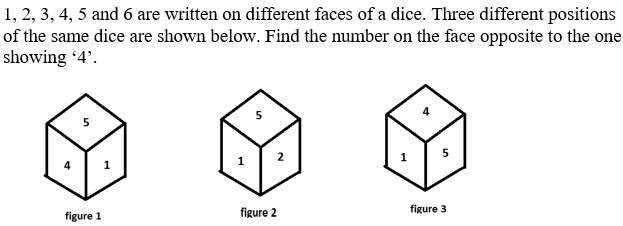
- (a) 6
- (b) 2
- (c) 5
- (d) 1
Show answer
Answer: (b)
22.
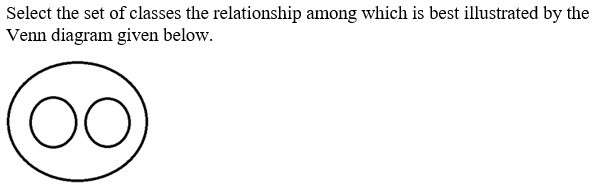
- (a) Shoes, Watches, Goggles
- (b) Spectacles, Pens, Diaries
- (c) Reptiles, Snakes, Lizards
- (d) Daughter, Son, Brother
Show answer
Answer: (c)
23. Select the correct mirror image of the given figure when the mirror is placed at MN as shown below.
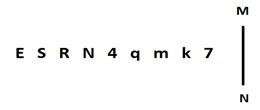
- (a)

- (b)

- (c)

- (d)

Show answer
Answer: (a)
- (a)
24. Select the set in which the numbers are related in the same way as are the numbers of the following set. (NOTE: Operations should be performed on the whole numbers, without breaking down the numbers into their constituent digits. E.g. 13 – Operations on 13 such as adding/substracting/multiplying etc. to 13 can be performed. Breaking down 13 into 1 and 3 and then performing mathematical operations on 1 and 3 is not allowed.) (3, 10, 26) (4, 17, 42)
- (a) (7, 50, 141)
- (b) (8, 64, 154)
- (c) (6, 37, 86)
- (d) (5, 26, 64)
Show answer
Answer: (c)
25. Select the option figure which is embedded in the given figure (Rotation is NOT allowed).
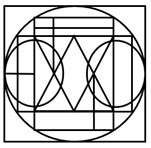
- (a)

- (b)

- (c)

- (d)

Show answer
Answer: (b)
- (a)
General Awareness
1. Part 3 of the Indian Constitution enlists how many groups of Fundamental Rights?
- (a) 4
- (b) 6
- (c) 7
- (d) 5
Show answer
Answer: (b)
2. What was the prime target of the first five-year plan of India?
- (a) Development of agriculture
- (b) Development of industries
- (c) Development of ports
- (d) Development of infrastructure
Show answer
Answer: (a)
3. Which of the following is the largest lake in India?
- (a) Shivaji Sagar Lake
- (b) Indira Sagar lake
- (c) Chilika Lake
- (d) Vembanad Lake
Show answer
Answer: (d)
4. Indian Olympic Association (IOA) was formed in the year ______.
- (a) 1926
- (b) 1930
- (c) 1927
- (d) 1929
Show answer
Answer: (c)
6. The first Paralympic games were held in:
- (a) Sydney
- (b) Rome
- (c) Tokyo
- (d) Beijing
Show answer
Answer: (b)
7. Which of the following is NOT one of the scheduled public sector banks in India?
- (a) Canara Bank
- (b) UCO Bank
- (c) Indian Overseas Bank
- (d) Bandhan Bank
Show answer
Answer: (d)
8. When was a comprehensive despatch on education called Wood’s despatch on education sent?
- (a) 1833
- (b) 1854
- (c) 1858
- (d) 1813
Show answer
Answer: (b)
9. In September 2021,the Pension Fund Regulatory and Development Authority (PFRDA) increased the entry age for the National Pension System (NPS) from_______ to ______.
- (a) 60 years; 65 years
- (b) 65 years; 70 years
- (c) 62 years; 65 years
- (d) 62 years; 70 years
Show answer
Answer: (b)
11. In January 2023, Union Minister of Education and Skill Development and Entrepreneurship Dharmendra Pradhan along with Minister for Railways, Communications, Electronics & Information Technology, Ashwini Vaishnaw successfully tested ‘BharOS’, a made-in-India mobile operating system developed by ________.
- (a) IIT Kanpur
- (b) IIT Madras
- (c) IIT Mumbai
- (d) IIT Kharagpur
Show answer
Answer: (b)
12. Padma Bhushan awardee, Alarmel Velli, who is renowned for Bharatanatyam, is also an exponent of which of the following dance forms?
- (a) Odissi
- (b) Kuchipudi
- (c) Kathak
- (d) Kathakali
Show answer
Answer: (a)
13. In 1808, whose work provided a physical picture of how compounds are formed by the combination of two or more different types of atoms?
- (a) George Zweig
- (b) Joseph J Thomson
- (c) Niels Bohr
- (d) John Dalton
Show answer
Answer: (d)
14. Which of the following can make provisions for Ancillary powers of the Supreme Court?
- (a) President of India
- (b) Law Commission of India
- (c) Minister of Law & Justice
- (d) Parliament of India
Show answer
Answer: (d)
15. Aruna Sairam, T M Krishna and Gayathri Girish are associated with which form of music?
- (a) Carnatic Music
- (b) Jazz Music
- (c) Pop Music
- (d) Hindustani Classical Music
Show answer
Answer: (a)
16. Which edition of India International Trade Fair (IITF) took place in the year 2021?
- (a) 40th
- (b) 39th
- (c) 38th
- (d) 41st
Show answer
Answer: (a)
17. Kathak is found in three distinct forms, called ‘gharanas’, named after the cities where the Kathak dance tradition evolved. Name those three cities.
- (a) Jaipur, Benaras, Lucknow
- (b) Prayagraj, Thiruvananthpuram, Surat
- (c) Ayodhya, Prayagraj, Jaipur
- (d) Banaras, Ayodhya, Lucknow
Show answer
Answer: (a)
18. In 2021,which financial institution entered into a collaboration with Google India Pvt Ltd (GIPL) for piloting a social impact lending programme with financial assistance up to ₹1 crore at subsidised interest rates?
- (a) IFCI
- (b) NABARD
- (c) IIFCL
- (d) SIDBI
Show answer
Answer: (d)
19. In a particular trophi level, how is the standing crop measured?
- (a) As biomass
- (b) As gross productivity
- (c) As net productivity
- (d) As pyramid of energy
Show answer
Answer: (a)
20. In the early nineteenth century, who demonstrated that there are fourteen space lattices, or regularly repeating arrangements of points in space, that differ in symmetry and geometry?
- (a) Auguste Bravais
- (b) William Bragg
- (c) Jerome Karle
- (d) Charles Frank
Show answer
Answer: (a)
21. Aner, Panzara and Waghur are the tributaries of which river?
- (a) Kaveri
- (b) Mahanadi
- (c) Tapi
- (d) Godavari
Show answer
Answer: (c)
22. Karsondas Mulji and Dadoba Pandurang were associated with ________, which worked against evils like caste system and encouraged widow remarriage.
- (a) Paramahansa Mandali
- (b) Arya samaj
- (c) Brahmo Samaj
- (d) Ramkrishna Mission
Show answer
Answer: (a)
23. The main (chief) social unit of the Aryans was ______.
- (a) Rajan
- (b) Parishad
- (c) Gana
- (d) Jana
Show answer
Answer: (d)
24. Who among the following was the founder of the Bahmani Sultanate, who took the title of Bahman Shah after his accession to the throne?
- (a) Muhammad Shah
- (b) Ghiyas ud din Tahmatan Shah
- (c) Daud Shah
- (d) Alauddin Hasan
Show answer
Answer: (d)
25.
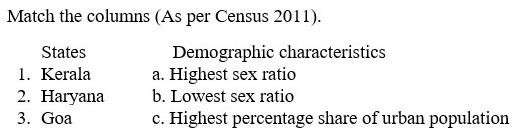
- (a) 1-a, 2-b, 3-c
- (b) 1-b, 2-a, 3-c
- (c) 1-a, 2-c, 3-b
- (d) 1-c, 2-b, 3-a
Show answer
Answer: (a)
Quantitative Aptitude
1. A vessel is filled with liquid, 5 parts of which are water and 11 parts syrup. What part of the mixture must be drawn off and replaced with water so that the mixture may be syrup and water in the ratio 3 : 2?
- (a)

- (b)

- (c)

- (d)

Show answer
Answer: (d)
- (a)
2. There are two circles that touch each other externally. Radius of the first circle with centre O is 12 cm. Radius of the second circle with centre A is 8 cm. Find the length of their common tangent BC.
- (a)

- (b)

- (c)

- (d)

Show answer
Answer: (d)
- (a)
3.

- (a) 48 cm
- (b) 12 cm
- (c) 30 cm
- (d) 27 cm
Show answer
Answer: (d)
4.

- (a) 68
- (b) 62
- (c) 64
- (d) 66
Show answer
Answer: (d)
5.
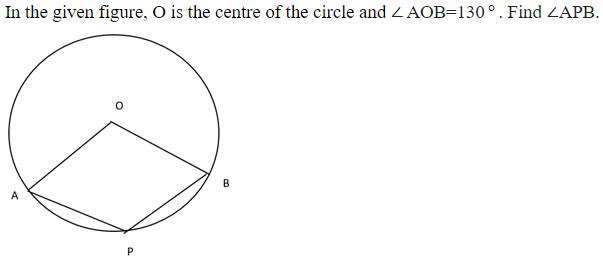
- (a) 110°
- (b) 115°
- (c) 100°
- (d) 95°
Show answer
Answer: (b)
6. A four-digits number abba is divisible by 4 and a<b. How many such numbers are there?
- (a) 10
- (b) 8
- (c) 12
- (d) 6
Show answer
Answer: (b)
7.

- (a)

- (b)

- (c)

- (d)

Show answer
Answer: (b)
- (a)
8. A boat goes 20 km upstream and 44 km downstream in 8 hours. In 5 hours, it goes 15 km upstream and 22 km downstream. Determine the speed of the boat in still water.
- (a) 6 km/h
- (b) 10 km/h
- (c) 8 km/h
- (d) 7 km/h
Show answer
Answer: (c)
9. 4 men’s work is equal to 6 women’s work, and 4 women’s work is equal to 6 boys’ work. A boy can finish the work in 60 days. In how many days can the work be finished by a man and a woman together?
- (a) 16
- (b) 24
- (c) 20
- (d) 12
Show answer
Answer: (a)
10. A policeman saw a thief at a distance of 400 m. The thief started running at a speed of 10 km/h and the policeman chased him at a speed of 12 km/h in the same direction. At what distance from the starting point will the policeman catch the thief?
- (a) 2.4 km
- (b) 3 km
- (c) 2 km
- (d) 2.8 km
Show answer
Answer: (a)
11. A group of men decided to do a job in 11 days but 16 men left the work after each day. The work, as a result, got completed in 15 days. How many men were there initially in the group?
- (a) 400
- (b) 480
- (c) 420
- (d) 450
Show answer
Answer: (c)
12.

- (a) 2
- (b) cos A
- (c) 1
- (d) sin A
Show answer
Answer: (b)
13. Which of the following sets of lengths (in cm) will give three sides of an obtuse-angled triangle?
- (a) 15, 62, 64
- (b) 17, 64, 66
- (c) 16, 63, 65
- (d) 18, 65, 67
Show answer
Answer: (a)
14.

- (a) 3880 cm2
- (b) 3820 cm2
- (c) 3960 cm2
- (d) 4020 cm2
Show answer
Answer: (c)
15. Find the value of the given expression. 1755 ÷ 39 × (8 − 28 ÷ 4) − 2
- (a) −315
- (b) −45
- (c) 270
- (d) 43
Show answer
Answer: (d)
16.
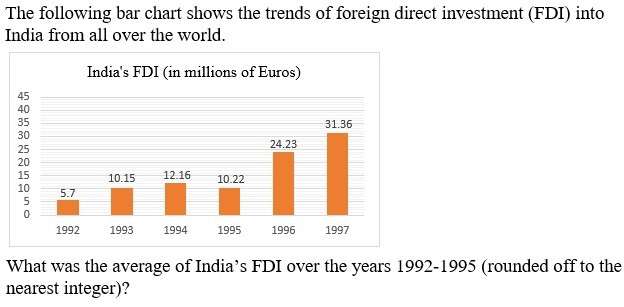
- (a) 7
- (b) 8
- (c) 10
- (d) 9
Show answer
Answer: (c)
17. The value of cosec 30° − cos 60° is:
- (a)

- (b)

- (c)

- (d)

Show answer
Answer: (c)
- (a)
18. A thief steals an item and escapes, running at 20 km/h. A policeman arrives at the spot of the crime after 6 minutes and immediately starts chasing the thief. 24 minutes after the policeman started to chase the thief, there is still a gap of 400 m between the two. At what distance from the spot of crime would the policeman catch up with the thief, and what is the speed at which the policeman ran?
- (a) 15 km; 25 km/h
- (b) 14.4 km; 24 km/h
- (c) 10 km; 25 km/h
- (d) 12 km; 24 km/h
Show answer
Answer: (d)
19. A shopkeeper sells his goods by allowing 18% discount and still earns 30% profit. If he sells his goods by allowing 12% discount on the marked price, then what will be his profit percentage (correct to 2 decimal places)?
- (a)

- (b)

- (c)

- (d)

Show answer
Answer: (d)
- (a)
20. Which of the following is the least? 12% of 625 15% of 555 10% of 720 9% of 845
- (a) 9% of 845
- (b) 12% of 625
- (c) 10% of 720
- (d) 15% of 555
Show answer
Answer: (c)
21. Ravi initially used to save 20% of his monthly income. Recently his monthly income was raised by 25%. His nominal savings also went up by 5%. What percentage of his present nominal income does Ravi currently save?
- (a)

- (b)

- (c)

- (d)

Show answer
Answer: (d)
- (a)
22. The following table shows the percentage of population of five states below poverty line and the proportion of males and females below and above poverty line.
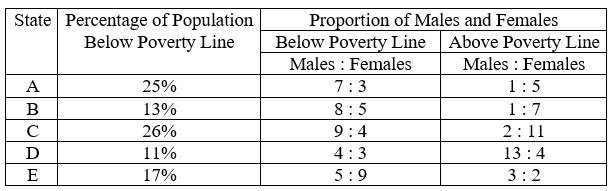 If the population of State B and State C is 6,000 each, then what is the total number of females below poverty line in these two states?
- (a) 720
- (b) 780
- (c) 740
- (d) 750
Show answer
Answer: (b)
23. R’s weighing machine shows 400 gm when the actual weight is 350 gm. The cost price of almonds is ₹880 per kg and packets of 200 gm are made using the faulty machine. What should be the selling price (in ₹) of each packet to get a profit of 25%?
- (a) 197.50
- (b) 175.50
- (c) 182.50
- (d) 192.50
Show answer
Answer: (d)
24.

- (a)

- (b)

- (c)

- (d)

Show answer
Answer: (d)
- (a)
25. At what rate percent per annum simple interest, a sum of money triples itself in 16 years?
- (a)

- (b)

- (c)

- (d)

Show answer
Answer: (d)
- (a)
English Comprehension
2. Select the most appropriate idiomatic expression to fill in the blank. Anita keeps on repeating that she is innocent, but there is ___________.
- (a) no smoke without fire
- (b) no pulling up of the socks
- (c) no rubbing of the shoulders
- (d) no love lost between
Show answer
Answer: (a)
3. Select the option that expresses the given sentence in active voice. Those four pages were torn by Jack.
- (a) Jack tears those four pages.
- (b) Jack tore those four pages.
- (c) Jack tear these four pages.
- (d) Jack tore these four pages.
Show answer
Answer: (b)
4. Select the most appropriate ANTONYM of the underlined word. We lived a very frugal life during our childhood.
- (a) Reckless
- (b) Weary
- (c) Severe
- (d) Extravagant
Show answer
Answer: (d)
5. Select the option that can be used as a one-word substitute for the given group of words. Which cannot be read.
- (a) Illiterate
- (b) Inaudible
- (c) Invisible
- (d) Illegible
Show answer
Answer: (d)
6. Select the INCORRECTLY spelt word.
- (a) Prefferance
- (b) Preservation
- (c) Preponderance
- (d) Perseverance
Show answer
Answer: (a)
7. Select the most appropriate ANTONYM of the underlined word to fill in the blank. While most friends persuaded him to choose the career, there were a few who _________ him from doing so.
- (a) evaded
- (b) bombarded
- (c) dissuaded
- (d) situated
Show answer
Answer: (c)
8. Select the most appropriate option to fill in the blank. Shakuntala Devi was born on 4th November 1929. In her childhood she ________to school.
- (a) never gone
- (b) went never
- (c) had never been
- (d) ever been
Show answer
Answer: (c)
10. Parts of the following sentence have been given as options. Select the option that contains an error. She is in an hurry to meet her brother.
- (a) to meet
- (b) She is in
- (c) her brother
- (d) an hurry
Show answer
Answer: (d)
11. Select the most appropriate option to fill in the blanks. Soon after the doctor gave her the next ______ of the medicine, the patient began to ______.
- (a) dose, dozed
- (b) dosed, doze
- (c) dose, doze
- (d) doze, dose
Show answer
Answer: (c)
12. Sentences of a paragraph are given below in jumbled order. Arrange the sentences in the correct order to form a meaningful and coherent paragraph. A. In Catholic, Eastern Orthodox, Anglican, Oriental Orthodox and Lutheran teaching, all of their faithful departed in heaven are considered saints, although some are deemed deserving of more praise or emulation. B. In religious belief, a saint is a person who is viewed as possessing an uncommon degree of holiness, similarity, or proximity to God. C. The term saint, however, is used differently depending on the setting and denomination. D. Some saints receive official ecclesiastical recognition and, as a result, a public cult of veneration through the process of canonisation in the Catholic Church or glorification in the Eastern Orthodox Church.
- (a) BCAD
- (b) BCDA
- (c) CBDA
- (d) BDAC
Show answer
Answer: (a)
14. Select the most appropriate ANTONYM of the underlined word in the given sentence. One may accomplish many things by a little effort.
- (a) Qualify
- (b) Retain
- (c) Execute
- (d) Miss
Show answer
Answer: (d)
16. Select the most appropriate option to substitute the underlined segment in the given sentence. There is a charm on the midnight air which all cannot experience.
- (a) over the midnight air
- (b) around the midnight air
- (c) in the midnight air
- (d) under the midnight air
Show answer
Answer: (c)
17. Select the most appropriate ANTONYM of the underlined word. The professor's lectures are very conventional and so tedious.
- (a) Interesting
- (b) Informative
- (c) Idle
- (d) Boring
Show answer
Answer: (a)
19. Sentences of a paragraph are given below in jumbled order. Arrange the sentences in the correct order to form a meaningful and coherent paragraph. A. Android began in 2003 as a project of the American technology company Android Inc., to develop an operating system for digital cameras. B. In 2004, the project changed to become an operating system for smartphones. C. Android is an operating system for cellular telephones and tablet computers. D. In 2005, Android Inc. was bought by the American search engine company Google Inc. that transformed the OS into what it is today.
- (a) CABD
- (b) ABDC
- (c) DCAB
- (d) BADC
Show answer
Answer: (a)
PassageFor questions 21–25
In the following passage, some words have been deleted. Read the passage carefully and select the most appropriate option to fill in each blank. We know infinitely (1)________ about the wealthy people of Egypt than we do about the ordinary people, as most monuments were made for the rich. Houses in which ordinary Egyptian lived have not been preserved, and when most people died they were (2)_______ in simple graves. Most of our traditional sources of information (3)_______ the Old Kingdom are monuments of the rich (4)_______ pyramids and tombs. Even papyri come mainly from pyramid temples. (5) ________ this does not mean that death was the Egyptians’ only preoccupation.
21. Select the most appropriate option to fill in blank no. 1.
- (a) more
- (b) most
- (c) much
- (d) many
Show answer
Answer: (a)
22. Select the most appropriate option to fill in blank no. 2.
- (a) buries
- (b) buried
- (c) burying
- (d) bury
Show answer
Answer: (b)
23. Select the most appropriate option to fill in blank no. 3.
- (a) on
- (b) off
- (c) about
- (d) at
Show answer
Answer: (c)
24. Select the most appropriate option to fill in blank no. 4.
- (a) like
- (b) thus
- (c) such
- (d) as
Show answer
Answer: (a)
25. Select the most appropriate option to fill in blank no. 5.
- (a) Moreover
- (b) Then
- (c) But
- (d) Yet
Show answer
Answer: (c)
Show answers
Answer key
Answer key as marked in the Staff Selection Commission’s response sheet. “—” means the sheet did not show it clearly.
General Intelligence and Reasoning
- Q 1
- (d)
- Q 2
- (d)
- Q 3
- (d)
- Q 4
- (c)
- Q 5
- (d)
- Q 6
- (c)
- Q 7
- (a)
- Q 8
- (b)
- Q 9
- (a)
- Q 10
- (b)
- Q 11
- (c)
- Q 12
- (a)
- Q 13
- (b)
- Q 14
- (c)
- Q 15
- (c)
- Q 16
- (c)
- Q 17
- (b)
- Q 19
- (b)
- Q 20
- (b)
- Q 21
- (b)
- Q 22
- (c)
- Q 23
- (a)
- Q 24
- (c)
- Q 25
- (b)
General Awareness
- Q 1
- (b)
- Q 2
- (a)
- Q 3
- (d)
- Q 4
- (c)
- Q 6
- (b)
- Q 7
- (d)
- Q 8
- (b)
- Q 9
- (b)
- Q 11
- (b)
- Q 12
- (a)
- Q 13
- (d)
- Q 14
- (d)
- Q 15
- (a)
- Q 16
- (a)
- Q 17
- (a)
- Q 18
- (d)
- Q 19
- (a)
- Q 20
- (a)
- Q 21
- (c)
- Q 22
- (a)
- Q 23
- (d)
- Q 24
- (d)
- Q 25
- (a)
Quantitative Aptitude
- Q 1
- (d)
- Q 2
- (d)
- Q 3
- (d)
- Q 4
- (d)
- Q 5
- (b)
- Q 6
- (b)
- Q 7
- (b)
- Q 8
- (c)
- Q 9
- (a)
- Q 10
- (a)
- Q 11
- (c)
- Q 12
- (b)
- Q 13
- (a)
- Q 14
- (c)
- Q 15
- (d)
- Q 16
- (c)
- Q 17
- (c)
- Q 18
- (d)
- Q 19
- (d)
- Q 20
- (c)
- Q 21
- (d)
- Q 22
- (b)
- Q 23
- (d)
- Q 24
- (d)
- Q 25
- (d)
English Comprehension
- Q 2
- (a)
- Q 3
- (b)
- Q 4
- (d)
- Q 5
- (d)
- Q 6
- (a)
- Q 7
- (c)
- Q 8
- (c)
- Q 10
- (d)
- Q 11
- (c)
- Q 12
- (a)
- Q 14
- (d)
- Q 16
- (c)
- Q 17
- (a)
- Q 19
- (a)
- Q 21
- (a)
- Q 22
- (b)
- Q 23
- (c)
- Q 24
- (a)
- Q 25
- (c)