ExamBharo · SSC CGL 2023 Tier I — 14 July 2023, Shift 1 · exambharo.com/previous-year-papers/ssc-cgl-2023-tier-1-14-jul-shift-1/
Question paper · SSC CGL
SSC CGL 2023 Tier I — 14 July 2023, Shift 1
14 July 2023 · 9:00 AM–10:00 AM97 of the paper’s 100 questions+2 for a correct answer, −0.5 for a wrong one
3 questions of the original paper are not included: those that need a figure or formatting we cannot show, that have no answer in the response sheet, or that we could not check against a second copy of the paper.
Questions from the Staff Selection Commission’s paper of 14 July 2023, 9:00 AM–10:00 AM. Each question’s answer is under it, hidden until you open it, and the full answer key is at the end. Take the paper as a timed practice test to be scored.
General Intelligence and Reasoning
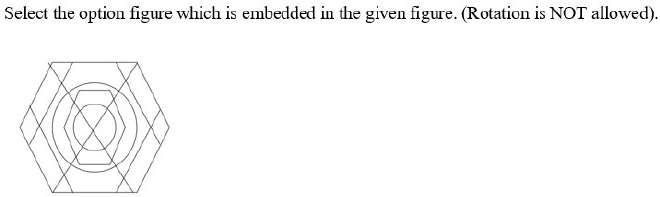
1.
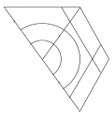
- (a)
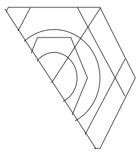
- (b)
- (c)
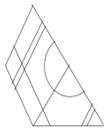
- (d)
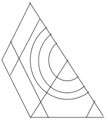
Show answer
Answer: (b)
- (a)
3. Three statements are given, followed by four conclusions numbered I, II, III and IV. Assuming the statements to be true, even if they seem to be at variance with commonly known facts, decide which of the conclusions logically follow(s) from the statements. Statements: Some desks are trays. Some trays are plates. Some plates are desks. Conclusions: I. All desks are plates. II. All plates are desks. III. Some plates are trays. IV. All trays are desks.
- (a) Only conclusion III follows
- (b) Only conclusion IV follows
- (c) Only conclusion II follows
- (d) Only conclusion I follows
Show answer
Answer: (a)
4. Select the option that is related to the third word in the same way as the second word is related to the first word. (The words must be considered as meaningful English words and must not be related to each other based on the number of letters/number of consonants/vowels in the word.) Skin : Touch :: Nose : ?
- (a) Smell
- (b) Taste
- (c) Nose ring
- (d) Sweat
Show answer
Answer: (a)
5. Ganesh was taking a walk with his mother’s brother’s father’s granddaughter. Who was he walking with?
- (a) Daughter
- (b) Mother
- (c) Cousin
- (d) Granddaughter
Show answer
Answer: (c)
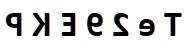
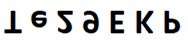
6.
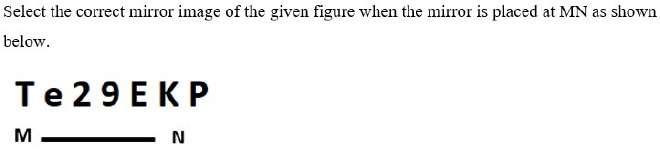
- (a)
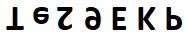
- (b)
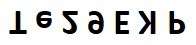
- (c)
- (d)
Show answer
Answer: (d)
- (a)
7. Which of the following letter-clusters will replace the question mark (?) in the given series? UV, OY, IB, EE, ?
- (a) ZK
- (b) AH
- (c) BI
- (d) BH
Show answer
Answer: (b)
8. The second number in the given number-pairs is obtained by performing certain mathematical operation(s) on the first number. The same operation(s) is/are followed in all the number-pairs except one. Find that odd number-pair.
- (a) 20 : 11
- (b) 6 : 4
- (c) 15 : 9
- (d) 12 : 7
Show answer
Answer: (c)
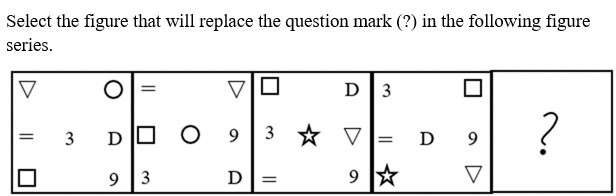
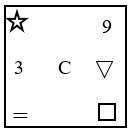
9.
- (a)
- (b)
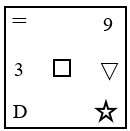
- (c)
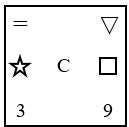
- (d)
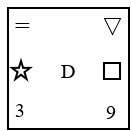
Show answer
Answer: (c)
- (a)
10. Three different positions of the same dice are shown. Find the number on the face opposite the face showing ‘1’.
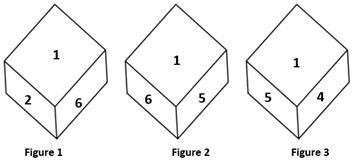
- (a) 6
- (b) 2
- (c) 3
- (d) 4
Show answer
Answer: (c)
11. Select the set in which the numbers are related in the same way as are the numbers of the following sets. (55, 11, 25) (64,16, 16) (NOTE : Operations should be performed on the whole numbers, without breaking down the numbers into its constituent digits. E.g. 13 – Operations on 13 such as adding /subtracting /multiplying etc. to 13 can be performed. Breaking down 13 into 1 and 3 and then performing mathematical operations on 1 and 3 is NOT allowed)
- (a) (33, 11, 9)
- (b) (33, 11, 22)
- (c) (33, 11, 3)
- (d) (33, 11, 10)
Show answer
Answer: (a)
12. Select the option that is related to the sixth letter-cluster in the same way as the first letter-cluster is related to the second letter-cluster and the third letter-cluster is related to the fourth letter-cluster. HMD : KOE : : BNQ : EPR :: ? : FLV
- (a) SJE
- (b) UJC
- (c) EJS
- (d) CJU
Show answer
Answer: (d)
13.
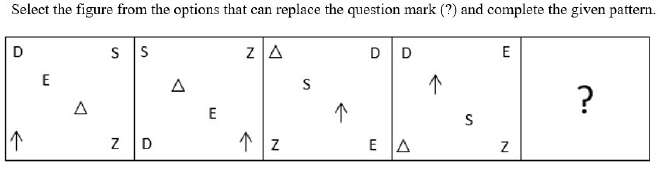
- (a)
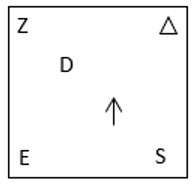
- (b)
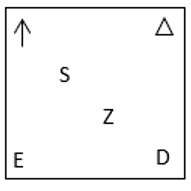
- (c)
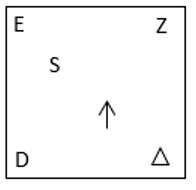
- (d)
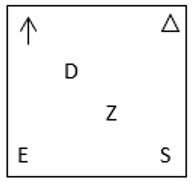
Show answer
Answer: (d)
- (a)
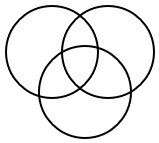
14. Select the Venn diagram that best illustrates the relationship between the following classes. Ticket, Aeroplane, Rail
- (a)
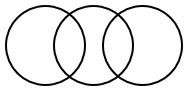
- (b)
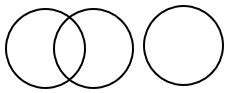
- (c)
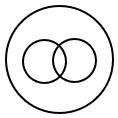
- (d)
Show answer
Answer: (a)
- (a)
15. Four letter-clusters have been given, out of which three are alike in some manner and one is different. Select the odd letter-cluster.
- (a) BFJN
- (b) DHLP
- (c) HJKP
- (d) JNRV
Show answer
Answer: (c)
16. Select the option that is related to the fifth number in the same way as the second number is related to the first number and the fourth number is related to the third number. 5 : 45::3 : 3::6 : ?
- (a) 90
- (b) 106
- (c) 110
- (d) 96
Show answer
Answer: (d)
17. Which of the following numbers will replace the question mark (?) in the given series? 8, 15, 26, ? , 56, 75
- (a) 39
- (b) 41
- (c) 35
- (d) 43
Show answer
Answer: (a)
18. Select the option that is related to the third term in the same way as the second term is related to the first term and the sixth term is related to the fifth term. 7183 : 3850 :: 6957 : ? :: 8972 : 5639
- (a) 3426
- (b) 3624
- (c) 3246
- (d) 3642
Show answer
Answer: (b)
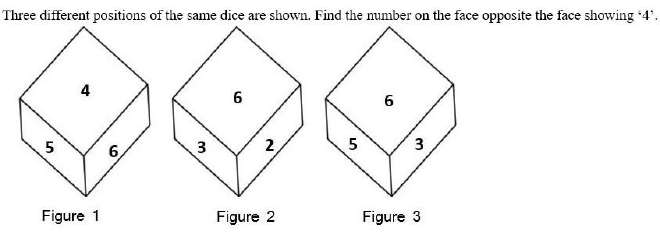
19.
- (a) 5
- (b) 6
- (c) 2
- (d) 3
Show answer
Answer: (d)
20. Select the option that is related to the fifth number in the same way as the second number is related to the first number and the fourth number is related to the third number. 625 : 5 :: 2560 : 8 :: 5000 : ?
- (a) 9
- (b) 12
- (c) 10
- (d) 15
Show answer
Answer: (c)
21. In a certain code language, ‘ASK’ is written as ‘62’ and ‘BYE’ is written as ‘64’. How will ‘CRY’ be written in that language?
- (a) 68
- (b) 72
- (c) 86
- (d) 92
Show answer
Answer: (d)
22. Select the correct combination of mathematical signs that can sequentially replace the * signs and balance the given equation. 256 * 4 * 9 * 3 * 14 = 51
- (a) × + − ÷
- (b) ÷ × − +
- (c) × ÷ + −
- (d) ÷ − × +
Show answer
Answer: (d)
23. Select the option that represents the letters that, when placed from left to right in the following blanks, will complete the letter-series. C L _ V E C _ _ W E C L O _ _ C _ O _ E
- (a) O L P X E L Y
- (b) O L O Y E L Z
- (c) O L O X F M Y
- (d) O L O X E L Y
Show answer
Answer: (d)
24. In a certain code language, ‘TABLE’ is coded as ELEAT and ‘SWING’ is coded as GNLWS. How will ‘FRAME’ be coded in the same language?
- (a) EMERF
- (b) EMDRF
- (c) ERMDF
- (d) MEDFR
Show answer
Answer: (b)
25. Which two signs should be interchanged to make the given equation correct? 588 ÷ 28 × 32 + 72 – 160 = 760
- (a) – and +
- (b) ÷ and –
- (c) + and ×
- (d) ÷ and +
Show answer
Answer: (a)
General Awareness
1. The length of the badminton court for singles is:
- (a) 13.44 m
- (b) 13.55 m
- (c) 14 m
- (d) 13.40 m
Show answer
Answer: (d)
2. Who is the Administrative Head of the Indian Audit and Accounts Department?
- (a) Accountant General
- (b) Principal Accountant General
- (c) Director General
- (d) The Comptroller and Auditor General
Show answer
Answer: (d)
3. Which of the following is the largest pan-India scheme to strengthen health care infrastructure across the country with focus on primary, secondary and tertiary care services?
- (a) LaQshya
- (b) AB-PMJAY
- (c) PM-ABHIM
- (d) PM-MI
Show answer
Answer: (c)
4. Which of the following festivals is associated with the term ‘ties of protection’?
- (a) Baisakhi
- (b) Karwa Chauth
- (c) Chhath Pooja
- (d) Raksha Bandhan
Show answer
Answer: (d)
5. In October 2021, 19-year-old ________ won the silver medal at the World Wrestling Championship.
- (a) Anshu Malik
- (b) Seema Bisla
- (c) Sanju Devi
- (d) Sonam Malik
Show answer
Answer: (a)
6. ________ emerged as the poorest state as per the first-ever Multi-dimensional Poverty Index (MPI) prepared by Niti Aayog and launched in November 2021.
- (a) Bihar
- (b) Madhya Pradesh
- (c) Uttar Pradesh
- (d) Mizoram
Show answer
Answer: (a)
7. The consumption of fixed capital is also known as _________.
- (a) depreciation
- (b) net investment
- (c) appreciation
- (d) gross investment
Show answer
Answer: (a)
8. The Vedic Aryans lived in the area called Sapt-Sindhu, which means area drained by seven rivers. One of the rivers among the seven is Jhelum. What was its ancient name?
- (a) Askini
- (b) Parushni
- (c) Vipash
- (d) Vitasta
Show answer
Answer: (d)
9. In Chola administration, ________ was the assembly in the villages which were inhabited predominantly by the Brahmanas.
- (a) Ur
- (b) Khilya
- (c) Nagaram
- (d) Sabha
Show answer
Answer: (d)
10. Which of the following states is NOT a part of the Tapi Basin?
- (a) Rajasthan
- (b) Maharashtra
- (c) Madhya Pradesh
- (d) Gujarat
Show answer
Answer: (a)
11. Which of the following is used as a cooling medium for the Large Hadron Collider (LHC) and the superconducting magnets in MRI scanners and NMR spectrometers?
- (a) Neon
- (b) Chlorine
- (c) Argon
- (d) Helium
Show answer
Answer: (d)
12. In 2018, Google Doodle celebrated the 100th birthday of Mrinalini Sarabhai. She is an exponent of which of the following dance forms?
- (a) Bharatanatyam and Kathakali
- (b) Odissi and Kathak
- (c) Kuchipudi and Bharatanatyam
- (d) Yakshagana
Show answer
Answer: (a)
13. Bharatanatyam expresses South Indian religious themes and spiritual ideas of _______.
- (a) Sufism
- (b) Shaivism
- (c) Buddhism
- (d) Jainism
Show answer
Answer: (b)
14. Who among the following musicians is popular for his mastery over the musical instrument Sitar?
- (a) Ali Akbar Khan
- (b) Vilayat Khan
- (c) Bahadur Khan
- (d) Amjad Ali Khan
Show answer
Answer: (b)
15. Which of the following countries was the host of AFC Women's Asia Cup Football–2022?
- (a) Japan
- (b) Bangladesh
- (c) India
- (d) China
Show answer
Answer: (c)
16. Ms Bhakti Pradip Kulkarni was conferred with the Arjuna Award 2022 for her outstanding contribution in which of the following sports?
- (a) Table Tennis
- (b) Chess
- (c) Badminton
- (d) Wrestling
Show answer
Answer: (b)
17. Who among the following was the founder of ‘Tiger Legion' or ‘Free India Legion'?
- (a) Vinayak Damodar Savarkar
- (b) Subhas Chandra Bose
- (c) Sohan Singh Bhakhna
- (d) Lala Hardayal
Show answer
Answer: (b)
18. Name a reproductive strategy in which parasites take advantage of the care of other individuals of the same species or different species to raise their young.
- (a) Brood parasitism
- (b) Sexual parasitism
- (c) Klepto parasitism
- (d) Competitive parasitism
Show answer
Answer: (a)
19. On the basis of tribal population (2011), identify the option that arranges the following states in ascending order. A. Madhya Pradesh B. Maharashtra C. Odisha
- (a) (C), (B), (A)
- (b) (B), (A), (C),
- (c) (C), (A), (B)
- (d) (B), (C), (A)
Show answer
Answer: (a)
20. In which industrial policy was the investment limit for tiny industry/unit increased to ₹2 lakh?
- (a) 1977
- (b) 1991
- (c) 1980
- (d) 1956
Show answer
Answer: (c)
21. Which scientist thought of the concept of steady state of the universe?
- (a) Harold Jeffrey
- (b) Edwin Hubble
- (c) Fred Hoyle
- (d) Pierre-Simon Laplace
Show answer
Answer: (c)
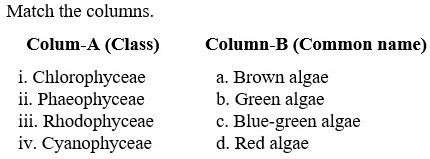
22.
- (a) i-b, ii-c, iii-a, iv-d
- (b) i-b, ii-a, iii-d, iv-c
- (c) i-d, ii-c, iii-b, iv-a
- (d) i-a, ii-b, iii-c, iv-d
Show answer
Answer: (b)
23. Ryotwari system of revenue collection in India, introduced by the British, was based on the _______.
- (a) Smith’s theory of rent
- (b) Ricardian theory of rent
- (c) Malthusian theory of rent
- (d) Marx’s theory of rent
Show answer
Answer: (b)
24. Who received the Nobel Prize in 1901 for ‘recognition of the extraordinary services rendered by the discovery of the laws of chemical dynamics and osmotic pressure in solutions’?
- (a) Hermann Emil Fischer
- (b) Jacobus Henricus van 't Hoff
- (c) Svante August Arrhenius
- (d) Henri Moissan
Show answer
Answer: (b)
25. Which of the following Articles of the Indian Constitution are related to citizenship?
- (a) Articles 15 to 21
- (b) Articles 5 to 11
- (c) Articles 2 to 4
- (d) Articles 25 to 31
Show answer
Answer: (b)
Quantitative Aptitude
1. If A is 95% of B, then what per cent of A is B?
- (a)

- (b)

- (c)

- (d)

Show answer
Answer: (d)
- (a)
2. The marked price of mustard oil is 25% more than its cost price. At what percentage less than the marked price should it be sold to have no profit and no loss?
- (a) 15%
- (b) 20%
- (c) 18%
- (d) 22%
Show answer
Answer: (b)
3. A can complete a piece of work in 25 days while B can complete the same work in 30 days. They work on alternate basis, starting with A. Both A and B follow this pattern for 5 days and then A leaves the work. In how many days will B finish the remaining work?
- (a)

- (b)

- (c)

- (d)

Show answer
Answer: (a)
- (a)
4. As part of his journey, a person travels 120 km at 80 km/h, the next 100 km at 40 km/h, and comes back to the starting point at 75 km/h. The average speed of the person throughout the journey (approximately) is:
- (a) 63.46 km/h
- (b) 58.74 km/h
- (c) 68.15 km/h
- (d) 49.58 km/h
Show answer
Answer: (a)
5. 8 men can complete a work in 45 days. 8 women can complete the same work in 18 days. In how many days will 5 men and 8 women, together, complete the same work?
- (a)

- (b)

- (c)

- (d)

Show answer
Answer: (c)
- (a)
6.

- (a) 256
- (b) 254
- (c) 255
- (d) 259
Show answer
Answer: (d)
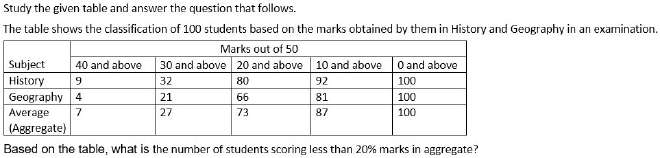
7.
- (a) 13
- (b) 11
- (c) 10
- (d) 12
Show answer
Answer: (a)
8. Two concentric circles are of radii 10 cm and 6 cm. Find the length of the chord of the larger circle which touches the smaller circle.
- (a) 8 cm
- (b) 16 cm
- (c) 12 cm
- (d) 9 cm
Show answer
Answer: (b)
9.

- (a) 75°
- (b) 30°
- (c) 15°
- (d) 45°
Show answer
Answer: (a)
10. A train 900 m long is running at 108 km/h. How long will it take to clear a 900 m long platform completely?
- (a) 60 s
- (b) 45 s
- (c) 30 s
- (d) 18 s
Show answer
Answer: (a)
11.

- (a)

- (b)

- (c)

- (d)

Show answer
Answer: (c)
- (a)
12. If m∠C=m∠Z and AC=XZ, then which of the following conditions is necessary for ΔABC and ΔXYZ to be congruent?
- (a) AB=AC
- (b) BC=YZ
- (c) AB=XY
- (d) BC=AB
Show answer
Answer: (b)
13.
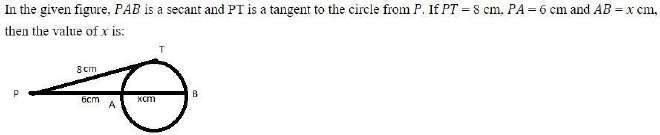
- (a)

- (b)

- (c)

- (d)

Show answer
Answer: (c)
- (a)
14. A shopkeeper offers the following two discount schemes. A) Buy 3 get 4 free B) Buy 5 get 6 free Which scheme has the maximum discount percentage?
- (a) A
- (b) A does not give any discount
- (c) A and B both have the same discount percentage
- (d) B
Show answer
Answer: (a)
15.
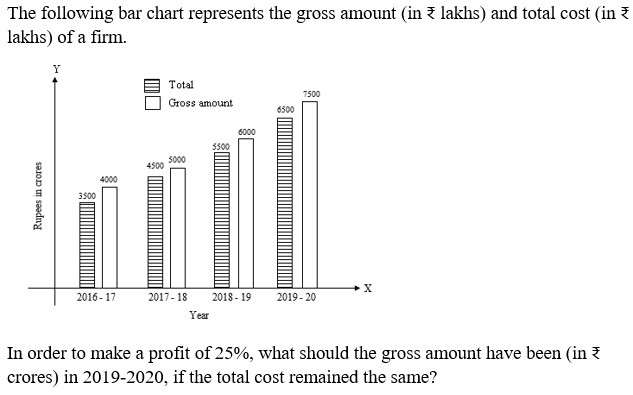
- (a) 7800
- (b) 8000
- (c) 8250
- (d) 8125
Show answer
Answer: (d)
16. In what time will ₹10,000 at 4% per annum, produce the same interest as ₹8,000 does in 4 years at 5% simple interest?
- (a) 5 years
- (b) 3 years
- (c) 4 years
- (d) 6 years
Show answer
Answer: (c)
17. A man, a boy and a woman can finish a work in 10 days, 15 days and 30 days, respectively. In how many days can the work be finished by a man, a woman and a boy when all of them work together?
- (a) 10
- (b) 5
- (c) 8
- (d) 6
Show answer
Answer: (b)
18.

- (a)

- (b)

- (c)

- (d)

Show answer
Answer: (b)
- (a)
19.

- (a) – 329
- (b) – 359
- (c) – 361
- (d) – 327
Show answer
Answer: (d)
20. If the four numbers, 39, 117, 17 and y are in proportion, then find the value of y.
- (a) 49
- (b) 51
- (c) 57
- (d) 85
Show answer
Answer: (b)
21.

- (a) 278.234 cm3
- (b) 312.725 cm3
- (c) 297.824 cm3
- (d) 310.464 cm3
Show answer
Answer: (d)
22.

- (a) 84
- (b) 83
- (c) 82
- (d) 81
Show answer
Answer: (b)
23. If {(3 sin θ – cos θ) / (cos θ + sin θ)} = 1, then the value of cot θ is:
- (a) 3
- (b) 0
- (c) 1
- (d) 2
Show answer
Answer: (c)
24. Two runners, Sony and Mony, start running on a circular track of length 200 m at speeds of 18 and 24 km/h, respectively, in the same direction. After how much time from the start will they meet again at the starting point?
- (a) 120 sec
- (b) 110 sec
- (c) 100 sec
- (d) 90 sec
Show answer
Answer: (a)
25. What will be the remainder when (265)4081+9 is divided by 266?
- (a) 8
- (b) 6
- (c) 1
- (d) 9
Show answer
Answer: (a)
English Comprehension
1. The following sentence has been split into four segments. Identify the segment that contains an error. Neetu have been / waiting for me / since 10 o’clock / in the morning.
- (a) Neetu have been
- (b) in the morning
- (c) since 10 o’clock
- (d) waiting for me
Show answer
Answer: (a)
2. Select the most appropriate ANTONYM of the underlined word. Her dog can climb under the fence.
- (a) Over
- (b) Sink
- (c) Behind
- (d) Beneath
Show answer
Answer: (a)
3. Select the INCORRECTLY spelt word in the given sentence. The village beggars, no longer ill at ease in the gathering of gliterring dignitaries, sat in their assigned rows and joked with vegetarian Brahmin apprentices.
- (a) assigned
- (b) apprentices
- (c) beggars
- (d) gliterring
Show answer
Answer: (d)
5. Select the grammatically correct sentence.
- (a) The participants of the competition are waiting for their turn curiously.
- (b) The participants of the competition has been waiting for their turn curiously.
- (c) A participants of the competition is waiting for their turn curiously.
- (d) The participants of the competition is waiting for their turn curiously.
Show answer
Answer: (a)
6. Select the most appropriate ANTONYM of the underlined word in the given sentence. Henry is so servile that other people take advantage of him.
- (a) Arrogant
- (b) Sheepish
- (c) Bickering
- (d) Cunning
Show answer
Answer: (a)
7. Select the option that can be used as a one-word substitute for the given group of words. A thing fit to eat.
- (a) Eligible
- (b) Digestible
- (c) Curable
- (d) Edible
Show answer
Answer: (d)
8. Select the most appropriate meaning of the given idiom. Lily-livered
- (a) Brave
- (b) Comical
- (c) Not brave
- (d) Naughty
Show answer
Answer: (c)
9. Select the most appropriate synonym of the given word. Zealous
- (a) Enthusiastic
- (b) Detached
- (c) Apathetic
- (d) Indifferent
Show answer
Answer: (a)
10. Select the most appropriate option that can substitute the underlined word in the given sentence. She had an ability to persuade others.
- (a) halt
- (b) suppress
- (c) outrage
- (d) impress
Show answer
Answer: (d)
11. Select the most appropriate option that can substitute the underlined segment in the given sentence. We must remember that what we teach our children is what we inculcate in them.
- (a) endanger
- (b) inspire
- (c) instil
- (d) import
Show answer
Answer: (c)
12. Select the option that expresses the given sentence in passive voice. He won’t receive any better choice than this from anywhere.
- (a) Any better choice won’t be received by him than this from anywhere.
- (b) Any better choice wouldn’t have received by him than this from anywhere.
- (c) Any better choice shouldn’t be received by him than this from anywhere.
- (d) Any better choice won’t have been be received by him than this from anywhere.
Show answer
Answer: (a)
13. Select the most appropriate synonym of the given word. Feeble
- (a) Unheedful
- (b) Strong
- (c) Weak
- (d) Baneful
Show answer
Answer: (c)
14. Select the correct spelling of the underline word. They denied having any associasion with the terrorists.
- (a) asociation
- (b) asocciation
- (c) assosiation
- (d) association
Show answer
Answer: (d)
16. Sentences of a paragraph are given below in jumbled order. Arrange the sentences in the correct order to form a meaningful and coherent paragraph. A. In Bihar and Central India, in particular, every district had smelters that used local deposits of ore to produce iron which was widely used for the manufacture of implements and tools of daily use. B. The smelting was done by men while women worked on the bellows, pumping air that kept the charcoal burning. C. But iron smelting in India was extremely common till the end of the nineteenth century. D. Production of Wootz steel required a highly specialised technique of refining iron.
- (a) ACDB
- (b) DCAB
- (c) BCDA
- (d) CBDA
Show answer
Answer: (b)
17. Sentences of a paragraph are given below in jumbled order. Arrange the sentences in the correct order to form a meaningful and coherent paragraph. A. He repeated the experiment, increasing the amount until he had weighed up to a thousand pounds. B. During the spring of 1717, the iron foundries in a remote district were often visited by a thin, middle-aged man with a notebook. C. Three cauldrons were next prepared under his directions. D. He would weigh out two pounds of iron, have them heated till they were red-hot and then weigh them again.
- (a) BDAC
- (b) ABDC
- (c) BCAD
- (d) CABD
Show answer
Answer: (a)
18. Select the most appropriate option to fill in the blank. She is _________ a peacock in the blue satin saree.
- (a) very beautiful as
- (b) so beautiful as
- (c) as beautiful as
- (d) beautiful like
Show answer
Answer: (c)
19. Sentences of a paragraph are given below in jumbled order. Arrange the sentences in the correct order to form a meaningful and coherent paragraph. A.The top band is made of saffron, which symbolises power and courage. B.The constituent assembly adopted our national flag, Tiranga, which means tricolour, on 22 July 1947. C.As a symbol of nationalism and freedom, it is fashioned from khadi, which is domestically spun Indian cotton. D.It features three horizontal stripes that are all the same width.
- (a) CBAD
- (b) CBDA
- (c) BCDA
- (d) BDCA
Show answer
Answer: (c)
20. Select the most appropriate homonym to fill in the blank. The hunter dogs followed the hyena’s ________.
- (a) sense
- (b) scent
- (c) cense
- (d) cents
Show answer
Answer: (b)
PassageFor questions 21–25
In the following passage some words have been deleted. Fill in the blanks with the help of the alternatives given. Select the most appropriate option for each number.
Human life is (1) _______ a unique blessing, which in turn depends on the (2) _______ of the Self. He who is not aware of the Self can neither have peace nor can he foster peaceful coexistence. We have to link our soul with God and body with the physical world for substance. (3) _______ the formless God is invisible to the naked eye, our mind often wanders wherever it goes. (4) _______ , we are unable to develop any love for the Divine. And religion like the white light of heavens (5) _______ multi-coloured fragmentations by the prisms of men and loses its gravity. Instead of uniting, it becomes a major dividing force. French philosopher Tail hard de Chardin, thinking deeply on meaning of our existence and relationship with the Divine, expounds, “we are not human beings having a spiritual experience, we are spiritual beings having a human experience”.
21. Select the most appropriate option to fill in blank no. 1.
- (a) considering
- (b) to consider
- (c) considered
- (d) consider
Show answer
Answer: (c)
22. Select the most appropriate option to fill in blank no. 2.
- (a) witness
- (b) known
- (c) awareness
- (d) aware
Show answer
Answer: (c)
23. Select the most appropriate option to fill in blank no. 3.
- (a) Since
- (b) From
- (c) As per
- (d) For
Show answer
Answer: (a)
24. Select the most appropriate option to fill in blank no. 4.
- (a) As a result
- (b) As a reaction
- (c) Causing
- (d) As a reason
Show answer
Answer: (a)
25. Select the most appropriate option to fill in blank no. 5.
- (a) break into
- (b) breaks to
- (c) break from
- (d) breaks into
Show answer
Answer: (d)
Show answers
Answer key
Answer key as marked in the Staff Selection Commission’s response sheet. “—” means the sheet did not show it clearly.
General Intelligence and Reasoning
- Q 1
- (b)
- Q 3
- (a)
- Q 4
- (a)
- Q 5
- (c)
- Q 6
- (d)
- Q 7
- (b)
- Q 8
- (c)
- Q 9
- (c)
- Q 10
- (c)
- Q 11
- (a)
- Q 12
- (d)
- Q 13
- (d)
- Q 14
- (a)
- Q 15
- (c)
- Q 16
- (d)
- Q 17
- (a)
- Q 18
- (b)
- Q 19
- (d)
- Q 20
- (c)
- Q 21
- (d)
- Q 22
- (d)
- Q 23
- (d)
- Q 24
- (b)
- Q 25
- (a)
General Awareness
- Q 1
- (d)
- Q 2
- (d)
- Q 3
- (c)
- Q 4
- (d)
- Q 5
- (a)
- Q 6
- (a)
- Q 7
- (a)
- Q 8
- (d)
- Q 9
- (d)
- Q 10
- (a)
- Q 11
- (d)
- Q 12
- (a)
- Q 13
- (b)
- Q 14
- (b)
- Q 15
- (c)
- Q 16
- (b)
- Q 17
- (b)
- Q 18
- (a)
- Q 19
- (a)
- Q 20
- (c)
- Q 21
- (c)
- Q 22
- (b)
- Q 23
- (b)
- Q 24
- (b)
- Q 25
- (b)
Quantitative Aptitude
- Q 1
- (d)
- Q 2
- (b)
- Q 3
- (a)
- Q 4
- (a)
- Q 5
- (c)
- Q 6
- (d)
- Q 7
- (a)
- Q 8
- (b)
- Q 9
- (a)
- Q 10
- (a)
- Q 11
- (c)
- Q 12
- (b)
- Q 13
- (c)
- Q 14
- (a)
- Q 15
- (d)
- Q 16
- (c)
- Q 17
- (b)
- Q 18
- (b)
- Q 19
- (d)
- Q 20
- (b)
- Q 21
- (d)
- Q 22
- (b)
- Q 23
- (c)
- Q 24
- (a)
- Q 25
- (a)
English Comprehension
- Q 1
- (a)
- Q 2
- (a)
- Q 3
- (d)
- Q 5
- (a)
- Q 6
- (a)
- Q 7
- (d)
- Q 8
- (c)
- Q 9
- (a)
- Q 10
- (d)
- Q 11
- (c)
- Q 12
- (a)
- Q 13
- (c)
- Q 14
- (d)
- Q 16
- (b)
- Q 17
- (a)
- Q 18
- (c)
- Q 19
- (c)
- Q 20
- (b)
- Q 21
- (c)
- Q 22
- (c)
- Q 23
- (a)
- Q 24
- (a)
- Q 25
- (d)