ExamBharo · SSC CGL 2022 Tier I — 5 December 2022, Shift 4 · exambharo.com/previous-year-papers/ssc-cgl-2022-tier-1-5-dec-shift-4/
Question paper · SSC CGL
SSC CGL 2022 Tier I — 5 December 2022, Shift 4
5 December 2022 · 5:15 PM–6:15 PM92 of the paper’s 100 questions+2 for a correct answer, −0.5 for a wrong one
8 questions of the original paper are not included: those that need a figure or formatting we cannot show, that have no answer in the response sheet, or that we could not check against a second copy of the paper.
Questions from the Staff Selection Commission’s paper of 5 December 2022, 5:15 PM–6:15 PM. Each question’s answer is under it, hidden until you open it, and the full answer key is at the end. Take the paper as a timed practice test to be scored.
General Intelligence and Reasoning
1. After interchanging the given two numbers and two signs what will be the values of equation (I) and (II) respectively? × and ÷, 7 and 9 I. 8 × 3 ÷ 6 + 9 – 7 II. 9 – 7 × 1 + 6 ÷ 3
- (a) 0, 8
- (b) 14, 16
- (c) 6, 9
- (d) 10, 11
Show answer
Answer: (b)
2. In the following question, four number pairs are given. In each pair the number on left side of (–) is related to the number of the right side of (–) with some Logic/Rule/Relation. Three pairs are similar on basis of same Logic/Rule/Relation. Select the odd one out from the given alternatives. (NOTE: Operations should be performed on the whole numbers, without breaking down the numbers into its constituent digits. E.g.13 – Operations on 13 such as adding /subtracting /multiplying etc. to 13 can be performed. Breaking down 13 into 1 and 3 and then performing mathematical operations on 1 and 3 is not allowed)
- (a) 12 – 145
- (b) 16 – 257
- (c) 14 – 193
- (d) 10 –101
Show answer
Answer: (c)
3. A series is given with one term missing. Select the correct alternative from the given ones that will complete the series. QML, PRC, OWT, NBK, ?
- (a) GMR
- (b) MGB
- (c) MBG
- (d) GQR
Show answer
Answer: (b)
4. By interchanging the given two signs which of the following equation will be correct? × and +
- (a) 7 × 8 ÷ 9 + 18 – 11 = 16
- (b) 24 – 8 – 5 × 5 + 3 = 14
- (c) 5 × 10 – 15 + 20 ÷ 25 = 8
- (d) 24 × 8 + 6 ÷ 3 – 18 = 22
Show answer
Answer: (d)
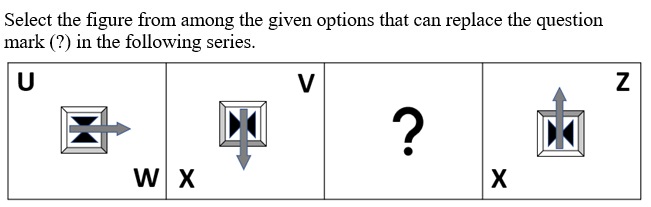
5.
- (a)
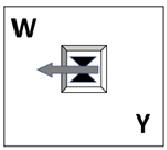
- (b)
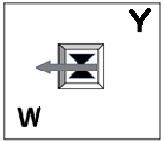
- (c)
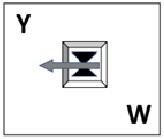
- (d)
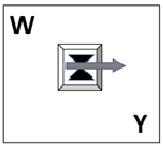
Show answer
Answer: (c)
- (a)
7. Read the given statement(s) and conclusions carefully. Assuming that the information given in the statements is true, even if it appears to be at variance with commonly known facts, decide which of the given conclusions logically follow(s) from the statement(s). Statements: Some coats are tables. No table is a mirror. All golds are tables. Conclusions: I. Some coats being golds is a possibility. II. No gold is a mirror. III. All tables are golds. IV. No coat is a mirror.
- (a) Only Conclusion I follows
- (b) Only Conclusions II and III follow
- (c) Only Conclusions I and II follow
- (d) Only Conclusions I, II and IV follow
Show answer
Answer: (c)
8. In a certain code language, 'PLAYGROUND' is written as ‘OKZXFQNTMC’ and ‘SCIENCE’ is written as ‘RBHDMBD, how will 'TYPEWRITER' be written in that language?
- (a) RVNCUQHSDQ
- (b) SXODVPGRCP
- (c) RVNCUPGRCP
- (d) SXODVQHSDQ
Show answer
Answer: (d)
9. Select the option that is related to the fifth number in the same way as the second number is related to the first number and the fourth number is related to the third number. 6 : 125 :: 2 : 1 :: 5 : ?
- (a) 81
- (b) 64
- (c) 68
- (d) 72
Show answer
Answer: (b)
10.

- (a)

- (b)

- (c)

- (d)

Show answer
Answer: (a)
- (a)
11. In the following question below are given some statements followed by some conclusions based on those statements. Taking the given statements to be true even if they seem to be at variance from commonly known facts. Read all the conclusions and then decide which of the given conclusion logically follows the given statements. Statements: I. All P are W. II. No O is W. Conclusion: I. Some O are not P. II. All W are O.
- (a) Neither conclusion follows
- (b) Only conclusion I follows
- (c) Only conclusion II follows
- (d) Both conclusions I and II follows
Show answer
Answer: (b)
12.
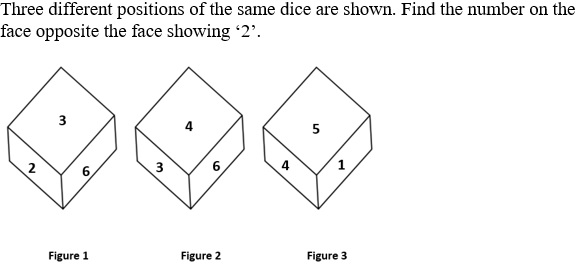
- (a) 4
- (b) 5
- (c) 6
- (d) 1
Show answer
Answer: (a)
13.
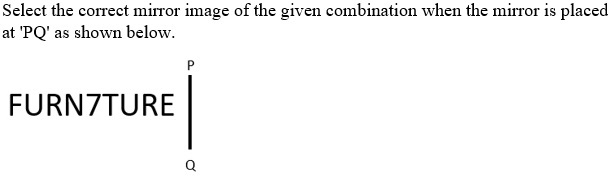
- (a)

- (b)

- (c)

- (d)

Show answer
Answer: (d)
- (a)
14. Which two numbers from amongst the given options should be interchanged to make the given equation correct? 248 ÷ 4 + 184 ÷ ( 4 × 6 – 2 × 8) = 77
- (a) 8 and 4
- (b) 184 and 77
- (c) 184 and 248
- (d) 4 and 6
Show answer
Answer: (c)
15. A # B means ‘A is the sister of B’. A @ B means ‘A is the son of B’. A & B means ‘A is the father of B’. A % B means ‘A is the mother of B’. If W & Q # T & Y @ M % K, then how is W related to K?
- (a) Mother’s father
- (b) Brother
- (c) Father’s father
- (d) Father
Show answer
Answer: (c)
16. In a certain code language, 'BOSS’ is coded as '21967' and 'DEAL' is coded as '19192414'. How will 'GAIN' be coded in that language?
- (a) 16231512
- (b) 16241612
- (c) 16231612
- (d) 16231611
Show answer
Answer: (c)
17. Study the given pattern carefully and select the number that can replace the question mark (?) in it. First row - 15, 11, 43 Second row - 13, 8, 48 Third row - 9, 7, ? (NOTE : Operations should be performed on the whole numbers, without breaking down the numbers into its constituent digits. E.g. 13 – Operations on 13 such as adding / subtracting / multiplying etc. to 13 can be performed. Breaking down 13 into 1 and 3 and then performing mathematical operations on 1 and 3 is NOT allowed)
- (a) 23
- (b) 30
- (c) 27
- (d) 28
Show answer
Answer: (a)
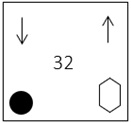
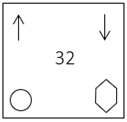
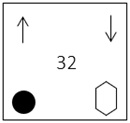
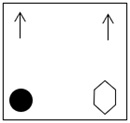
18.
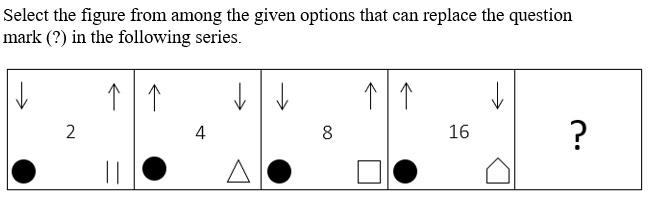
- (a)
- (b)
- (c)
- (d)
Show answer
Answer: (a)
- (a)
19. Select the set in which the numbers are related in the same way as are the numbers of the following set. (NOTE: Operations should be performed on the whole numbers, without breaking down the numbers into its constituent digits.) (5, 41, 4) (2, 68, 8)
- (a) (6, 100, 8)
- (b) (5, 18, 4)
- (c) (5, 100, 4)
- (d) (4, 49, 3)
Show answer
Answer: (a)
20. Select the option that is related to the third word in the same way as the second word is related to the first word. (The words must be considered as meaningful English words and must not be related to each other based on the number of letters/number of consonants/vowels in the word.) Ant : Antling :: Deer : ?
- (a) Pup
- (b) Fawn
- (c) Cub
- (d) Foal
Show answer
Answer: (b)
21. Which of the following numbers will replace the question mark (?) in the given series? 97, 131, 165, 199, 233, ?
- (a) 260
- (b) 273
- (c) 251
- (d) 267
Show answer
Answer: (d)
22. If K ÷ L means that K is the mother of L, K – L means that K is the father of L, K × L means that K is the sister of L, then which of the following expression shows that P is the paternal grandmother of R?
- (a) P ÷ Q × R
- (b) R – Q ÷ P
- (c) P ÷ Q – R
- (d) Q ÷ P – R
Show answer
Answer: (c)
23. Which of the following letter-clusters will replace the question mark (?) in the given series? HFK, KHM, ?, QLQ, TNS
- (a) NJO
- (b) OKN
- (c) MJN
- (d) MKP
Show answer
Answer: (a)
24. Three of the following letter-clusters are alike in some manner and hence form a group. Which letter-cluster does not belong to that group?
- (a) YNUF
- (b) CRYB
- (c) ATRE
- (d) DSZA
Show answer
Answer: (c)
25. Select the option that is related to the third word in the same way as the second word is related to the first word. (The words must be considered as meaningful English words and must not be related to each other based on the number of letters/number of consonants/vowels in the word.) Rice : Grain :: Lentils : ?
- (a) Pulses
- (b) Sprouts
- (c) Cereal
- (d) Starch
Show answer
Answer: (a)
General Awareness
1. As per the Hindu calendar, Ugadi festival in southern states of India is celebrated in which of the following months?
- (a) Margashirsha
- (b) Vaishaka
- (c) Chaitra
- (d) Shravan
Show answer
Answer: (c)
2. Who among the following was the winner of the National Film Award in 2002 for his choreography in the Hindi movie ‘Lagaan’?
- (a) Ahmed Khan
- (b) Raju Khan
- (c) Dinesh Kumar
- (d) Shiamak Davar
Show answer
Answer: (b)
4. Which of the following is a right under Article 300A?
- (a) Right to freedom
- (b) Right to life
- (c) Right to property
- (d) Right to education
Show answer
Answer: (c)
5. Which of the following is known as the world’s wettest place?
- (a) Waialeal
- (b) Mumbai
- (c) Mawsynram
- (d) Singapore
Show answer
Answer: (c)
6. In September 2022, which legislative assembly withdrew a bill aimed at prohibiting the movement of stray cattle on roads and public places in urban areas of the state, months after it was passed?
- (a) Andhra Pradesh
- (b) Gujarat
- (c) Uttar Pradesh
- (d) Assam
Show answer
Answer: (b)
7. Who became the Nawab of Bengal in 1756 after the death of Alivardi Khan?
- (a) Siraj Ud Daulah
- (b) Nigam Shaan
- (c) Shaan Nawab
- (d) Murshid Quli Khan
Show answer
Answer: (a)
8. An early temple at Bhitargaon, Uttar Pradesh was built about 1500 years ago was made of _______.
- (a) wood
- (b) mud brick
- (c) clay and thatch
- (d) baked brick
Show answer
Answer: (d)
9. Which of the following is a famous folk dance of Odisha?
- (a) Birha
- (b) Ghoomar
- (c) Kalbelia
- (d) Rangabati
Show answer
Answer: (d)
10. Which theory discusses the relationship between ligand bonding and degradation of d orbitals in metal complexes and the geometry of metal complexes and the splitting of d orbitals?
- (a) Crystal field theory (CFT)
- (b) Ligand field theory (LFT)
- (c) Valence bond theory (VBT)
- (d) Molecular orbital theory (MOT)
Show answer
Answer: (a)
11. The West Bengal government has launched 'Paray Shikshalaya’ programme. This initiative supports _______.
- (a) open air classroom
- (b) financial assistance for girl child
- (c) blackboard distribution in every school
- (d) higher education for class 10th students
Show answer
Answer: (a)
12. Which Indian musician performed ‘Raga For Peace’ at the 2014 Nobel Peace Prize Concert in Oslo?
- (a) Bahadur Khan
- (b) Amjad Ali Khan
- (c) Buddhadev Das Gupta
- (d) Satyaki Banerjee
Show answer
Answer: (b)
13. Who has been appointed as the chairman of Defence Research and Development Organisation and in August 2022?
- (a) Rajiv bahl
- (b) Anil Chouhan
- (c) Samir V Kamat
- (d) Ranjit Rath
Show answer
Answer: (c)
14. An undifferentiated layer, ______, is present in between the ectoderm and the endoderm.
- (a) Coeliea
- (b) Acoelomea
- (c) Ectinoglea
- (d) Mesoglea
Show answer
Answer: (d)
15. Developing place of settlement is called _________ .
- (a) Home
- (b) Site
- (c) Plain
- (d) Shelter
Show answer
Answer: (b)
16. Which of the following is caused by exagenic force?
- (a) Crosion
- (b) Landslide
- (c) Earthquake
- (d) Volcano
Show answer
Answer: (a)
17. How many times has India hosted the ICC Men’s Cricket World Cup (One Day)?
- (a) 2
- (b) 1
- (c) 4
- (d) 3
Show answer
Answer: (d)
18. The first match of IPL 2022 was played in_______.
- (a) Bengaluru
- (b) Mumbai
- (c) Kolkata
- (d) Lucknow
Show answer
Answer: (b)
19. In India initially HYVP was implemented in about how much area?
- (a) 5 million hectares
- (b) 3 million hectares
- (c) 4 million hectares
- (d) 2 million hectares
Show answer
Answer: (d)
20. Which of the following greenhouse gases is most abundant in the atmosphere?
- (a) Nitrous Oxide
- (b) Water Vapour
- (c) Methane
- (d) Carbon Oxide
Show answer
Answer: (b)
21. Who among the following was the best-known Chahamana ruler?
- (a) Prithviraja III
- (b) Vigraharaja II
- (c) Prithviraja I
- (d) Vasudeva
Show answer
Answer: (a)
22. In which year was the Indian Parliamentary Group established?
- (a) 1950
- (b) 1949
- (c) 1948
- (d) 1951
Show answer
Answer: (b)
23. The government of India initiated the comprehensive family planning programme in the year ______.
- (a) 1960
- (b) 1991
- (c) 1972
- (d) 1982
Show answer
Answer: (c)
24. Which of the following revolts was led by Kanhu and Sidhu?
- (a) Bheel Revolt
- (b) Khasi Revolt
- (c) Munda Revolt
- (d) Santhal Revolt
Show answer
Answer: (d)
25. Identify an example of diploblastic animals.
- (a) Platyhelminthes
- (b) Arachnids
- (c) Chordates
- (d) Coelenterates
Show answer
Answer: (d)
Quantitative Aptitude
1.
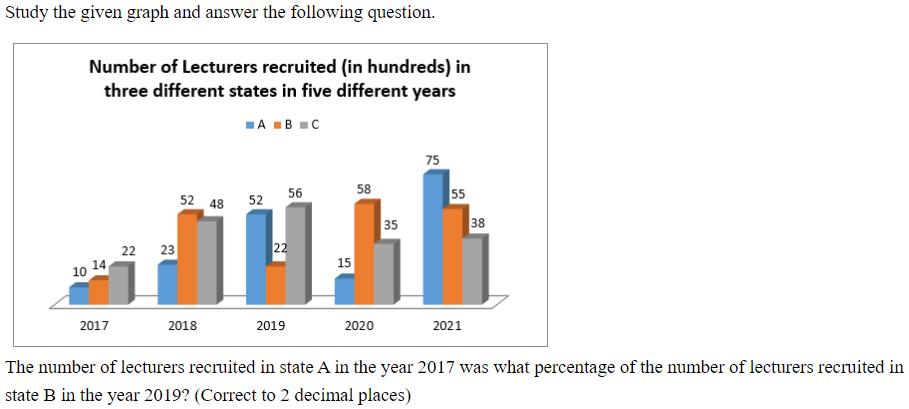
- (a) 42.50%
- (b) 36.25%
- (c) 45.45%
- (d) 56.23%
Show answer
Answer: (c)
3. A cap having marked price ₹90 is sold for ₹68. What is the percent rate of discount (correct up to two decimal places)?
- (a)

- (b)

- (c)

- (d)

Show answer
Answer: (a)
- (a)
4.

- (a) 16 cm
- (b) 14 cm
- (c) 10 cm
- (d) 12 cm
Show answer
Answer: (c)
5.

- (a) 212
- (b) 216
- (c) 180
- (d) 196
Show answer
Answer: (c)
7. Two tourist buses start from the same point and move along two roads at right angles at speeds of 48 km/h and 36 km/h, respectively. The distance between the buses after 15 seconds is ________.
- (a) 175m
- (b) 350m
- (c) 250m
- (d) 150m
Show answer
Answer: (c)
8. The table given below shows the earnings of two persons on five different days.
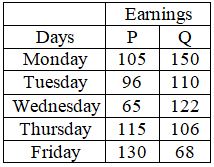 What is the ratio of total earnings of P to the total earnings of Q?
- (a) 511 : 556
- (b) 531 : 331
- (c) 556 : 511
- (d) 331 : 441
Show answer
Answer: (a)
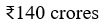
9.
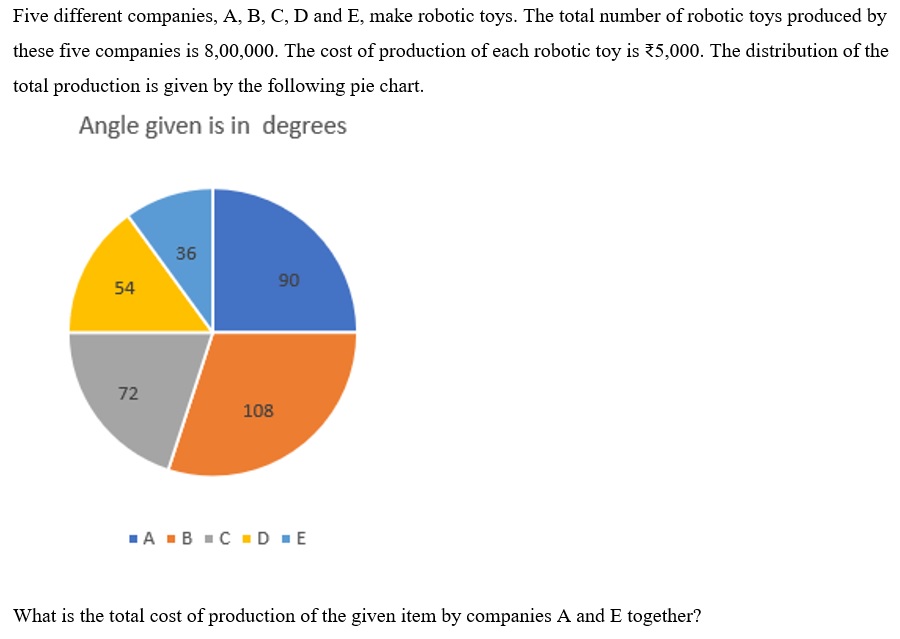
- (a)
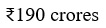
- (b)

- (c)

- (d)
Show answer
Answer: (d)
- (a)
10. If ∆ABC ~ ∆DEF, and BC = 4 cm, EF = 5 cm and the area of triangle ABC = 80 cm2, then the area of the triangle DEF is:
- (a)

- (b)

- (c)

- (d)

Show answer
Answer: (d)
- (a)
11. A certain sum amounts to ₹3,640 in 2 years and ₹4,060 in 8 years at simple interest. Find the approximate rate percentage per annum?
- (a)

- (b)

- (c)

- (d)

Show answer
Answer: (b)
- (a)
12.

- (a) 12
- (b) 7
- (c) 2
- (d) 5
Show answer
Answer: (b)
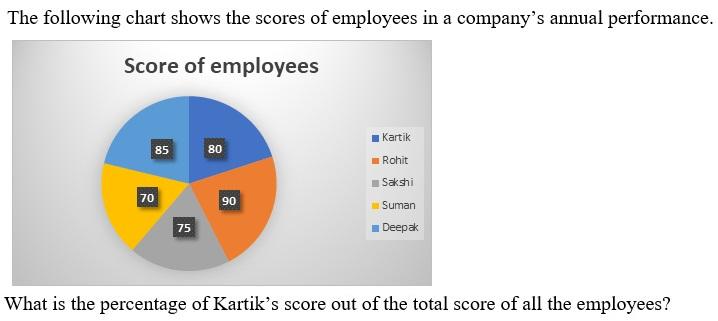
13.
- (a)

- (b)

- (c)

- (d)

Show answer
Answer: (d)
- (a)
14.

- (a)

- (b)

- (c)

- (d)

Show answer
Answer: (b)
- (a)
15.

- (a)

- (b)

- (c)

- (d)

Show answer
Answer: (d)
- (a)
16. The LCM of the two numbers is 4104 and the HCF is 9. If one of the numbers is 171, find the other.
- (a) 218
- (b) 215
- (c) 220
- (d) 216
Show answer
Answer: (d)
17. If x2 − 2xy = 84 and x − y = −10, then the value of y is:
- (a) 2
- (b) 1
- (c) 4
- (d) 3
Show answer
Answer: (c)
18. There are 3 taps A, B, and C in a tank. These can fill the tank in 10 hours, 20 hours and 25 hours, respectively. At first, all three taps are opened simultaneously. After 2 hours, tap C is closed and A and B keep running. After 4 hours from the beginning, tap B is also closed. The remaining tank is filled by tap A alone. Find the percentage of work done by tap A itself.
- (a) 32%
- (b) 75%
- (c) 52%
- (d) 72%
Show answer
Answer: (d)
19. Prasad goes 96 kilometres on a bike at a speed of 16 km/h, 124 kilometres at 31 km/h in a car, and 105 kilometres at 7 km/h in a horse cart. Find his average speed for the entire distance travelled.
- (a) 16 km/h
- (b) 13 km/h
- (c) 17 km/h
- (d) 11 km/h
Show answer
Answer: (b)
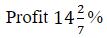
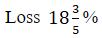
20. Apples were purchased at 100 for Rs.350 and sold at Rs.48 a dozen. What is the profit or loss percentage?
- (a)
- (b)
- (c)

- (d)

Show answer
Answer: (a)
- (a)
21. In a ∆ABC, AB = BC, and P, Q and R are the mid points of the sides AB, BC and AC, respectively. If PR = 5 cm, then find the length of QR.
- (a) 5 cm
- (b) 2 cm
- (c) 7 cm
- (d) 4 cm
Show answer
Answer: (a)
22. Two numbers are in the ratio of 5 : 7. If 6 be added to each, the ratio becomes 3 : 4. Find the numbers.
- (a) 30, 42
- (b) 55, 88
- (c) 10, 16
- (d) 25, 40
Show answer
Answer: (a)
23. During the first year, the population of a town increased by 12%.The next year, due to some contagious disease, it decreased by 8%. At the end of the second year, the population was 64,400. Find the population of the town at beginning of the first year.
- (a) 50,000
- (b) 54,750
- (c) 62,500
- (d) 50,500
Show answer
Answer: (c)
24.

- (a) 6
- (b) 7
- (c) 8
- (d) 9
Show answer
Answer: (c)
25. Three circles of radius 4 cm are kept touching each other. The string is tightly tied around these three circles. What is the length of the string?
- (a) 24 + 8p cm
- (b) 24p + 16 cm
- (c) 32 + 16p cm
- (d) 24 + 18p cm
Show answer
Answer: (a)
English Comprehension
3. Select the INCORRECTLY spelt word.
- (a) Dimolish
- (b) Conduct
- (c) Biopic
- (d) Handful
Show answer
Answer: (a)
4. Select the most appropriate ANTONYM of the underlined word. The Government ruthlessly decided to force its citizens to pay taxes even during famine.
- (a) Leniently
- (b) Indifferently
- (c) Unscrupulously
- (d) Tyrannically
Show answer
Answer: (a)
5. Select the most appropriate option that can substitute the underlined segment in the given sentence. Mother ordered John to switch on the light as it was time to sleep.
- (a) to switch of the light
- (b) to switch in the light
- (c) to switch off the light
- (d) to switch out the light
Show answer
Answer: (c)
6. Select the word that is OPPOSITE in meaning to the given word. Cease
- (a) Origin
- (b) Halt
- (c) Produce
- (d) Begin
Show answer
Answer: (d)
8. Select the most appropriate meaning of the given idiom. In hot waters
- (a) To be in trouble
- (b) To dip in hot water
- (c) To be in a hot climate
- (d) To feel relaxed
Show answer
Answer: (a)
9. Select the most appropriate collocation to substitute the underlined word in the given sentence. The intern should take a right choice in choosing the right job for her.
- (a) rake a right choice
- (b) make a right choice
- (c) fix a right choice
- (d) take the right choice
Show answer
Answer: (b)
10. Select the option that is similar in meaning to the underlined word. No plausible explanation could be found for her disappearance.
- (a) Just
- (b) Legal
- (c) Credible
- (d) Useless
Show answer
Answer: (c)
12. Select the option that can be used as a one-word substitute for the given group of words. An excessively intense desire for returning to past or lost conditions
- (a) Affection
- (b) Glitterati
- (c) Nostalgia
- (d) Paranoia
Show answer
Answer: (c)
13. Select the option that can be used as a one-word substitute for the given group of words. The act of killing one’s mother
- (a) Regicide
- (b) Homicide
- (c) Uxoricide
- (d) Matricide
Show answer
Answer: (d)
14. Select the correct active form of the given sentence. This game will not be played by you.
- (a) You will not play this game.
- (b) You will not be playing this game.
- (c) You could not play this game.
- (d) You had not play this game.
Show answer
Answer: (a)
15. Rearrange the parts of the sentence in correct order. We are encouraged P. help accelerate their return to Q. by how women are embracing online R. work and promote economic mobility S. learning to develop new skills that can
- (a) QSPR
- (b) PSQR
- (c) PRQS
- (d) SPRQ
Show answer
Answer: (a)
16. Select the most appropriate synonym of the given word. Wrathful
- (a) Pleased
- (b) Amiable
- (c) Furious
- (d) Cordial
Show answer
Answer: (c)
17. Select the INCORRECTLY spelt word in the following sentence. Ratan is such an efficient sergeant that he doesn’t need to imbibe any artillery craftmanship.
- (a) artillery
- (b) efficient
- (c) craftmanship
- (d) sergeant
Show answer
Answer: (c)
18. Select the most appropriate option to substitute the underlined segment in the given sentence. Biden write a letter to the Russian President to restrain from war.
- (a) writes a letter
- (b) wrote a letter
- (c) write a good letter
- (d) writing a surprise letter
Show answer
Answer: (b)
19. Select the sentence with the appropriate use of preposition.
- (a) We have been playing for 4 o’clock.
- (b) We have been playing from 4 o’clock.
- (c) We have been playing to 4 o’clock.
- (d) We have been playing since 4 o’clock.
Show answer
Answer: (d)
20. Select the most appropriate option to fill in the blank. I looked at her face and found she was getting disturbed. I decided to drop that ________.
- (a) product
- (b) chance
- (c) subject
- (d) pride
Show answer
Answer: (c)
PassageFor questions 21–25
In the following passage, some words have been deleted. Read the passage carefully and select the most appropriate option to fill in each blank. A robot is a mechanical or virtual artificial agent, usually an electromechanical machine that is (1)______ by a computer programme or electronic circuitry. In general, robots can be autonomous or semi-autonomous and are now used in different fields. They have replaced (2)_______ in performing repetitive and dangerous tasks which humans prefer not to do, or are unable to do because of size limitations, or which take place in extreme (3)________ such as outer space or the bottom of the sea. For instance, robots can now be used in industry, as in car manufacturing, or they can be used in homes to do the (4)_______. Some robots may respond to speech or even be medical operating tools. There are concerns about the increasing use of robots and their role in society. Robots are blamed for the rising (5)________ as they replace workers in increasing numbers of functions.
21. Select the most appropriate option to fill in blank number 1.
- (a) included
- (b) chased
- (c) guided
- (d) challenged
Show answer
Answer: (c)
22. Select the most appropriate option to fill in blank number 2.
- (a) machines
- (b) humans
- (c) agents
- (d) toys
Show answer
Answer: (b)
23. Select the most appropriate option to fill in blank number 3.
- (a) beauty
- (b) pattern
- (c) enjoyment
- (d) environments
Show answer
Answer: (d)
24. Select the most appropriate option to fill in blank number 4.
- (a) network
- (b) housework
- (c) software
- (d) handwork
Show answer
Answer: (b)
25. Select the most appropriate option to fill in blank number 5.
- (a) unemployment
- (b) peace
- (c) social issues
- (d) corruption
Show answer
Answer: (a)
Show answers
Answer key
Answer key as marked in the Staff Selection Commission’s response sheet. “—” means the sheet did not show it clearly.
General Intelligence and Reasoning
- Q 1
- (b)
- Q 2
- (c)
- Q 3
- (b)
- Q 4
- (d)
- Q 5
- (c)
- Q 7
- (c)
- Q 8
- (d)
- Q 9
- (b)
- Q 10
- (a)
- Q 11
- (b)
- Q 12
- (a)
- Q 13
- (d)
- Q 14
- (c)
- Q 15
- (c)
- Q 16
- (c)
- Q 17
- (a)
- Q 18
- (a)
- Q 19
- (a)
- Q 20
- (b)
- Q 21
- (d)
- Q 22
- (c)
- Q 23
- (a)
- Q 24
- (c)
- Q 25
- (a)
General Awareness
- Q 1
- (c)
- Q 2
- (b)
- Q 4
- (c)
- Q 5
- (c)
- Q 6
- (b)
- Q 7
- (a)
- Q 8
- (d)
- Q 9
- (d)
- Q 10
- (a)
- Q 11
- (a)
- Q 12
- (b)
- Q 13
- (c)
- Q 14
- (d)
- Q 15
- (b)
- Q 16
- (a)
- Q 17
- (d)
- Q 18
- (b)
- Q 19
- (d)
- Q 20
- (b)
- Q 21
- (a)
- Q 22
- (b)
- Q 23
- (c)
- Q 24
- (d)
- Q 25
- (d)
Quantitative Aptitude
- Q 1
- (c)
- Q 3
- (a)
- Q 4
- (c)
- Q 5
- (c)
- Q 7
- (c)
- Q 8
- (a)
- Q 9
- (d)
- Q 10
- (d)
- Q 11
- (b)
- Q 12
- (b)
- Q 13
- (d)
- Q 14
- (b)
- Q 15
- (d)
- Q 16
- (d)
- Q 17
- (c)
- Q 18
- (d)
- Q 19
- (b)
- Q 20
- (a)
- Q 21
- (a)
- Q 22
- (a)
- Q 23
- (c)
- Q 24
- (c)
- Q 25
- (a)
English Comprehension
- Q 3
- (a)
- Q 4
- (a)
- Q 5
- (c)
- Q 6
- (d)
- Q 8
- (a)
- Q 9
- (b)
- Q 10
- (c)
- Q 12
- (c)
- Q 13
- (d)
- Q 14
- (a)
- Q 15
- (a)
- Q 16
- (c)
- Q 17
- (c)
- Q 18
- (b)
- Q 19
- (d)
- Q 20
- (c)
- Q 21
- (c)
- Q 22
- (b)
- Q 23
- (d)
- Q 24
- (b)
- Q 25
- (a)