ExamBharo · UP PGT 2021 — Chemistry (Series A) · exambharo.com/up-pgt/previous-year-papers/up-pgt-2021-chemistry-series-a/
Question paper · UP PGT
UP PGT 2021 — Chemistry (Series A)
17 or 18 August 2021125 questions+3.4 for a correct answer, −0 for a wrong one
Questions from the U.P. Secondary Education Services Selection Board’s paper of 17 or 18 August 2021. Each question’s answer is under it, hidden until you open it, and the full answer key is at the end. Take the paper as a timed practice test to be scored.
The official booklet is a scan with no text, so ExamBharo typed this paper from it by hand. A typing slip is possible; report one through the contact page.
The board deleted questions 6, 29 and 96 in its final answer key: shown here, with no answer, and not counted in the score.
Chemistry
1. The work done, in dissolving one mole of zinc in an aqueous HCl in open beaker at 27°C is
- (a) 8.314 kJ
- (b) 2.494 kJ
- (c) 24.94 J
- (d) 8.314 J
Show answer
Answer: (b)
2. The equation that represents the water gas shift reaction is
- (a) CH₄(g) + H₂O(g) —(1270K, Ni)→ CO(g) + 3H₂(g)
- (b) 2C(s) + O₂(g) + 4N₂(g) —(1273K)→ 2CO(g) + 4N₂(g)
- (c) C(s) + H₂O(g) —(1270K)→ CO(g) + H₂(g)
- (d) CO(g) + H₂O(g) —(673K, Catalyst)→ CO₂(g) + H₂(g)
Show answer
Answer: (d)
3. The synthesis of aromatic hydrocarbons can not be done by the process
- (a) Fittig reaction
- (b) Wurtz-Fittig reaction
- (c) Wurtz reaction
- (d) Friedal-Craft alkylation
Show answer
Answer: (c)
4. The aqueous solution of a salt of one of the given lanthanide ions is used as a volumetric standard in redox reactions. Identify the lanthanide ion.
- (a) Ce⁴⁺
- (b) Pr⁴⁺
- (c) Tb⁴⁺
- (d) Dy⁴⁺
Show answer
Answer: (a)
5. A Cobalt (II) complex is expected to have lowest value of magnetic moment when the ligand field in it is
- (a) a weak octahedral field
- (b) a strong octahedral field
- (c) a weak tetrahedral field
- (d) a strong tetrahedral field
Show answer
Answer: (b)
6. “Photochemical equivalence can only be applied to primary processes”. This statement was given by
- (a) Stark
- (b) Bodenstein
- (c) Einstein
- (d) Grotthus
Show answer
Answer: —
7. Which one of the following has the highest melting point ?
- (a) Tartaric acid
- (b) Aminoacetic acid
- (c) Succinic acid
- (d) Oxalic acid
Show answer
Answer: (b)
8. Ratio of molar heat capacities of diatomic gas molecules is
- (a) 1.15
- (b) 1.16
- (c) 1.30
- (d) 1.67
Show answer
Answer: (c)
9. The unit of specific conductance in SI system is
- (a) S cm⁻¹
- (b) ohm⁻¹ cm⁻¹
- (c) S m⁻¹
- (d) ohm⁻¹ m⁻¹
Show answer
Answer: (c)
10. Among the following complexes most stable species are
- (a) [AgI₂]⁻, [CoF₆]³⁻, [Co(NCS)₄]²⁻
- (b) [AgF₂]⁻, [CoI₆]³⁻, [Pd(NCS)₄]²⁻
- (c) [Co(CN)₅F]³⁻, [Co(NCS)₄]²⁻, [Pd(SCN)₄]²⁻
- (d) [Co(NH₃)₅F]²⁺, [CoF₆]³⁻, [Co(SCN)₄]²⁻
Show answer
Answer: (a)
11. In the three heterocyclic compounds, for example, furan, pyrrole and thiophene, the order of aromaticity is
- (a) Thiophene > pyrrole > furan
- (b) Pyrrole > thiophene > furan
- (c) Pyrrole > furan > thiophene
- (d) Furan > pyrrole > thiophene
Show answer
Answer: (a)
12. Why presence of oxygen decreases the rate of chlorination of methane in the presence of sunlight ?
- (a) CH₃ − Ȯ is formed
- (b) CH₃ − O − Cl is formed
- (c) CH₃ − O − Ȯ is formed
- (d) CH₃ − O − ĊH₂ is formed
Show answer
Answer: (c)
13. The glucose molecule reacts with X molecules of phenyl hydrazine to yield osazone. The value of X is
- (a) 4
- (b) 2
- (c) 3
- (d) 1
Show answer
Answer: (c)
14. Which one of the following will have the highest coagulating power for As₂S₃ colloid ?
- (a) PO₄³⁻
- (b) Al³⁺
- (c) SO₄²⁻
- (d) Na⁺
Show answer
Answer: (b)
15. [Re₂Cl₈]²⁻ possess
- (a) Single bond between two Re
- (b) Double bond between two Re
- (c) Triple bond between two Re
- (d) Quadruple bond between two Re
Show answer
Answer: (d)
16. Which complex amongst the following is stable according to HSAB principle ?
- (a) [AgF₂]⁻
- (b) [Cd(NH₃)₄]²⁺
- (c) [CoI₆]³⁻
- (d) [AgI₂]⁻
Show answer
Answer: (d)
17. The collision theory of reaction rates is only valid for
- (a) Complex reactions
- (b) Parallel reactions
- (c) Simple bimolecular reactions
- (d) All the reactions
Show answer
Answer: (c)
18. Which ion possess sp³d² hybridisation ?
- (a) [IF₆]⁻
- (b) [ICl₄]⁻
- (c) [BrF₂]⁻
- (d) [ICl₂]⁻
Show answer
Answer: (b)
19. The outcome of Carnot’s theorem is the concept of the following
- (a) Enthalpy
- (b) Internal energy
- (c) Free energy
- (d) Entropy
Show answer
Answer: (d)
20. Surface area of an adsorbent is calculated by using following equation
- (a) Freundlich equation
- (b) Langmuir equation
- (c) B.E.T. equation
- (d) McBain equation
Show answer
Answer: (c)
21. Among the chlorides of alkaline earths given below, the lowest melting point as per Fajan’s rules will be shown by
- (a) CaCl₂
- (b) BaCl₂
- (c) MgCl₂
- (d) SrCl₂
Show answer
Answer: (c)
22. Who first used phenyl isothiocyanate for the synthesis of a peptide ?
- (a) Frederic Sanger
- (b) Max Bergmann
- (c) Leonidas Zervas
- (d) Fehr Edman
Show answer
Answer: (d)
23. The most strong acid is
- (a)
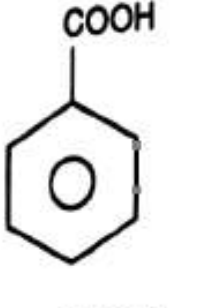
- (b)
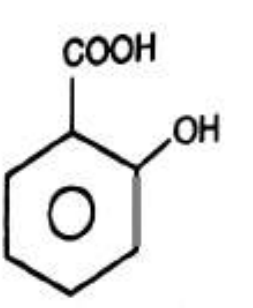
- (c)
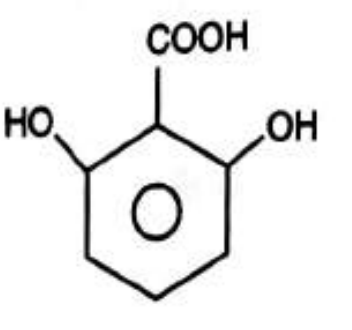
- (d)
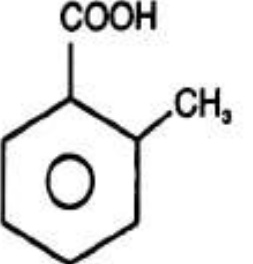
Show answer
Answer: (c)
- (a)
24. Which of the following compounds has a cylindrical symmetry ?
- (a) Ethane
- (b) Ethyne
- (c) Methane
- (d) Ethene
Show answer
Answer: (b)
25. First law of thermodynamics is based on
- (a) Theory
- (b) Derivation
- (c) Quantum mechanics
- (d) Experimental facts
Show answer
Answer: (d)
26. 4PCl₅ + 4NH₃ → ? The aforementioned reaction yields
- (a) (PNCl₂)₃ + 9HCl
- (b) (PNCl₂)₄ + 12HCl
- (c) (PNCl₂)₃ + 12HCl
- (d) (PNCl₂)₄ + 9HCl
Show answer
Answer: (b)
27. Concentrations of following aqueous solutions are equal. Select the solution with highest B.P.
- (a) Potassium sulfate
- (b) Potassium chloride
- (c) Potassium phosphate
- (d) Urea
Show answer
Answer: (c)
28. In orthoboric acid, H₃BO₃, the trigonal BO₃³⁻ units are bonded together through
- (a) Electrovalent bond
- (b) Covalent bond
- (c) Hydrogen bonds into two dimensional sheet
- (d) Coordinate bonds
Show answer
Answer: (c)
29. The expression for Joul-Thomson coefficient μ_JT is
- (a) μ_JT = −(∂H/∂P)_T / C_V
- (b) μ_JT = −(∂E/∂P)_T / C_V
- (c) μ_JT = −(∂E/∂V)_T / C_P
- (d) μ_JT = −(∂H/∂V)_T / C_P
Show answer
Answer: —
30. With Fenton’s reagent t-butanol forms
- (a) CH₃CH₂CH₂CHO
- (b) (CH₃)₂C(OH)CH₂CH₂C(OH)(CH₃)₂
- (c) CH₃CH₂CH₂COOH
- (d) (CH₃)₂C(OH)CH═CHC(OH)(CH₃)₂
Show answer
Answer: (b)
31. Hydrolysis of which of the following compounds forms benzaldehyde ?
- (a) Benzyl chloride
- (b) Benzal chloride
- (c) Benzotrichloride
- (d) Benzonitrile
Show answer
Answer: (b)
32. Number of Cr−O bonds in Chromium (II) acetate hydrate are
- (a) 2
- (b) 9
- (c) 10
- (d) 8
Show answer
Answer: (c)
33. Which of the following relation holds true for the reaction ? CO(g) + (1/2)O₂(g) → CO₂(g)
- (a) ΔH = ΔE
- (b) ΔH = ΔE + RT
- (c) ΔH = ΔE + (1/2)RT
- (d) ΔH = ΔE − (1/2)RT
Show answer
Answer: (d)
34. The complex M(NH₃)₂Cl₂ does not show geometrical isomerism, if the central metal ion, M is
- (a) Ni²⁺
- (b) Cu²⁺
- (c) Zn²⁺
- (d) Pt²⁺
Show answer
Answer: (c)
35. The Miller Indices of a crystal plane which cut through the crystal axes at (2a, 3b, c) is
- (a) (231)
- (b) (312)
- (c) (623)
- (d) (326)
Show answer
Answer: (d)
36. In the following compounds
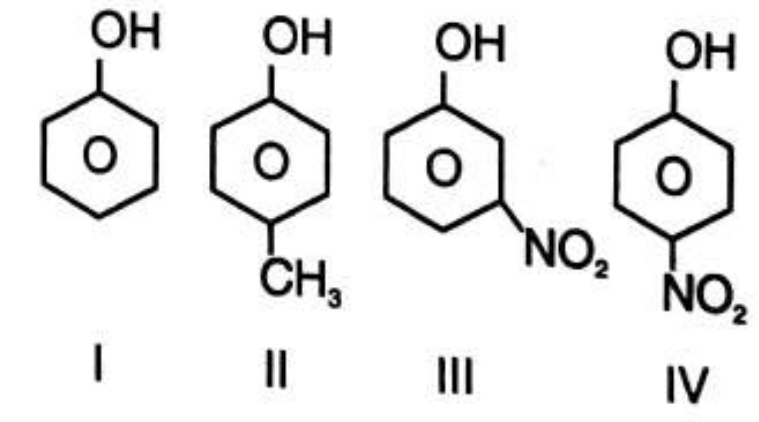 the order of acidity is
- (a) III > IV > I > II
- (b) I > IV > III > II
- (c) II > I > III > IV
- (d) IV > III > I > II
Show answer
Answer: (d)
37. The reaction C₆H₅CH₃ + 2CrO₂Cl₂ → C₆H₅CH(OCrCl₂OH)₂ —(H₂O)→ C₆H₅CHO + 2CrCl₂(OH)₂ is called
- (a) Leukart reaction
- (b) Dakin reaction
- (c) Etard reaction
- (d) Strecker reaction
Show answer
Answer: (c)
38. The chromates are oxidising while molybdate and tungstates are non-oxidising because
- (a) Cr is unstable in all its oxidation states
- (b) Mo and W are stable in their higher oxidation states
- (c) Mo and W are stable in their lower oxidation states
- (d) Cr is stable in its higher oxidation state
Show answer
Answer: (b)
39. In [UO₂(NO₃)₃]⁻, the coordination number and geometry are
- (a) 8 and hexagonal bipyramidal
- (b) 8 and square antiprism
- (c) 5 and square pyramidal
- (d) 5 and trigonal bipyramidal
Show answer
Answer: (a)
40. If the half-life for first order reaction A → Products is 200 seconds, the value of rate constant will be
- (a) 3.46×10⁻²s⁻¹
- (b) 3.46×10⁻³s⁻¹
- (c) 3.46×10⁻⁴s⁻¹
- (d) 3.46×10⁻⁵s⁻¹
Show answer
Answer: (b)
41. In which of the following d-orbital resonance is possible ?
- (a) CF₃⁻
- (b) CCl₃⁻
- (c) CH₃⁻
- (d) CHF₂⁻
Show answer
Answer: (b)
42. Nitrogenase enzyme involves which of the following as co-factor ?
- (a) Mg²⁺
- (b) Mo
- (c) Cu²⁺
- (d) Zn²⁺
Show answer
Answer: (b)
43. If the standard oxidation potential of zinc electrode is 0.763 volt at 25°C, the electrode potential of half cell consisting of zinc electrode dipped in 0.01M ZnSO₄ solution at 25°C will be
- (a) 0.822 volt
- (b) 8.22 volt
- (c) 82.2 volt
- (d) 0.0591 volt
Show answer
Answer: (a)
44. Identify [X] in the following reaction.
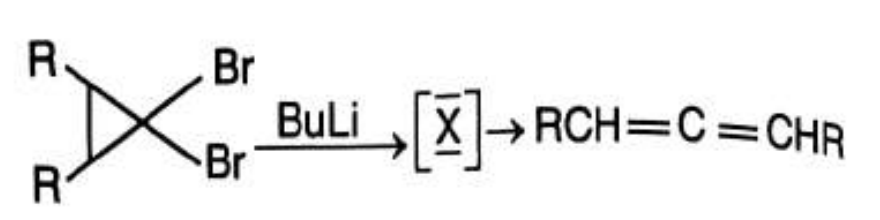
- (a)
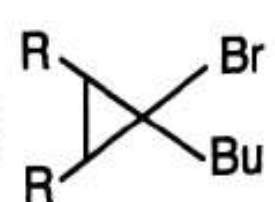
- (b)
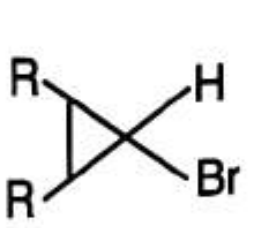
- (c)
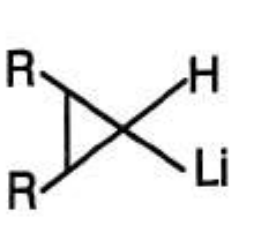
- (d)
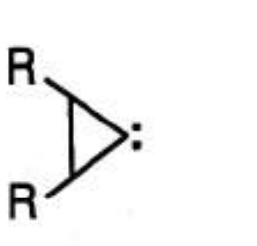
Show answer
Answer: (d)
- (a)
45. The correct set of magic numbers for nuclear shells is
- (a) 2, 8, 20, 52, ....
- (b) 2, 8, 16, 32, ....
- (c) 2, 8, 32, 64, ....
- (d) 2, 8, 26, 80, ....
Show answer
Answer: (a)
46. The number of triple points in phase diagram of sulfur are
- (a) Six
- (b) Three
- (c) Two
- (d) One
Show answer
Answer: (b)
47. The ground state electronic configurations of the central metal atom in some octahedral complexes are given below. In which case the electronic transition is forbidden as per the spin selection rule ?
- (a) t₂g⁶ e_g¹
- (b) t₂g³ e_g⁰
- (c) t₂g⁶ e_g²
- (d) t₂g⁶ e_g³
Show answer
Answer: (a)
48. Cl₂ —(Cold and dil. NaOH)→ (A) + NaCl + H₂O Cl₂ —(Hot and Conc. NaOH)→ (B) + NaCl + H₂O Compounds (A) and (B) are respectively
- (a) NaClO and NaClO₃
- (b) NaClO₂ and NaOCl
- (c) NaClO₃ and NaOCl
- (d) NaOCl and NaOCl₂
Show answer
Answer: (a)
49. A molecule in vibrational motion is associated with energy equal to the following
- (a) (3/2)kT
- (b) (1/2)kT
- (c) kT
- (d) 2kT
Show answer
Answer: (c)
50.
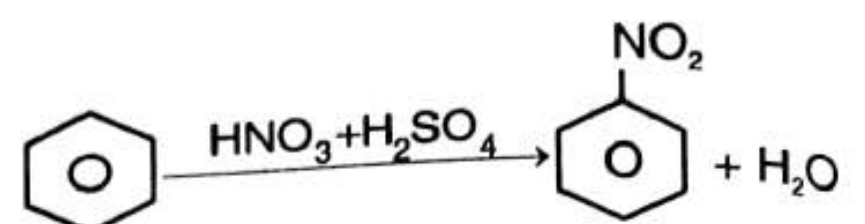 In the above reaction, in the nitrating mixture, HNO₃ acts as
- (a) a base
- (b) an acid
- (c) a catalyst
- (d) a reducing agent
Show answer
Answer: (a)
51.
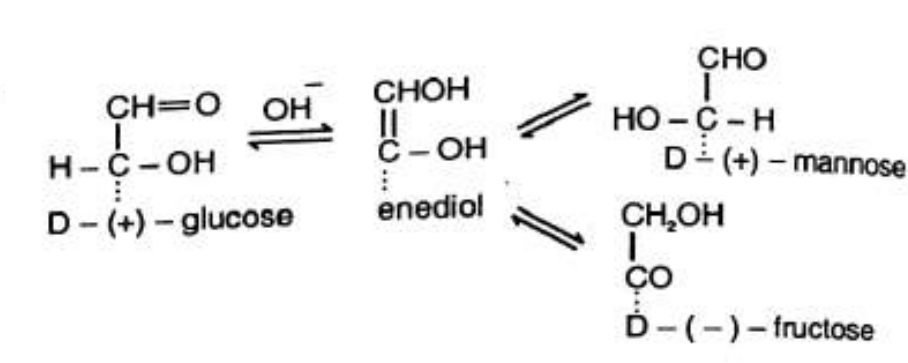 The above reaction is called
- (a) Amadori rearrangement
- (b) Lobry de Bruyn van Ekenstein rearrangement
- (c) Wallach rearrangement
- (d) Semidine rearrangement
Show answer
Answer: (b)
52. Which one of the following represent the compressibility factor of a perfect gas ?
- (a) 0
- (b) 1
- (c) 2
- (d) 3
Show answer
Answer: (b)
53.
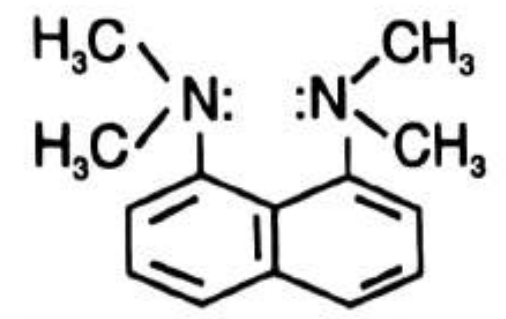 The above mentioned compound is precisely termed as
- (a) Base
- (b) Proton sponge
- (c) Electron sponge
- (d) Acid
Show answer
Answer: (b)
54. I₂ (A) + I⁻ → I₃⁻ (B) (A) + I⁺ → I₃⁺ (C) Correct order of ν_I-I in A, B, C are
- (a) A > B > C
- (b) A < B < C
- (c) A < C < B
- (d) B > A > C
Show answer
Answer: (b)
55. Which one of the following undergoes the Diels-Alder reaction ?
- (a) Thiophene
- (b) Pyridine
- (c) Pyrrole
- (d) Furan
Show answer
Answer: (d)
56. Which carbanion is most stable among given below ?
- (a) R−C≡C⁻
- (b) R₂C=C⁻−R
- (c) R₃C−CH₂⁻
- (d) CH₃⁻
Show answer
Answer: (a)
57. For a reaction in equilibrium state, the value of (ΔG)_P,T is
- (a) Zero
- (b) +ve
- (c) −ve
- (d) Depends on the reaction
Show answer
Answer: (a)
58. Geometries of N(CH₃)₃ and N(SiH₃)₃ are respectively
- (a) Planar and Pyramidal
- (b) Planar and Planar
- (c) Pyramidal and Planar
- (d) Pyramidal and Pyramidal
Show answer
Answer: (c)
59. Given that, ΔH°f (HCl) = −92.3 kJmol⁻¹ and ΔHf(HCl.100H₂O) = −168.1 kJmol⁻¹. The enthalpy of dissolution of one mole of HCl in 100 moles of water is
- (a) −260.4 kJ
- (b) +260.4 kJ
- (c) −75.8 kJ
- (d) +75.8 kJ
Show answer
Answer: (c)
60. Indicate the product P in the following reaction.
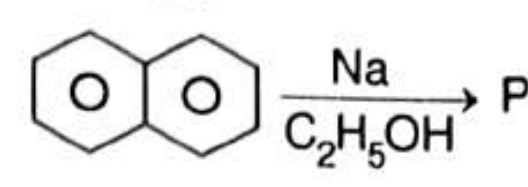
- (a)
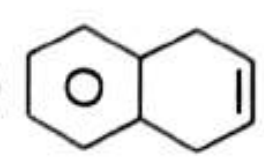
- (b)
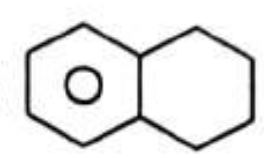
- (c)
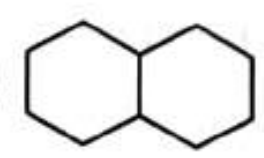
- (d)
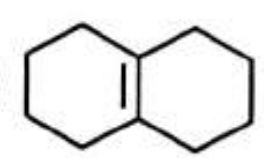
Show answer
Answer: (a)
- (a)
61. In the following reaction
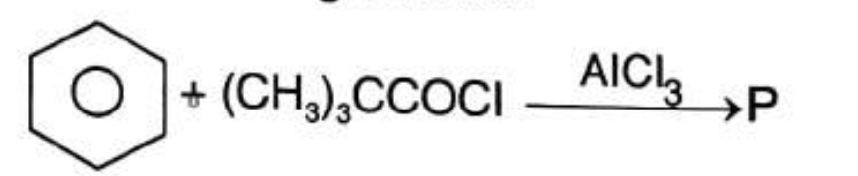 the product P is
- (a)
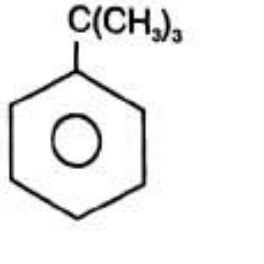
- (b)
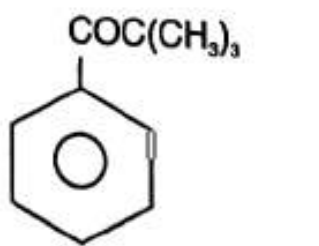
- (c)
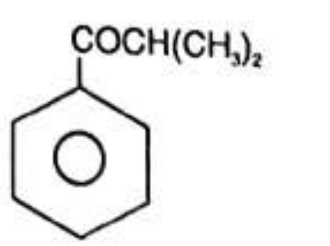
- (d)
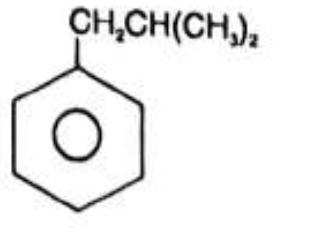
Show answer
Answer: (a)
- (a)
62. CFSE will be highest for
- (a) [CoF₆]³⁻
- (b) [Co(NCS)₄]²⁻
- (c) [Mn(H₂O)₆]²⁺
- (d) [Co(NH₃)₆]³⁺
Show answer
Answer: (d)
63. Calomel electrode is an example of
- (a) Metal-metal ion electrode
- (b) Metal-amalgam electrode
- (c) Oxidation-reduction electrode
- (d) Metal-insoluble metal ion-soluble same anion electrode
Show answer
Answer: (d)
64. In the following reactions, products (A) and (B) respectively, are NaOH(hot and conc.) + Cl₂ → A + side-product Ca(OH)₂ (dry) + Cl₂ → B + side-product
- (a) NaClO₃ and Ca(ClO₃)₂
- (b) NaOCl and Ca(ClO₃)₂
- (c) NaClO₃ and Ca(OCl)₂
- (d) NaOCl and Ca(OCl)₂
Show answer
Answer: (c)
65. The effect of increase in temperature on rate of enzyme catalyzed reaction is
- (a) Increases
- (b) Decreases
- (c) Reaches to an optimum value and then decreases
- (d) For some increases and for some decreases
Show answer
Answer: (c)
66. The temperature above which a real gas cannot be liquified is known as
- (a) Critical temperature
- (b) Consolute temperature
- (c) Boyle temperature
- (d) Inversion temperature
Show answer
Answer: (a)
67. The most suitable alkali metal to remove traces of N₂ from highly pure argon gas is
- (a) Li
- (b) K
- (c) Rb
- (d) Cs
Show answer
Answer: (a)
68. Which of the following figure represents the 3s atomic orbital ?
- (a)
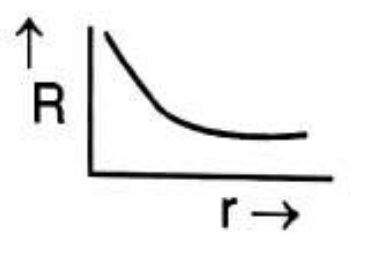
- (b)
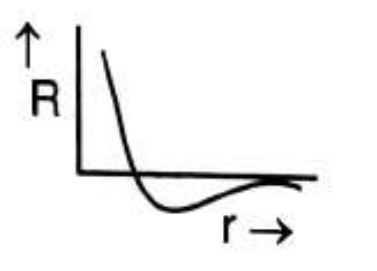
- (c)
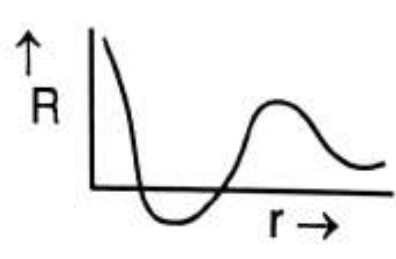
- (d)
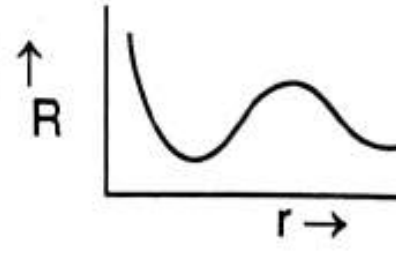
Show answer
Answer: (c)
- (a)
69. The pair of ions that most commonly forms complexes with coordination number two
- (a) Cd(II), Hg(II)
- (b) Cu(II), Hg(I)
- (c) Cu(I), Hg(I)
- (d) Cu(I), Hg(II)
Show answer
Answer: (d)
70. The example of a vat dye is
- (a) Indigo
- (b) Alizarin
- (c) Malachite green
- (d) Methyl orange
Show answer
Answer: (a)
71. Select the crystal system which has no symmetry
- (a) Tetragonal
- (b) Monoclinic
- (c) Triclinic
- (d) Hexagonal
Show answer
Answer: (c)
72. The complex
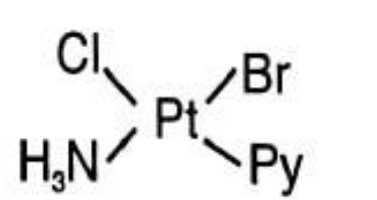 can be formally formed from K₂[PtCl₄] by which one of the following sequences of substitutions of the chloride ions ?
- (a) Py, Br⁻, NH₃
- (b) Br⁻, Py, NH₃
- (c) Br⁻, NH₃, Py
- (d) NH₃, Br⁻, Py
Show answer
Answer: (a)
73. Dewar benzene is
- (a) bicyclo [2, 0, 2] hexadiene
- (b) bicyclo [2, 1, 2] hexadiene
- (c) bicyclo [1, 0, 2] hexadiene
- (d) bicyclo [2, 2, 0] hexadiene
Show answer
Answer: (d)
74. Identify the product of the following reaction.
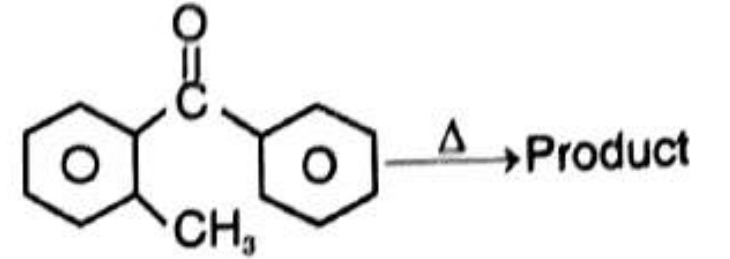
- (a) Phenanthrene
- (b) Naphthalene
- (c) 2-Methylanthracene
- (d) Anthracene
Show answer
Answer: (d)
75. C₆H₅CONH₂ + P₂O₅ —(Δ)→ Product. The product of the above reaction is
- (a) C₆H₅NH₂
- (b) C₆H₅CN
- (c) C₆H₅CH₂NH₂
- (d) C₆H₅NC
Show answer
Answer: (b)
76. The acid-base concept involving molten condition is
- (a) Arrhenius concept
- (b) Lowry-Bronsted concept
- (c) Lux-flood concept
- (d) Lewis concept
Show answer
Answer: (c)
77. Which of the following statement is not correct ?
- (a) Cu²⁺ ion behaves as harder acid than Mn²⁺ ion
- (b) Cs⁺ ion is harder acid than Li⁺ ion
- (c) NH₃ is harder base than C₆H₅NH₂
- (d) (C₆H₅)₂NH is a soft base
Show answer
Answer: (b)
78. A monobasic acid has a dissociation constant equal to 1.8×10⁻⁵ at 25°C. Its degree of dissociation at a concentration of 0.20 M at the same temperature is
- (a) 0.00949
- (b) 0.00849
- (c) 0.00994
- (d) 0.00489
Show answer
Answer: (a)
79. Electrophilic substitution in quinoline takes place preferentially at which position ?
- (a) 2
- (b) 3
- (c) 7
- (d) 8
Show answer
Answer: (d)
80. The α-Helix structure of protein is stabilised by
- (a) Peptide bond
- (b) Vander-Waals forces
- (c) Hydrogen bond
- (d) Dipole-dipole force
Show answer
Answer: (c)
81. Most probable velocity (C_mp) of a gas molecule is given by the following expression
- (a) C_mp = √(8RT/πM)
- (b) C_mp = √(3RT/M)
- (c) C_mp = √(2RT/M)
- (d) C_mp = √(RT/M)
Show answer
Answer: (c)
82. An ion M²⁺ forms the complex [M(H₂O)₆]²⁺, [M(en)₃]²⁺ and [MBr₆]⁴⁻. Match the complex with appropriate colour.
- (a) green, blue, red
- (b) blue, red, green
- (c) green, red, blue
- (d) red, blue, green
Show answer
Answer: (c)
83. Bond enthalpy is evaluated by using following
- (a) Kirchoff’s equation
- (b) Gibbs Duhem equation
- (c) Hess law
- (d) Maxwell’s relations
Show answer
Answer: (c)
84. Naphthalene on oxidation with chromiumtrioxide and acetic acid gives
- (a)
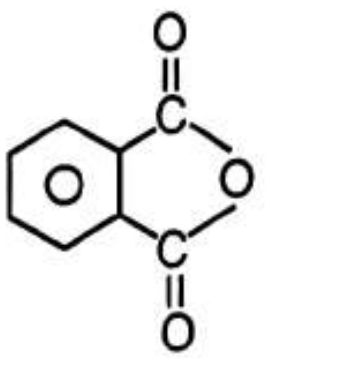
- (b)
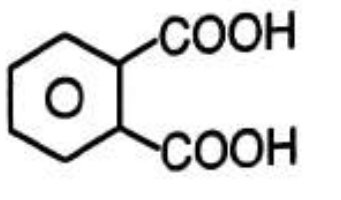
- (c)
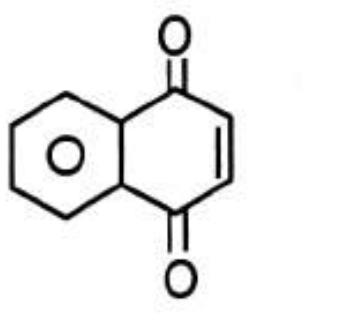
- (d)
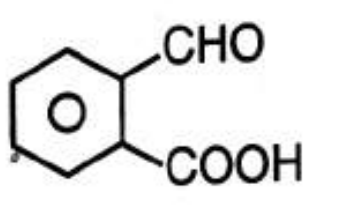
Show answer
Answer: (c)
- (a)
85.
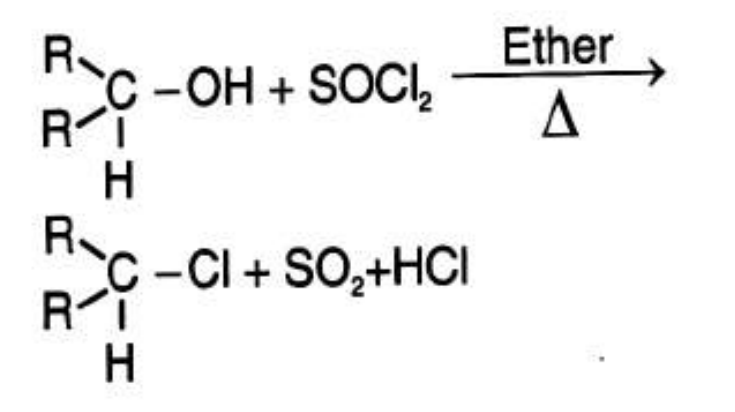 This reaction can be explained by
- (a) SN₁ mechanism
- (b) SN₂ mechanism
- (c) E₂ mechanism
- (d) SNᵢ mechanism
Show answer
Answer: (d)
86. Which one of the following theories is used to explain homogeneous catalysis ?
- (a) Intermediate compound theory
- (b) Adsorption theory
- (c) Arrhenius theory
- (d) Dalton’s theory
Show answer
Answer: (a)
87. Select the photochemical reaction with quantum yield two.
- (a) H₂ + Cl₂ —(hν)→ 2HCl
- (b) H₂ + Br₂ —(hν)→ 2HBr
- (c) 2HBr —(hν)→ H₂ + Br₂
- (d) SO₂ + Cl₂ —(hν)→ SO₂Cl₂
Show answer
Answer: (c)
88. Allene on reaction with dilute sulphuric acid gives
- (a) CH₃CH₂CHO
- (b) CH₃COCH₃
- (c) CH₃COCOOH
- (d) CH₃CH₂CH₃
Show answer
Answer: (b)
89. NOCl and NaNO₃ react in liquid N₂O₄ to produce
- (a) NO⁺
- (b) NO₃⁻
- (c) N₂O₄ and NaCl
- (d) NaNO₃ and NaCl
Show answer
Answer: (c)
90. The correct order of LMCT energies is
- (a) MnO₄⁻ < CrO₄²⁻ < VO₄³⁻
- (b) MnO₄⁻ > CrO₄²⁻ > VO₄³⁻
- (c) MnO₄⁻ > CrO₄²⁻ < VO₄³⁻
- (d) MnO₄⁻ < CrO₄²⁻ > VO₄³⁻
Show answer
Answer: (a)
91. What is phorone ?
- (a) (CH₃)₂C═CHCOCH═C(CH₃)₂
- (b) (CH₃)₂C═CHCOCH₃
- (c) (CH₃)₂C═CHCOCH₂OH
- (d) CH₃COCH₂CH₂COCH₃
Show answer
Answer: (a)
92. Conductivity at infinite dilution of CH₃COONH₄ can be determined by using following
- (a) Hittorf method
- (b) Kohlrausch law
- (c) Arrhenius theory
- (d) Debye-Huckel-Onsagar equation
Show answer
Answer: (b)
93. The octahedral complex which shows both fac- and mer- isomerism
- (a) triglycinatocobalt(III)
- (b) tris(ethylenediamine)cobalt(III)
- (c) dichlorodiglycinatocobalt(III)
- (d) trioxalatocobaltate(III)
Show answer
Answer: (a)
94. Which of the following will not give haloform reaction ?
- (a) CH₃ − CHO
- (b) CH₃ − CO − CH₃
- (c) CH₃ − CH₂ − CO − CH₃
- (d) CH₃ − CH₂ − CO − CH₂ − CH₃
Show answer
Answer: (d)
95. Among the following substituted silanes the one which will give rise to cross linked silicone polymer on hydrolysis is
- (a) R₃SiCl
- (b) R₄Si
- (c) RSiCl₃
- (d) R₂SiCl₂
Show answer
Answer: (c)
96. Which of the following does not obey EAN rule ?
- (a) Fe(CO)₄
- (b) V(CO)₆
- (c) K₄[Fe(CN)₆]
- (d) Mn₂(CO)₁₀
Show answer
Answer: —
97. The resistance of 0.01 M solution of an electrolyte is 210 ohm at 25°C. The molar conductance of solution is (cell constant = 0.90)
- (a) 0.0410 sm² mol⁻¹
- (b) 0.0419 sm² mol⁻¹
- (c) 0.0423 sm² mol⁻¹
- (d) 0.0429 sm² mol⁻¹
Show answer
Answer: (d)
98. If 3g urea is dissolved in 45g water, the relative lowering of vapour pressure will be
- (a) 0.02
- (b) 0.01
- (c) 0.04
- (d) 0.05
Show answer
Answer: (a)
99. In potassium permanganate the dark colour arises because of
- (a) Polarisation
- (b) d − d transition
- (c) Both polarisation and d − d transition
- (d) Charge transfer transition
Show answer
Answer: (d)
100. The CFSE for [CoCl₆]⁴⁻ is 18000 cm⁻¹ Δt for [CoCl₄]²⁻ will be
- (a) 18000 cm⁻¹
- (b) 16000 cm⁻¹
- (c) 8000 cm⁻¹
- (d) 7450 cm⁻¹
Show answer
Answer: (c)
101. Which positions are very reactive in phenanthrene ?
- (a) 1, 2
- (b) 9, 10
- (c) 3, 4
- (d) 5, 6
Show answer
Answer: (b)
102. Which intermediate forms triptycene on reaction with anthracene ?
- (a) Benzyne
- (b) Carbene
- (c) Nitrene
- (d) Carbocation
Show answer
Answer: (a)
103. Reaction of acetone with selenium dioxide forms
- (a) CHO−CHO
- (b) CHO−CH₂OH
- (c) CH₃COCHO
- (d) CH₃COCOOH
Show answer
Answer: (c)
104. Match the following compounds (Column – I) with their uses (Column – II). Column-I — Column-II I. Ca(OH)₂ — a. Cast of statues II. NaCl — b. White wash III. CaSO₄·0.5 H₂O — c. Antacids IV. CaCO₃ — d. Washing soda preparation Code : I II III IV
- (a) d a c b
- (b) b d a c
- (c) b c d a
- (d) c d b a
Show answer
Answer: (b)
105. Which of the following reaction will be preferred to remain on the left side ?
- (a) CaS + H₂O → CaO + H₂S
- (b) HgF₂ + BeI₂ → HgI₂ + BeF₂
- (c) BeF₂ + HgI₂ → HgF₂ + BeI₂
- (d) LiI + CsF → LiF + CsI
Show answer
Answer: (c)
106.
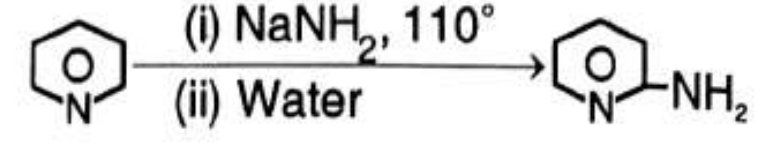 Reaction is known as
- (a) Carbylamine reaction
- (b) Chichibabin reaction
- (c) Sandmeyer reaction
- (d) None of the above
Show answer
Answer: (b)
107. The order of reaction C₁₂H₂₂O₁₁ + H₂O —(H⁺)→ C₆H₁₁O₆ + C₆H₁₁O₆ is
- (a) Zero
- (b) Half
- (c) One
- (d) Two
Show answer
Answer: (c)
108. The number of S═O and S−OH bonds present in Marshall’s acid and Oleum, respectively are
- (a) (4 and 2) and (4 and 2)
- (b) (2 and 4) and (2 and 4)
- (c) (4 and 2) and (2 and 4)
- (d) (2 and 2) and (2 and 2)
Show answer
Answer: (a)
109. Which one of the following is responsible for lesser pressure of a real gas in comparison to an ideal gas ?
- (a) Finite size of molecules
- (b) Enhancement of kinetic energy of molecules
- (c) Viscosity
- (d) Intermolecular forces
Show answer
Answer: (d)
110. For which group of cations the magnetic moment can be given by spin only formula ?
- (a) Gd³⁺ and Lu³⁺
- (b) Ce³⁺ and Nd³⁺
- (c) Yb³⁺ and Tm³⁺
- (d) Pm³⁺ and HO³⁺
Show answer
Answer: (a)
111. In liquid ammonia, sulphamic acid behaves as
- (a) Monobasic acid
- (b) Tribasic acid
- (c) Dibasic acid
- (d) Base
Show answer
Answer: (c)
112. Ethanol on reaction with bromine in aqueous solution gives
- (a) CH₃COOH
- (b) CH₃CHO
- (c) CH₂═CH₂
- (d) CH₂═CH − OH
Show answer
Answer: (b)
113. Which one is not nucleophilic reagent in the following ?
- (a) CH₃⁻
- (b) NH₂⁻
- (c) :CH₂
- (d) R − Ö − R
Show answer
Answer: (c)
114. The unit of rate constant for zero order reaction is
- (a) s⁻¹
- (b) mol dm⁻³ s⁻¹
- (c) mol⁻¹ dm⁻³ s⁻¹
- (d) mol⁻² dm⁻⁶ s⁻¹
Show answer
Answer: (b)
115. C_V for CO₂ at room temperature is equal to (assume 20% vibrational contribution at room temperature)
- (a) 54.04 JK⁻¹mol⁻¹
- (b) 27.44 JK⁻¹mol⁻¹
- (c) 22.44 JK⁻¹mol⁻¹
- (d) 12.44 JK⁻¹mol⁻¹
Show answer
Answer: (b)
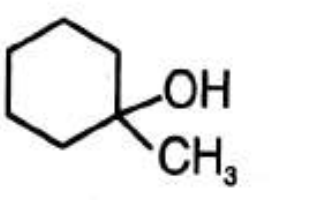
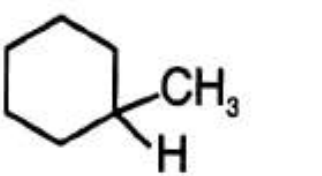
116. In the reaction BrMg(CH₂)₅MgBr + CH₃CO₂C₂H₅ → P what is P ?
- (a)
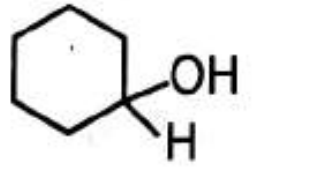
- (b)
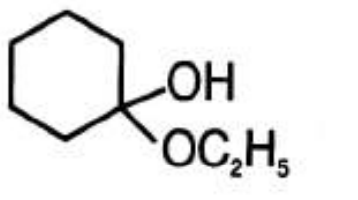
- (c)
- (d)
Show answer
Answer: (c)
- (a)
117. If the gold number for the colloidal solutions A, B and C are 0.1, 2.5 and 20 respectively, the order of protective powers of these colloids will be
- (a) C > B > A
- (b) A > B > C
- (c) A = B = C
- (d) B > A > C
Show answer
Answer: (b)
118. Which one of the following is hydrolysed more rapidly ?
- (a) CH₃Cl
- (b) CH₃CH₂Cl
- (c) CH₂═CHCl
- (d) CH₃OCH₂Cl
Show answer
Answer: (d)
119. What type of reaction takes place upon treatment of ketone with HCN to form a cyanohydrin ?
- (a) Nucleophilic addition reaction
- (b) Electrophilic substitution reaction
- (c) Electrophilic addition reaction
- (d) Nucleophilic substitution reaction
Show answer
Answer: (a)
120. The expression I = I₀e^(−∈cl) is known as
- (a) Lambert law
- (b) Lambert-Beer law
- (c) Grotthus-Draper law
- (d) Stark-Einstein law
Show answer
Answer: (b)
121. A 5.13% sugar solution is isotonic with a 0.9% unknown solution. The molar mass of the solute is
- (a) 51.3
- (b) 60.0
- (c) 72.4
- (d) 90.0
Show answer
Answer: (b)
122. Among the given statements about structure of NH₃ and H₃O⁺, which one is incorrect ?
- (a) All N − H bonds in NH₃ are equal in length and strength
- (b) All O − H bonds in H₃O⁺ are equal in length and strength
- (c) N in NH₃ and O in H₃O⁺, both the atoms involve sp³ hybridization
- (d) Number of lone pairs of electrons on N atom is only one but it is two in case of O in H₃O⁺
Show answer
Answer: (d)
123. The anodic oxidation, in the electrolysis of ice cold H₂SO₄(50%) between Pt electrodes at high current density, gives
- (a) Oleum, H₂S₂O₇
- (b) Dithionic acid, H₂S₂O₆
- (c) Marshall’s acid, H₂S₂O₈
- (d) Caro’s acid, H₂SO₅
Show answer
Answer: (c)
124. OsO₄ + 9CO → Os(CO)₅ + 4CO₂ The above mentioned reaction is
- (a) Substitution reaction
- (b) Direct carbonylation reaction
- (c) Reductive carbonylation reaction
- (d) Reduction reaction
Show answer
Answer: (c)
125. Which of the following metalloenzymes do not contain zinc ?
- (a) Carboxy peptidase
- (b) Carbonic anhydrase
- (c) Nitrogenase
- (d) Alcohol dehydrogenase
Show answer
Answer: (c)
Show answers
Answer key
Answer key from the U.P. Secondary Education Services Selection Board’s official answer key for this sitting. “—” means the key gave none: the question was deleted.
Chemistry
- Q 1
- (b)
- Q 2
- (d)
- Q 3
- (c)
- Q 4
- (a)
- Q 5
- (b)
- Q 6
- —
- Q 7
- (b)
- Q 8
- (c)
- Q 9
- (c)
- Q 10
- (a)
- Q 11
- (a)
- Q 12
- (c)
- Q 13
- (c)
- Q 14
- (b)
- Q 15
- (d)
- Q 16
- (d)
- Q 17
- (c)
- Q 18
- (b)
- Q 19
- (d)
- Q 20
- (c)
- Q 21
- (c)
- Q 22
- (d)
- Q 23
- (c)
- Q 24
- (b)
- Q 25
- (d)
- Q 26
- (b)
- Q 27
- (c)
- Q 28
- (c)
- Q 29
- —
- Q 30
- (b)
- Q 31
- (b)
- Q 32
- (c)
- Q 33
- (d)
- Q 34
- (c)
- Q 35
- (d)
- Q 36
- (d)
- Q 37
- (c)
- Q 38
- (b)
- Q 39
- (a)
- Q 40
- (b)
- Q 41
- (b)
- Q 42
- (b)
- Q 43
- (a)
- Q 44
- (d)
- Q 45
- (a)
- Q 46
- (b)
- Q 47
- (a)
- Q 48
- (a)
- Q 49
- (c)
- Q 50
- (a)
- Q 51
- (b)
- Q 52
- (b)
- Q 53
- (b)
- Q 54
- (b)
- Q 55
- (d)
- Q 56
- (a)
- Q 57
- (a)
- Q 58
- (c)
- Q 59
- (c)
- Q 60
- (a)
- Q 61
- (a)
- Q 62
- (d)
- Q 63
- (d)
- Q 64
- (c)
- Q 65
- (c)
- Q 66
- (a)
- Q 67
- (a)
- Q 68
- (c)
- Q 69
- (d)
- Q 70
- (a)
- Q 71
- (c)
- Q 72
- (a)
- Q 73
- (d)
- Q 74
- (d)
- Q 75
- (b)
- Q 76
- (c)
- Q 77
- (b)
- Q 78
- (a)
- Q 79
- (d)
- Q 80
- (c)
- Q 81
- (c)
- Q 82
- (c)
- Q 83
- (c)
- Q 84
- (c)
- Q 85
- (d)
- Q 86
- (a)
- Q 87
- (c)
- Q 88
- (b)
- Q 89
- (c)
- Q 90
- (a)
- Q 91
- (a)
- Q 92
- (b)
- Q 93
- (a)
- Q 94
- (d)
- Q 95
- (c)
- Q 96
- —
- Q 97
- (d)
- Q 98
- (a)
- Q 99
- (d)
- Q 100
- (c)
- Q 101
- (b)
- Q 102
- (a)
- Q 103
- (c)
- Q 104
- (b)
- Q 105
- (c)
- Q 106
- (b)
- Q 107
- (c)
- Q 108
- (a)
- Q 109
- (d)
- Q 110
- (a)
- Q 111
- (c)
- Q 112
- (b)
- Q 113
- (c)
- Q 114
- (b)
- Q 115
- (b)
- Q 116
- (c)
- Q 117
- (b)
- Q 118
- (d)
- Q 119
- (a)
- Q 120
- (b)
- Q 121
- (b)
- Q 122
- (d)
- Q 123
- (c)
- Q 124
- (c)
- Q 125
- (c)