ExamBharo · UP PGT 2016 — Physics (Series A) · exambharo.com/up-pgt/previous-year-papers/up-pgt-2016-physics-series-a/
Question paper · UP PGT
UP PGT 2016 — Physics (Series A)
1 or 2 February 2019125 questions+3.4 for a correct answer, −0 for a wrong one
Questions from the U.P. Secondary Education Services Selection Board’s paper of 1 or 2 February 2019. Each question’s answer is under it, hidden until you open it, and the full answer key is at the end. Take the paper as a timed practice test to be scored.
The official booklet is a scan with no text, so ExamBharo typed this paper from it by hand. A typing slip is possible; report one through the contact page.
The board deleted question 46 in its final answer key: shown here, with no answer, and not counted in the score.
Physics
1. Kepler’s second law – areal velocity remains constant – is equivalent to which of the following conservation laws ?
- (a) Energy
- (b) Linear momentum
- (c) Angular momentum
- (d) None of the above
Show answer
Answer: (c)
2. At what temperature will the Fahrenheit and Kelvin thermometer scales give the same numerical value ?
- (a) – 40.75°
- (b) 180.25°
- (c) 435.50°
- (d) 574.25°
Show answer
Answer: (d)
3. In Joule-Thompson effect, which quantity remains constant ?
- (a) Temperature
- (b) Enthalpy
- (c) Entropy
- (d) Internal energy
Show answer
Answer: (b)
4. The ratio of intensities of two light waves is 25 : 16. If they interfere, the ratio of intensities of maxima and minima of resultant pattern is
- (a) 5 : 4
- (b) 9 : 1
- (c) 49 : 9
- (d) 81 : 1
Show answer
Answer: (d)
5. A ray of light is incident at polarising angle on a transparent plate of refractive index √3. What is the angle of refraction ?
- (a) 30°
- (b) 60°
- (c) 90°
- (d) 120°
Show answer
Answer: (a)
6. Two lenses of focal lengths f₁ and f₂ are at a distance d from each other. When will the spherical aberration be minimum ?
- (a) d = ½(f₁ + f₂)
- (b) d = ½(f₁ – f₂)
- (c) d = f₁ – f₂
- (d) d = f₁ + f₂
Show answer
Answer: (c)
7. An electric charge q is placed at the centre of a cube of side l. The electric flux passing through one of its faces is
- (a) q/(6ε₀)
- (b) q/(lε₀)
- (c) q/(l²ε₀)
- (d) ql²/(4πε₀)
Show answer
Answer: (a)
8. A wire of 40 Ω resistance is bent to form a complete circle as in the figure. What is the effective resistance between points A and B ?
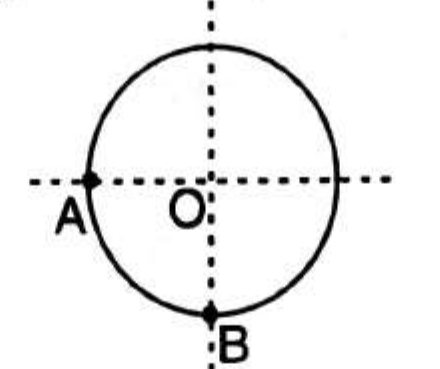
- (a) 40.33 Ω
- (b) 30.66 Ω
- (c) 7.50 Ω
- (d) 5.00 Ω
Show answer
Answer: (c)
9. The shortest wavelength in the radiation obtained from an X-ray tube having accelerating voltage of 50,000 volts is about
- (a) 0.0025 Å
- (b) 0.025 Å
- (c) 0.250 Å
- (d) 2.5 Å
Show answer
Answer: (c)
10. The function of a grid in the triode is to control the
- (a) Cathode potential
- (b) Filament current
- (c) Cathode temperature
- (d) Anode current
Show answer
Answer: (d)
11. The source of solar energy is
- (a) Chemical reactions
- (b) Nuclear fusion
- (c) Nuclear fission
- (d) Gravitational interaction with other solar systems
Show answer
Answer: (b)
12. The maximum efficiency of a half wave rectifier can be
- (a) 25.3%
- (b) 40.6%
- (c) 50.5%
- (d) 81.2%
Show answer
Answer: (b)
13. The excess pressure inside a soap bubble of radius 3 mm will be (Surface tension is 0.03 N/m)
- (a) 60 N/m²
- (b) 120 N/m²
- (c) 40 N/m²
- (d) 80 N/m²
Show answer
Answer: (c)
14. Three capillaries of equal lengths but internal radii r, 2r and 3r respectively are connected in series, a liquid flows in streamline motion through them. If the pressure difference across the entire system is 77 cm (of water), then the pressure difference across the first capillary is
- (a) 71.64 cm
- (b) 70.32 cm
- (c) 76.00 cm
- (d) 77.00 cm
Show answer
Answer: (a)
15. The ratio of the gram molecular specific heats (γ) of a diatomic gas is
- (a) 1.66
- (b) 1.33
- (c) 1.40
- (d) 1.00
Show answer
Answer: (c)
16. If the root mean square velocity of hydrogen molecules at NTP is 1.84 km/sec, what will it be for oxygen molecules at NTP ?
- (a) 0.42 km/sec
- (b) 0.40 km/sec
- (c) 0.38 km/sec
- (d) 0.46 km/sec
Show answer
Answer: (d)
17. The potential difference of an electron microscope is increased from 20 kV to 80 kV. Its resolving power will become
- (a) Two times
- (b) Four times
- (c) Half
- (d) Quarter
Show answer
Answer: (a)
18. Which of the following is incorrect ?
- (a) Zone plate has many focii
- (b) Zone plate is similar to convex lens
- (c) Focal length of zone plate depends on wavelength of light used
- (d) None of the above
Show answer
Answer: (d)
19. A spring has length 10 cm and a force constant 10³ N/m. Two masses of 10 gm and 90 gm are attached to its ends. The spring is placed on a horizontal table, stretched and released. What is the frequency of oscillation ?
- (a) 50 Hz
- (b) 45 Hz
- (c) 53 Hz
- (d) 60 Hz
Show answer
Answer: (c)
20. What is the fundamental basis of a laser ?
- (a) Absorption
- (b) Spontaneous emission
- (c) Stimulated emission
- (d) Scattering
Show answer
Answer: (c)
21. On moving from the surface towards the centre of a charged solid metal sphere, the electric field
- (a) Increases
- (b) Decreases
- (c) Is same as on surface
- (d) Is everywhere zero
Show answer
Answer: (d)
22. The current flowing in a coil of self induction 0.4 mH is changed by 250 mA in 0.1 seconds. What is the induced emf in the coil ?
- (a) – 1 mV
- (b) – 2 mV
- (c) – 3 mV
- (d) – 5 mV
Show answer
Answer: (a)
23. A 220 volt A.C. source is connected across an inductance of One Henry. If the frequency of the source is 50 Hz then what is the powerloss ?
- (a) 220 W
- (b) 110 W
- (c) 440 W
- (d) Zero
Show answer
Answer: (d)
24. An X-ray tube operates at 20 kV. Which of the following is correct ? 1) 0.5 Å wavelength will be absent 2) 0.8 Å wavelength will be present (h = 6.6 × 10⁻³⁴ Js, c = 3 × 10⁸ m/s, 1 eV = 1.6 × 10⁻¹⁹ J)
- (a) Only 1
- (b) Only 2
- (c) Both 1 and 2
- (d) Neither 1 nor 2
Show answer
Answer: (c)
25. The half life of radon is 3.8 days starting with 9.6 mg of radon, how much will be left after 19 days ?
- (a) 0.5 mg
- (b) 0.6 mg
- (c) 0.3 mg
- (d) 0.2 mg
Show answer
Answer: (c)
26. Dimension of 1/(μ₀ε₀) is
- (a) [LT⁻¹]
- (b) [L⁻¹T]
- (c) [L⁻²T²]
- (d) [L²T⁻²]
Show answer
Answer: (d)
27. Two lenses of powers +4D and –2D are kept in contact. The combinations focal length will be
- (a) 100 cm
- (b) 75 cm
- (c) 50 cm
- (d) 25 cm
Show answer
Answer: (c)
28. Law of Malus is
- (a) I = I₀ Sin² θ
- (b) I = I₀ Sin θ
- (c) I = I₀ Cos² θ
- (d) I = I₀ Tan² θ
Show answer
Answer: (c)
29. A transistor amplifier has β = 30, R_Load = 4000 Ω and input resistance R_in = 400 Ω. Its voltage amplification is
- (a) 100
- (b) 200
- (c) 300
- (d) 400
Show answer
Answer: (c)
30. Formula for variation of acceleration due to gravity while going above the surface of the earth is
- (a) g′ = g/(1 – h/Re)²
- (b) g′ = g/(1 – h/Re)
- (c) g′ = g/(1 + h/Re)
- (d) g′ = g/(1 + h/Re)²
Show answer
Answer: (d)
31. For a perfectly rigid body, Young’s modulus of elasticity will be
- (a) ∞
- (b) 100
- (c) 1
- (d) 0
Show answer
Answer: (a)
32. What remains constant during simple harmonic motion ?
- (a) Restoring force
- (b) Kinetic energy
- (c) Potential energy
- (d) Time period
Show answer
Answer: (d)
33. What is the relation between phase difference (Δϕ) and path difference (Δx) ?
- (a) Δϕ = (2π/λ)Δx
- (b) Δϕ = (λ/2π)Δx
- (c) Δϕ = λ/(2πΔx)
- (d) Δϕ = (π/λ)Δx
Show answer
Answer: (a)
34. When the net external torque acting on a rigid body is zero, then what becomes constant ?
- (a) Linear momentum
- (b) Energy
- (c) Angular momentum
- (d) None of the above
Show answer
Answer: (c)
35. Two capillaries of diameter 5 mm and 4 mm respectively are standing in water. The water rises 5.7 mm in the first one (diameter 5 mm). How much will it rise in the other capillary ?
- (a) 5.7 mm
- (b) 7.1 mm
- (c) 6.6 mm
- (d) 9.9 mm
Show answer
Answer: (b)
36. What does diffraction indicate ?
- (a) Particle nature
- (b) Wave nature
- (c) Both particle and wave nature
- (d) None of the above
Show answer
Answer: (b)
37. The graph between square of time period and length of a simple pendulum is
- (a) Straight line
- (b) Circle
- (c) Parabola
- (d) Hyperbola
Show answer
Answer: (a)
38. Sound waves in hydrogen gas are of which type ?
- (a) Transverse
- (b) Longitudinal
- (c) Stationary
- (d) Electromagnetic
Show answer
Answer: (b)
39. In an AC circuit resonance condition is
- (a) L > 1/(ω²C)
- (b) L < 1/(ω²C)
- (c) L = 1/(ω²C)
- (d) L = C
Show answer
Answer: (c)
40. The internal resistance of an ideal voltmeter should be
- (a) Zero
- (b) Infinite
- (c) Equal to internal resistance of source
- (d) Negative
Show answer
Answer: (b)
41. A lens of refractive index μ₂ is immersed in a medium of refractive index μ₁. The radii of curvature of the surfaces of the lense are R₁ and R₂. The focal length (f) will be
- (a) 1/f = (μ₂ – 1)(1/R₁ – 1/R₂)
- (b) 1/f = (μ₂/μ₁ – 1)(1/R₁ – 1/R₂)
- (c) 1/f = (μ₂/μ₁ – 1)(1/R₁ + 1/R₂)
- (d) 1/f = (μ₁/μ₂ – 1)(1/R₁ + 1/R₂)
Show answer
Answer: (b)
42. If the phase difference between an alternating current and voltage is π/2, which of the following can not be part of the circuit ?
- (a) R, L both present
- (b) C alone present
- (c) L alone present
- (d) L and C both present
Show answer
Answer: (a)
43. In photoelectric effect, the most energetic electrons are emitted from
- (a) Inner shells
- (b) Surface of metal
- (c) Nucleus
- (d) Deep inside the metal
Show answer
Answer: (b)
44. Which of the following is the unit of strain ?
- (a) Joule
- (b) Newton
- (c) No unit
- (d) Watt
Show answer
Answer: (c)
45. Formula Volt × Charge/Time (V × Q/T) can be equivalent to
- (a) Acceleration
- (b) Work done
- (c) Power
- (d) Velocity
Show answer
Answer: (c)
46. Material having low retentivity is suitable for making
- (a) Weak magnets
- (b) Temporary magnets
- (c) Permanent magnets
- (d) Electro magnets
Show answer
Answer: —
47. Which expression is incorrect ? (symbols have their usual meaning)
- (a)
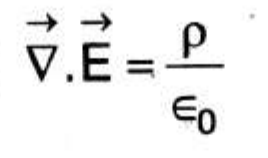
- (b)
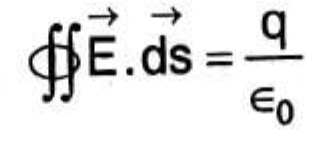
- (c)
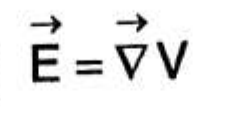
- (d)
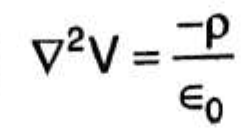
Show answer
Answer: (c)
- (a)
48. If a point charge 1.5 × 10⁻⁶ C is placed at the origin, then the 30 V equipotential surface will have radius
- (a) 135 m
- (b) 450 m
- (c) 270 m
- (d) 900 m
Show answer
Answer: (b)
49. Attraction between nucleons is due to exchange of
- (a) Photons
- (b) Mesons
- (c) Hadrons
- (d) Neutrinos
Show answer
Answer: (b)
50. A body of mass 2 gm and charge + 5 μC is suspended from the ceiling at the end of a string. If a horizontal electric field of 10 KV/m is applied, what is the angle between the string and vertical direction ?
- (a) tan⁻¹ (2.55)
- (b) tan⁻¹ (3.00)
- (c) tan⁻¹ (3.55)
- (d) tan⁻¹ (4.00)
Show answer
Answer: (a)
51. If unpolarized light of intensity I₀ falls on a polarizer and the angle between polarizer and analyzer is 60°, then the intensity of the emergent light is
- (a) I₀/8
- (b) I₀/4
- (c) I₀/2
- (d) I₀
Show answer
Answer: (a)
52. The average energy of the Planck oscillator is
- (a) kT
- (b)

- (c)

- (d)
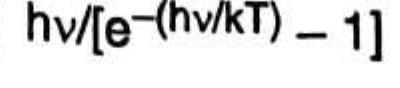
Show answer
Answer: (b)
53. When tension in a wire is T₁ its length is L₁ and when tension is T₂, its length is L₂. What is the length when there is no tension ?
- (a) (T₂L₁ – T₁L₂)/(T₂ – T₁)
- (b) (T₂ – T₁)/(T₂L₁ – T₁L₂)
- (c) Zero
- (d) (T₂L₁ – T₁L₂)/(T₂² – T₁²)
Show answer
Answer: (a)
54. The gravitational field due to a mass distribution is kx^(−3/2) in X-direction at distance x (constant k > 0). If potential at infinity is zero, the potential at distance x will be
- (a) 2k√x
- (b) 2k/√x
- (c) 2kx³
- (d) 2k/x³
Show answer
Answer: (b)
55. A 1m long resonance tube (internal radius 1 cm) gives first resonance at length 4.6 cm and second resonance at 14.0 cm. When a tuning fork of frequency 2000 Hz is used. What is the speed of sound ?
- (a) 332 m/s
- (b) 336 m/s
- (c) 340 m/s
- (d) 376 m/s
Show answer
Answer: (d)
56. The distance x travelled by an object in time t is given by x = a + bt²/a. The dimensions of a and b are
- (a) L, L²T⁻²
- (b) LT⁻¹, LT⁻²
- (c) L, LT⁻²
- (d) L², L²T⁻²
Show answer
Answer: (a)
57. If the position of a particle y is given by y = 3t³ + t² + 5, then what is the acceleration at t = 2 ?
- (a) 5.39
- (b) 5.38
- (c) 37
- (d) 38
Show answer
Answer: (d)
58. If potential is given by V = 5(x² + xy), what will be the electric field at point (1, –2, 0) ?
- (a) E⃗ = –5ĵ
- (b) E⃗ = –5î
- (c) E⃗ = –5î + 5ĵ
- (d) E⃗ = –3î – 3ĵ
Show answer
Answer: (a)
59. If eλ and aλ are the emissive and absorptive powers of a body and Eλ the emissive power of an ideal black body, then according to Kirchhoff’s law which relation is correct ?
- (a) eλ = aλ = Eλ
- (b) eλ Eλ = aλ
- (c) eλ = aλEλ
- (d) eλaλEλ = constant
Show answer
Answer: (c)
60. A force F⃗ = 4î + 5ĵ + 6k̂ is applied on a body and it is displaced by x⃗ = 3î + 7ĵ + 8k̂. How much work is done ?
- (a) 48
- (b) 60
- (c) 95
- (d) 120
Show answer
Answer: (c)
61. A ring, a circular plate, a spherical shell and a solid sphere have same mass and radius. Which will have least moment of inertia about its geometrical axis ?
- (a) Ring
- (b) Circular plate
- (c) Spherical shell
- (d) Solid sphere
Show answer
Answer: (d)
62. Which one of the following represents the correct relation between various elastic constants of a material ?
- (a) 3/Y = 9/η + 1/K
- (b) 3/Y = 1/η + 9/K
- (c) 9/Y = 3/η + 1/K
- (d) 9/Y = 1/η + 3/K
Show answer
Answer: (c)
63. A particle moves in a circular path with uniform speed. The direction of acceleration of the particle will be
- (a) Along the radius
- (b) Along the tangent to the path
- (c) Normal to the plane of the path
- (d) Acceleration is zero
Show answer
Answer: (a)
64. Normal atmospheric pressure is 10⁵ Pascal. What force does the atmosphere exert on an area of 3 sq. cm. of your head ?
- (a) 10 N
- (b) 15 N
- (c) 20 N
- (d) 30 N
Show answer
Answer: (d)
65. The first law of thermodynamics is equivalent to the conservation law of
- (a) Temperature
- (b) Energy
- (c) Heat
- (d) Momentum
Show answer
Answer: (b)
66. If Cₚ and Cᵥ are the molar heat capacities of an ideal gas at constant pressure and constant volume respectively, then which of the following quantities will be a universal constant ?
- (a) Cₚ – Cᵥ
- (b) Cₚ + Cᵥ
- (c) Cₚ/Cᵥ
- (d) Cₚ.Cᵥ
Show answer
Answer: (a)
67. Using light of wavelength 6000 Å in Young’s experiment, 64 fringes were observed in the field of view. How many fringes will be observed if light of wavelength 4800 Å is used ?
- (a) 50
- (b) 64
- (c) 80
- (d) 120
Show answer
Answer: (c)
68. If in one complete rotation of the Nicol Prism, no variation in intensity is observed for the transmitted light, then the incident light must be which one of the following ?
- (a) Plane polarized
- (b) Circularly polarized
- (c) Elliptically polarized
- (d) Mixture of plane polarized and unpolarized
Show answer
Answer: (b)
69. The equation of a damped harmonic oscillator is
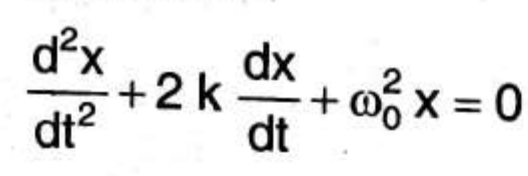 When will there be overdamping ?
- (a) k < ω₀
- (b) k = ω₀
- (c) k > ω₀
- (d) k = ω₀²
Show answer
Answer: (c)
70. An air core solenoid has 2000 turns in a length of 60 cm. Its diameter is 2 cm. If a current of 5 amps flows through the coil, what will be the flux density within it ?
- (a) 0.042 T
- (b) 0.035 T
- (c) 0.030 T
- (d) 0.021 T
Show answer
Answer: (d)
71. If the electron in the hydrogen atom jumps from the third to the second orbit, what is the wavelength of the emitted radiation ? (R ≡ Rydberg Constant)
- (a) 36/(5R)
- (b) 5R/36
- (c) 5/R
- (d) R/6
Show answer
Answer: (a)
72. The equation ∇⃗ × E⃗ = –∂B⃗/∂t is the differential form of which law ?
- (a) Ampere’s law
- (b) Faraday law
- (c) Coulomb law
- (d) Gauss law
Show answer
Answer: (b)
73. What potential must be applied to stop the fastest photoelectrons emitted when ultraviolet light of 2000 Å wavelength falls on a nickel surface ? (Work function of nickel = 5.01 eV)
- (a) 5.01 V
- (b) 3.02 V
- (c) 2.10 V
- (d) 1.20 V
Show answer
Answer: (d)
74. Nuclear forces are
- (a) Always repulsive
- (b) Always attractive
- (c) Attractive at large distances and repulsive at short distances
- (d) Repulsive at large distances and attractive at short distances
Show answer
Answer: (c)
75. What is the dimension of the coefficient of viscosity ‘η’ ?
- (a) ML⁻¹T⁻¹
- (b) ML⁻¹T⁻²
- (c) ML⁻²T⁻²
- (d) ML⁻²T⁻¹
Show answer
Answer: (a)
76. If the work done by a force in moving a particle from point A to point B does not depend on the path, then the force is of which type ?
- (a) Central
- (b) Non-conservative
- (c) Conservative
- (d) Inverse square law force
Show answer
Answer: (c)
77. The first law of thermodynamics for an adiabatic process is
- (a) dU = δW
- (b) dU = 0
- (c) dU = – δW
- (d) dU = –δQ + 2δW
Show answer
Answer: (c)
78. A Carnot engine has the same efficiency when it works between a source at 1000° K and a sink at 500° K, as it has when the source is at T°K and sink is at 1000° K. What is the value of T ?
- (a) 1500° K
- (b) 2000° K
- (c) 3000° K
- (d) 500° K
Show answer
Answer: (b)
79. A man can not see objects more distant than 40 cm. What is the power of the lens needed to allow him to see very distant objects ?
- (a) – 3.5 D
- (b) + 3.5 D
- (c) – 2.5 D
- (d) + 2.5 D
Show answer
Answer: (c)
80. A sound source of frequency 440 Hz is tied to the end of a 1.5 m long string and rotated in a horizontal plane at an angular velocity of 20 radians/sec. What is the frequency range of the sound heard by a listener standing for away ? (Velocity of sound in air = 330 m/s)
- (a) 440 – 480 Hz
- (b) 403 – 484 Hz
- (c) 400 – 500 Hz
- (d) 408 – 490 Hz
Show answer
Answer: (b)
81. If the polarizing angle for a medium is 60°, what will the critical angle be ?
- (a) 60°
- (b) cos⁻¹ (1/√3)
- (c) sin⁻¹ (1/√3)
- (d) tan⁻¹ (1/√3)
Show answer
Answer: (c)
82. An organ pipe of length 0.5 m is open at both ends. What is the frequency of its fundamental note ? (Velocity of sound in air = 350 m/s)
- (a) 350 Hz
- (b) 175 Hz
- (c) 700 Hz
- (d) 450 Hz
Show answer
Answer: (a)
83. 27 identical mercury drops are each charged to 10 V potential. Then they are merged to form one large drop. What will be the potential of the large drop ?
- (a) 270 V
- (b) 30 V
- (c) 60 V
- (d) 90 V
Show answer
Answer: (d)
84. Three equal resistances R are connected in the form of a triangle. The equivalent resistance between any two corners is
- (a) 3R
- (b) (3/2)R
- (c) (1/3)R
- (d) (2/3)R
Show answer
Answer: (d)
85. Two long parallel wires are at a distance 2R from each other. If currents i and 2i flow through them in opposite directions, what is the magnetic field B at the midpoint between them ?
- (a) μ₀i/(2πR)
- (b) 3μ₀i/(2πR)
- (c) 2μ₀i/(2πR)
- (d) 3μ₀i/(πR)
Show answer
Answer: (b)
86. Which is a symbol of the n-p-n transistor ?
- (a)
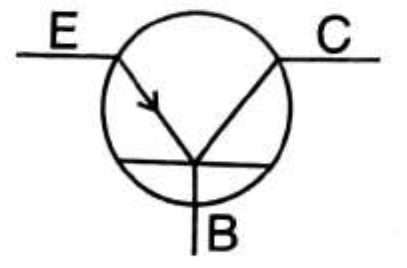
- (b)
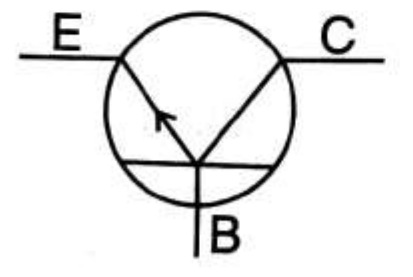
- (c)
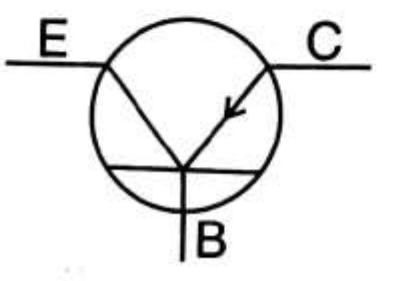
- (d)
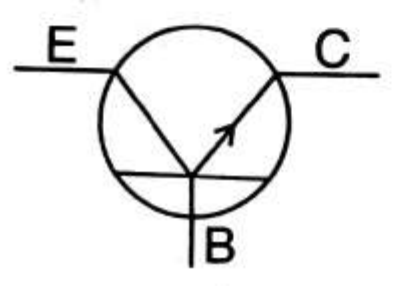
Show answer
Answer: (b)
- (a)
87. An element ₈₄X²⁰² emits an α – particle and then a β⁻ particle. If the final product is ₐYᵇ, then a and b are
- (a) 82, 198
- (b) 83, 198
- (c) 82, 199
- (d) 83, 199
Show answer
Answer: (b)
88. Which of the following is incorrect ?
- (a) Neutral pi-meson disintegrates into two photons
- (b) Average life of +ve and –ve pi-mesons is about 10⁻⁸ secs.
- (c) Mass of neutral pi-meson is about 264 times that of electron
- (d) +ve pi-meson is a stable particle
Show answer
Answer: (d)
89. Newton’s formula for the focal length of a thin lens is
- (a) xx′ = –ff′
- (b) xx′ = ff′
- (c) xx′ = –f²f′
- (d) xx′ = f/f′
Show answer
Answer: (b)
90. A prism of angle 60° has minimum deviation angle of 30°. What is the refractive index of the material of the prism ?
- (a) 2
- (b) √2
- (c) √(3/2)
- (d) √3
Show answer
Answer: (b)
91. If |A⃗ × B⃗| = AB, then angle between A⃗ and B⃗ is
- (a) 0
- (b) π/4
- (c) π/2
- (d) π
Show answer
Answer: (c)
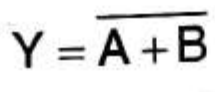
92. Boolean expression for AND gate is
- (a) Y = A + B
- (b) Y = A . B
- (c)
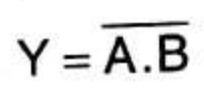
- (d)
Show answer
Answer: (b)
93. What is the relation between orbital and escape velocities (v₀ and vₑ) ? (orbit is close to earth’s surface)
- (a) vₑ = √2 v₀
- (b) vₑ = √3 v₀
- (c) vₑ = √5 v₀
- (d) vₑ = √7 v₀
Show answer
Answer: (a)
94. Equation for Bernoullis Theorem is
- (a) P + ρv² + ρgh = constant
- (b) P + mv² + mgh = constant
- (c) P + ½ρv² + ρgh = constant
- (d) P + ½mv² + mgh = constant
Show answer
Answer: (c)
95. If a simple pendulum is falling freely under gravitational force of attraction, its time period will be
- (a) 2π√(l/g)
- (b) 2π√g
- (c) ∞
- (d) 0
Show answer
Answer: (c)
96. Physical quantities which have same units are
- (a) Force and work
- (b) Pressure and stress
- (c) Pressure and strain
- (d) Pressure and volume
Show answer
Answer: (b)
97. The dimensions of constant ‘a’ in Van der Waal’s equation is
- (a) MLT⁻²
- (b) ML⁻¹T⁻³
- (c) ML⁵T⁻²
- (d) L⁶
Show answer
Answer: (c)
98. The diameter of the objective of a telescope is d and light of wavelength λ is being used. What will be the limit of resolution ?
- (a) 1.22λ/d
- (b) λ/d
- (c) d/(1.22λ)
- (d) 1.22d/λ
Show answer
Answer: (a)
99. When two lenses are in contact, the condition for achromatism is
- (a) ω₁/f₁ = ω₂/f₂
- (b) ω₁f₁ = ω₂f₂
- (c) ω₁/f₁ + ω₂/f₂ = 0
- (d) ω₁f₁ = – ω₂f₂
Show answer
Answer: (c)
100. Velocity of sound will be highest in
- (a) Air
- (b) Water
- (c) Vacuum
- (d) Steel
Show answer
Answer: (d)
101. Two sound sources have equations y₁ = 0.25 Sin 316 t and y₂ = 0.25 Sin 310 t respectively. If the listener hears both together how many beats will be hear per second ?
- (a) 6
- (b) 6/π
- (c) 3/π
- (d) 3π
Show answer
Answer: (c)
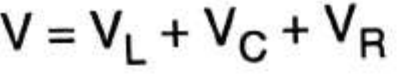
102. An AC source (V volts) sends current through a series L, C, R circuit. If voltages V_L, V_C, V_R are measured across L, C, R, then
- (a)
- (b)

- (c)

- (d)

Show answer
Answer: (d)
- (a)
103. In photoelectric effect, the rate of emission of photoelectrons depends on
- (a) Intensity of radiation
- (b) Frequency of radiation
- (c) Both (A) and (B) above
- (d) None of the above
Show answer
Answer: (a)
104. If the rms potential difference across a 15 kΩ resistance is 16 V, the maximum current flowing is
- (a) 15 mA
- (b) 1 mA
- (c) 10 mA
- (d) 1.5 mA
Show answer
Answer: (d)
105. A circular coil of N turns and radius r is placed initially with its plane perpendicular to a uniform magnetic field B. It is then rotated through 90°. How much charge flows through the coil ? Coil resistance is R.
- (a) Zero
- (b) πN²r B/R
- (c) 2πr N²B/R
- (d) πr² NB/R
Show answer
Answer: (d)
106. A light wave enters glass from air. What does not change ?
- (a) Frequency
- (b) Wavelength
- (c) Velocity
- (d) All the above change
Show answer
Answer: (a)
107. A transformer heats up after long use mainly because of
- (a) Current in the coils
- (b) Hysteresis loss
- (c) Electromagnetic radiation
- (d) External sources
Show answer
Answer: (b)
108. The Balmer series of Hydrogen is found in which region ?
- (a) Infra-red
- (b) Ultraviolet
- (c) Visible
- (d) X-ray
Show answer
Answer: (c)
109. A straight wire of length L has current I flowing through it. A constant magnetic field B, parallel to the wire, is applied. What is the force on the wire ?
- (a) Zero
- (b) BLI
- (c) B²LI
- (d) BL²I
Show answer
Answer: (a)
110. Which statement is incorrect ?
- (a) Two equipotential surfaces cannot intersect
- (b) Line integral of electric field on an equipotential surface is a finite constant
- (c) Electric field at surface of a conductor is always perpendicular to it
- (d) Work done in moving a charge on an equipotential surface is zero
Show answer
Answer: (b)
111. After collision of photon with an electron the photon has
- (a) Higher frequency
- (b) Larger wavelength
- (c) More energy
- (d) Lesser velocity
Show answer
Answer: (b)
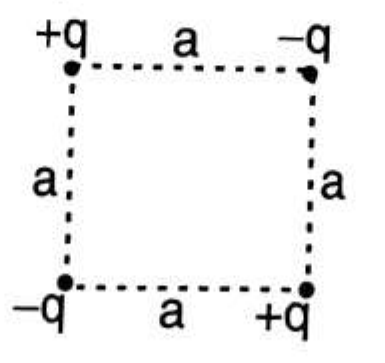
112. The interaction energy of the charges in the set-up below will be
- (a) q²/(4πε₀a) (√2 – 4)
- (b) q²/(4πε₀a) (√2 + 4)
- (c) q²/(4πε₀a) 2√2
- (d) q²/(4πε₀a) 4√2
Show answer
Answer: (a)
113. If μ₀ = 1.544 and μ_E = 1.558 then the thickness of a quarter wave plate for λ = 6500Å is
- (a) 0.25 μm
- (b) 0.38 μm
- (c) 10.0 μm
- (d) 11.6 μm
Show answer
Answer: (d)
114. For diffraction at a single slit, the width of the central maximum is ________ the wavelength of light.
- (a) Proportional to
- (b) Proportional to the square of
- (c) Inversely proportional to
- (d) Independent of
Show answer
Answer: (a)
115. Water rises to a height of 10 cm in a capillary. Mercury falls to a depth of 3.42 cm in same capillary. If the relative density of mercury is 13.6 and its angle of contact is 135°, the ratio of surface tensions of water and mercury is
- (a) 0.05
- (b) 0.10
- (c) 0.15
- (d) 0.20
Show answer
Answer: (c)
116. The electric field components of a plane electromagnetic wave are
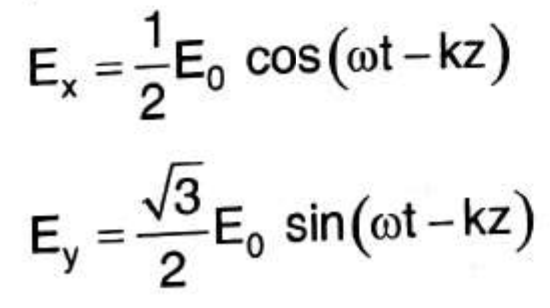 What is the nature of the wave ?
- (a) Right elliptical
- (b) Left elliptical
- (c) Right circular
- (d) Left circular
Show answer
Answer: (a)
117. The mass ratio of two planets is x and the density ratio is y. What is the ratio of the acceleration due to gravity on their surfaces ?
- (a) x²/y
- (b)
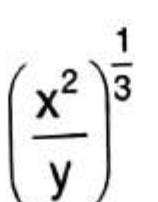
- (c) x²y
- (d)
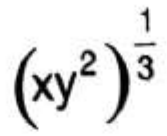
Show answer
Answer: (d)
118. If the values of M and A are experimentally measured as 3.00 units and 2.820 units respectively, what will be the percentage error in the calculated value of Y (=M/A) ?
- (a) 0.036%
- (b) 0.072%
- (c) 0.36%
- (d) 0.72%
Show answer
Answer: (c)
119. If I = I₀ sin² (2πt/T), then what is the average value of I between t = 0 and t = T/2 ?
- (a) √2 I₀
- (b) I₀/√2
- (c) I₀/2
- (d) I₀
Show answer
Answer: (c)
120. A ring of radius R is uniformly charged with charge q. What is the electric potential V at a point on the axis, at a distance x from the centre ?
- (a)
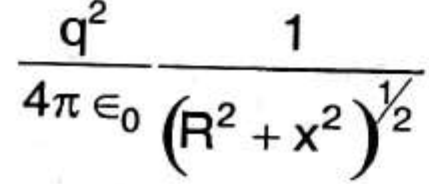
- (b)
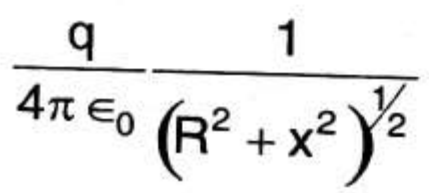
- (c)
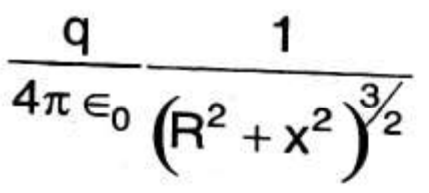
- (d)
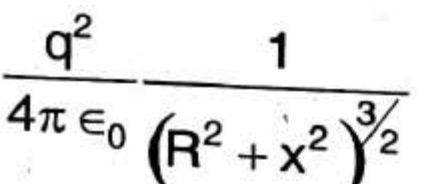
Show answer
Answer: (b)
- (a)
121. Which of the following is a reversible process ?
- (a) Production of heat by passing current through a resistance
- (b) Conduction of heat from hot body to cold body
- (c) Infinitely slow changes in the pressure and volume of the working substance
- (d) Forcing a real gas through a porous plug while keeping them insulated from the environment
Show answer
Answer: (c)
122. The mass and radius of the earth are M and R. How long should one day be so that a person feels weightless on the equator ? (acceleration due to gravity = g)
- (a) 2π√(R/g)
- (b) (1/2π)√(g/R)
- (c) (1/2π)√(g/MR)
- (d) 2π√(MR²/g)
Show answer
Answer: (a)
123. An adiabatic process is also known as
- (a) Isoentropic
- (b) Isothermal
- (c) Isobaric
- (d) Isochoric
Show answer
Answer: (a)
124. A small solid sphere is dropped into a viscous liquid. It finally moves with a constant velocity which is called
- (a) Escape velocity
- (b) Terminal velocity
- (c) Critical velocity
- (d) Reynold velocity
Show answer
Answer: (b)
125. Three vectors A⃗, B⃗ and C⃗ will be coplanar only if
- (a) A⃗.B⃗ = B⃗.C⃗ = A⃗.C⃗ = 0
- (b) A⃗.(B⃗ × C⃗) = 0
- (c) A⃗ × (B⃗ × C⃗) = 0
- (d) (A⃗.B⃗) × C⃗ = 0
Show answer
Answer: (b)
Show answers
Answer key
Answer key from the U.P. Secondary Education Services Selection Board’s official answer key for this sitting. “—” means the key gave none: the question was deleted.
Physics
- Q 1
- (c)
- Q 2
- (d)
- Q 3
- (b)
- Q 4
- (d)
- Q 5
- (a)
- Q 6
- (c)
- Q 7
- (a)
- Q 8
- (c)
- Q 9
- (c)
- Q 10
- (d)
- Q 11
- (b)
- Q 12
- (b)
- Q 13
- (c)
- Q 14
- (a)
- Q 15
- (c)
- Q 16
- (d)
- Q 17
- (a)
- Q 18
- (d)
- Q 19
- (c)
- Q 20
- (c)
- Q 21
- (d)
- Q 22
- (a)
- Q 23
- (d)
- Q 24
- (c)
- Q 25
- (c)
- Q 26
- (d)
- Q 27
- (c)
- Q 28
- (c)
- Q 29
- (c)
- Q 30
- (d)
- Q 31
- (a)
- Q 32
- (d)
- Q 33
- (a)
- Q 34
- (c)
- Q 35
- (b)
- Q 36
- (b)
- Q 37
- (a)
- Q 38
- (b)
- Q 39
- (c)
- Q 40
- (b)
- Q 41
- (b)
- Q 42
- (a)
- Q 43
- (b)
- Q 44
- (c)
- Q 45
- (c)
- Q 46
- —
- Q 47
- (c)
- Q 48
- (b)
- Q 49
- (b)
- Q 50
- (a)
- Q 51
- (a)
- Q 52
- (b)
- Q 53
- (a)
- Q 54
- (b)
- Q 55
- (d)
- Q 56
- (a)
- Q 57
- (d)
- Q 58
- (a)
- Q 59
- (c)
- Q 60
- (c)
- Q 61
- (d)
- Q 62
- (c)
- Q 63
- (a)
- Q 64
- (d)
- Q 65
- (b)
- Q 66
- (a)
- Q 67
- (c)
- Q 68
- (b)
- Q 69
- (c)
- Q 70
- (d)
- Q 71
- (a)
- Q 72
- (b)
- Q 73
- (d)
- Q 74
- (c)
- Q 75
- (a)
- Q 76
- (c)
- Q 77
- (c)
- Q 78
- (b)
- Q 79
- (c)
- Q 80
- (b)
- Q 81
- (c)
- Q 82
- (a)
- Q 83
- (d)
- Q 84
- (d)
- Q 85
- (b)
- Q 86
- (b)
- Q 87
- (b)
- Q 88
- (d)
- Q 89
- (b)
- Q 90
- (b)
- Q 91
- (c)
- Q 92
- (b)
- Q 93
- (a)
- Q 94
- (c)
- Q 95
- (c)
- Q 96
- (b)
- Q 97
- (c)
- Q 98
- (a)
- Q 99
- (c)
- Q 100
- (d)
- Q 101
- (c)
- Q 102
- (d)
- Q 103
- (a)
- Q 104
- (d)
- Q 105
- (d)
- Q 106
- (a)
- Q 107
- (b)
- Q 108
- (c)
- Q 109
- (a)
- Q 110
- (b)
- Q 111
- (b)
- Q 112
- (a)
- Q 113
- (d)
- Q 114
- (a)
- Q 115
- (c)
- Q 116
- (a)
- Q 117
- (d)
- Q 118
- (c)
- Q 119
- (c)
- Q 120
- (b)
- Q 121
- (c)
- Q 122
- (a)
- Q 123
- (a)
- Q 124
- (b)
- Q 125
- (b)