ExamBharo · UP PGT 2016 — Mathematics (Series A) · exambharo.com/up-pgt/previous-year-papers/up-pgt-2016-mathematics-series-a/
Question paper · UP PGT
UP PGT 2016 — Mathematics (Series A)
1 or 2 February 2019125 questions+3.4 for a correct answer, −0 for a wrong one
Questions from the U.P. Secondary Education Services Selection Board’s paper of 1 or 2 February 2019. Each question’s answer is under it, hidden until you open it, and the full answer key is at the end. Take the paper as a timed practice test to be scored.
The official booklet is a scan with no text, so ExamBharo typed this paper from it by hand. A typing slip is possible; report one through the contact page.
The board deleted question 102 in its final answer key: shown here, with no answer, and not counted in the score.
Mathematics
1. If A and B are symmetric matrices, then AB is symmetric matrix if and only if
- (a) AB = BA
- (b) AB = – BA
- (c) AB⁻¹ = B⁻¹A
- (d) None of the above
Show answer
Answer: (a)
2. If the roots of the equation x² + x + a = 0, a > 0 are real and distinct, then the roots of the equation x² – 4√a x + 1 = 0 are
- (a) rational
- (b) irrational
- (c) imaginary
- (d) none of the above
Show answer
Answer: (c)
3. The matrix A =
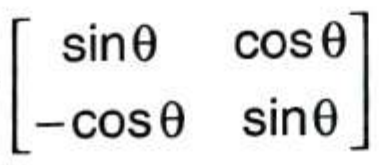 is
- (a) Symmetric
- (b) Skew-symmetric
- (c) Orthogonal
- (d) Singular
Show answer
Answer: (c)
4. If 1, ω, ω² are the cube roots of unity, then value of the determinant
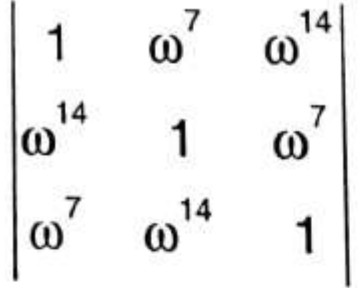 is
- (a) ω²
- (b) ω
- (c) 1
- (d) 0
Show answer
Answer: (d)
5. Number of terms in the expansion of (2x – y + 3z)²⁰ is
- (a) 228
- (b) 230
- (c) 231
- (d) 236
Show answer
Answer: (c)
6. The sum of two distinct roots of the equation
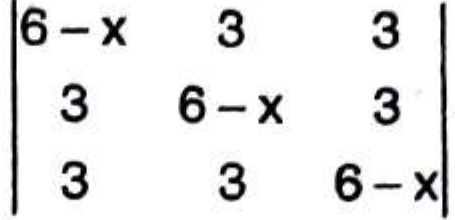 = 0 is
- (a) 3
- (b) 12
- (c) 15
- (d) 9
Show answer
Answer: (c)
7. What is
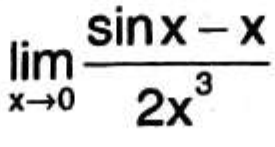 equal to ?
- (a) –1/2
- (b) –1/4
- (c) –1/12
- (d) does not exist
Show answer
Answer: (c)
8. If Q is a non-singular matrix and P is a square matrix such that det(Q⁻¹P²Q) = 4, then det P is equal to
- (a) 0
- (b) 1
- (c) 2
- (d) 4
Show answer
Answer: (c)
9. If A =
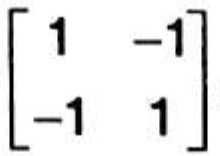 , then A³ is equal to
- (a) A
- (b) 4A
- (c) 3A
- (d) 2A
Show answer
Answer: (b)
10. If a, b, c are rational numbers and ax² + bx + c = 0 and 2x² + x – 2 = 0 have a common root, then 4a – 2b + 3c is equal to
- (a) –1
- (b) –2
- (c) 0
- (d) 4
Show answer
Answer: (c)
11. If H and K are subgroups of a group G and O(H) = 3, O(K) = 5, O(G) = 30 then O(H ∩ K) is
- (a) 1
- (b) 2
- (c) 3
- (d) 5
Show answer
Answer: (a)
12. If A⁻¹ =
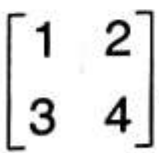 , then 2A is equal to
- (a)
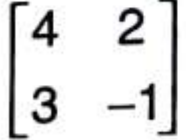
- (b)
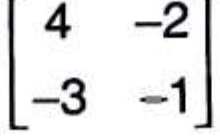
- (c)
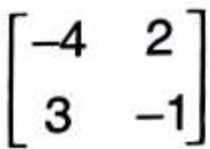
- (d)
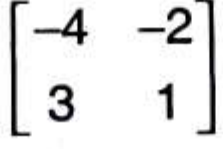
Show answer
Answer: (c)
- (a)
13. If x, y are elements of a group G and O(y) = 3, then O(xyx⁻¹) is
- (a) 1
- (b) 2
- (c) 3
- (d) 6
Show answer
Answer: (c)
14. If f : G → G′ is a group isomorphism then which of the following is true ?
- (a) O(a) < O(f(a))
- (b) O(a) = O(f(a))
- (c) O(a) > O(f(a))
- (d) None of the above
Show answer
Answer: (b)
15. If A = {4ⁿ – 3n – 1, n ∈ N} and B = {9(n – 1), n ∈ N}, then which of the following is true ?
- (a) A ⊆ B
- (b) B ⊆ A
- (c) A ∪ B = A
- (d) None of the above
Show answer
Answer: (a)
16. In the additive group of integers the order of every element except zero is
- (a) finite
- (b) infinite
- (c) some times finite and some times infinite
- (d) none of the above
Show answer
Answer: (b)
17. If W is a subspace of R⁴ spanned by {(1, 0, –1, 0), (0, 1, 0, 1)}, then which of the following is in W ?
- (a) (1, 2, 1, 2)
- (b) (1, 2, –1, 2)
- (c) (2, 2, 3, 2)
- (d) (0, 1, 1, 1)
Show answer
Answer: (b)
18. Let V be a vector space over R consisting of solutions of d²y/dx² – 4y = 0. Dimension of V is
- (a) 0
- (b) 1
- (c) 2
- (d) 4
Show answer
Answer: (c)
19. For what value of m, the vector (m, 3, 1) is a linear combination of the vectors (3, 2, 1) and (2, 1, 0) ?
- (a) 2
- (b) 3
- (c) 5
- (d) 1
Show answer
Answer: (c)
20. Vectors x = (1, 0, 1), y = (–4, a, 4) and z = (a, –1, –a) are linearly dependent in R³, if a is equal to
- (a) 2 only
- (b) –2 only
- (c) ± 2 both
- (d) 0
Show answer
Answer: (c)
21. The equation r(6 – 4 cosθ) = 5 represents
- (a) a parabola
- (b) an ellipse
- (c) a hyperbola
- (d) a circle
Show answer
Answer: (b)
22. The focus of the parabola 4y² – 6x – 4y = 5 is
- (a) (–5/8, 1/2)
- (b) (–3/8, 1/2)
- (c) (–7/8, –1/2)
- (d) (–5/8, –1/2)
Show answer
Answer: (a)
23. Equation 9x² + 2hxy + 4y² + 6x + 2fy = 3 represents two parallel lines if (h + f) is equal to
- (a) 2
- (b) 6
- (c) 8
- (d) 0
Show answer
Answer: (c)
24. If the line y = x + 3 meets the circle x² + y² = 9 at A and B, then the equation of the circle whose diameter is AB, is
- (a) x² + y² + 3x – 3y = 0
- (b) x² + y² – 3x + 3y = 0
- (c) x² + y² + 3x + 3y = 0
- (d) x² + y² – 3x – 3y = 0
Show answer
Answer: (a)
25. Circles x² + y² – 2x – 4y = 0 and x² + y² – 8y – 4 = 0
- (a) touch externally
- (b) touch internally
- (c) do not touch
- (d) none of the above
Show answer
Answer: (b)
26. The centre of the conic 5x² – 6xy + 5y² + 22x – 26y + 29 = 0 is
- (a) (–1, 1)
- (b) (–1, 2)
- (c) (2, 2)
- (d) (0, 3)
Show answer
Answer: (b)
27. If e and e′ be the eccentricities of the hyperbola x²/a² – y²/b² = 1 and its conjugate hyperbola, then
- (a) e² + e′² = 1
- (b) e = e′
- (c) 1/e² + 1/e′² = 1
- (d) 1/e² – 1/e′² = 1
Show answer
Answer: (c)
28. Centre of circle passing through the points (2, 0), (0, 6) and (5, 1) is
- (a) (3/2, 1)
- (b) (2, 3)
- (c) (5/2, 2)
- (d) (5/2, 7/2)
Show answer
Answer: (d)
29. The vertices of a hyperbola are (1, 0) and (–1, 0) and the foci are (2, 0) and (–2, 0). The equation of the hyperbola is
- (a) 3x² – y² = 3
- (b) 2x² – 3y² = 3
- (c) x² – 3y² = 2
- (d) 3x² – 2y² = 6
Show answer
Answer: (a)
30. Equation of a cone, whose vertex is at origin and base is the curve z = k, f(x, y) = 0, is
- (a) f(xk/z, yk/z) = 0
- (b) f(k, xyz) = 0
- (c) f(ky, kxz) = 0
- (d) none of the above
Show answer
Answer: (a)
31.
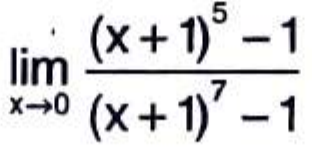 is equal to
- (a) 7/5
- (b) 5/7
- (c) 2/7
- (d) 2/5
Show answer
Answer: (b)
32. If f(x + 1/x) = x³ + 1/x³, then f(1) is equal to
- (a) –3
- (b) –2
- (c) –1
- (d) 0
Show answer
Answer: (b)
33. Number of points, where the function f(x) = |x + 3| + |x² – 4| is not differentiable, is
- (a) 0
- (b) 1
- (c) 2
- (d) 3
Show answer
Answer: (d)
34. What is the general solution of the differential equation ydx – (x + 2y²)dy = 0 ?
- (a) x = y² + cy
- (b) x = 2cy²
- (c) x = 2y² + cy
- (d) x = 2y + cy²
Show answer
Answer: (c)
35.
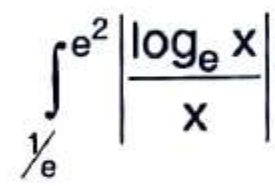 dx is equal to
- (a) 1/2
- (b) 3/2
- (c) 5/2
- (d) 2
Show answer
Answer: (c)
36. If f(x) = √(4 – x²), then
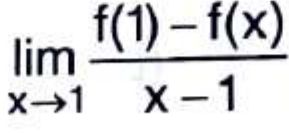 is equal to
- (a) 1/√3
- (b) √3
- (c) 0
- (d) 2/√3
Show answer
Answer: (a)
37. Value of
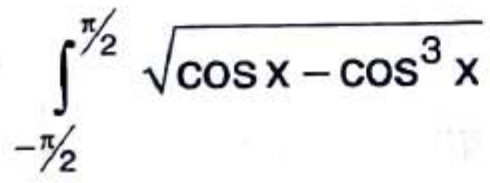 dx is equal to
- (a) 0
- (b) 1/3
- (c) 2/3
- (d) 4/3
Show answer
Answer: (d)
38. Solution of the differential equation
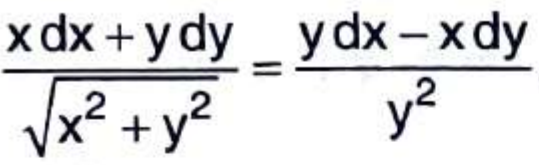 , y(0) = 1 is
- (a) y√(x² + y²) = 2x + y
- (b) x√(x² + y²) = x + y
- (c) y√(x² + y²) = x + y
- (d) x√(x² + y²) = 2x + y
Show answer
Answer: (c)
39. Maclaurin’s expansion of tan⁻¹x is
- (a)
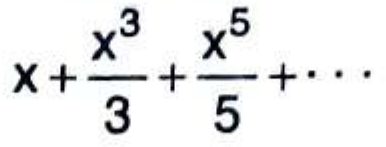
- (b)
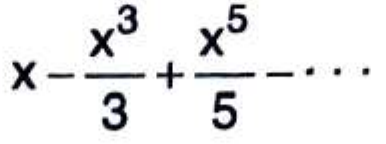
- (c)
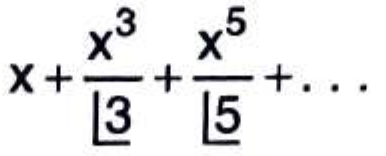
- (d)
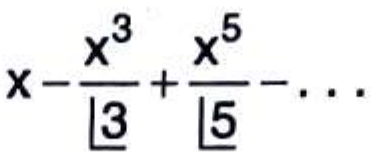
Show answer
Answer: (b)
- (a)
40. Number of asymptotes of the curve x²y – 3x² – 5xy + 6y + 2 = 0 is
- (a) 0
- (b) 1
- (c) 2
- (d) 3
Show answer
Answer: (d)
41. If y =
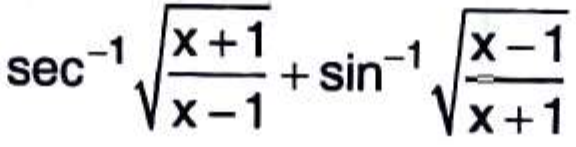 , then value of dy/dx at x = 2 is
- (a) 1
- (b) 2
- (c) 0
- (d) 3
Show answer
Answer: (c)
42. The differential equation for the family of curves y = Ae²ˣ + Be⁻²ˣ, where A and B are arbitrary constants, is
- (a) d²y/dx² + 4y = 0
- (b) d²y/dx² – 4y = 0
- (c) d²y/dx² + dy/dx – 4y = 0
- (d) d²y/dx² + 4 dy/dx – y = 0
Show answer
Answer: (b)
43. tan⁻¹x > cot⁻¹x is true for
- (a) x = 1
- (b) x > 1
- (c) x < 1
- (d) All values of x
Show answer
Answer: (b)
44. Which one of the following is correct ?
- (a) sinh⁻¹x = i sin⁻¹(ix)
- (b) cosh⁻¹x = log(x + √(1 – x²))
- (c) cosh⁻¹x = i cos⁻¹(ix)
- (d) tanh⁻¹x = –i tan⁻¹(ix)
Show answer
Answer: (d)
45. Value of
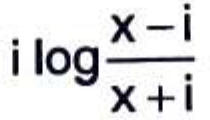 is
- (a) π + 2 tan⁻¹x
- (b) π/2 + 2tan⁻¹x
- (c) π/2 – 2tan⁻¹x
- (d) π – 2 tan⁻¹x
Show answer
Answer: (d)
46. If |z + 5| ≤ 2, z = x + iy, then the greatest value of |z + 2| is
- (a) 2
- (b) 4
- (c) 5
- (d) 6
Show answer
Answer: (c)
47. If i = √–1, then the general value of iⁱ is equal to
- (a)
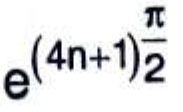
- (b)
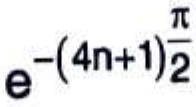
- (c)
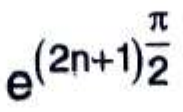
- (d) none of the above
Show answer
Answer: (b)
- (a)
48. Sinh⁻¹(cot x) is equal to
- (a) log(cosx + sinx)
- (b) log(cosx – sinx)
- (c) log(cotx + cosecx)
- (d) log(tanx + cotx)
Show answer
Answer: (c)
49. If A + iB =
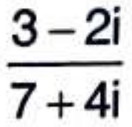 , then value of A – B is
- (a) 1/5
- (b) 2/5
- (c) 3/5
- (d) –1/5
Show answer
Answer: (c)
50. If |a⃗| + |b⃗| = |c⃗| and a⃗ + b⃗ = c⃗, then angle between a⃗ and b⃗ is
- (a) 0°
- (b) 45°
- (c) 90°
- (d) 180°
Show answer
Answer: (a)
51. If vectors p⃗ = xî + 3ĵ + 2k̂, a⃗ = 2î + 2ĵ + 3k̂ and b⃗ = 2î + 3ĵ + 4k̂ are coplanars, then value of x is
- (a) 2
- (b) –2
- (c) 3
- (d) –3
Show answer
Answer: (b)
52. If â and b̂ are two unit vectors inclined at an angle 30° to each other, then |â + b̂| is equal to
- (a) √3 – 1
- (b) √3 + 1
- (c) (√3 – 1)/√2
- (d) (√3 + 1)/√2
Show answer
Answer: (d)
53. If F⃗ = grad (x³ + y³ + z³ – 3xyz), then F⃗ is
- (a) solenoidal
- (b) irrotational
- (c) solenoidal and irrotational both
- (d) none of the above
Show answer
Answer: (b)
54. A vector, which is normal to the surface x² – xy + yz = 5 at the point (1, 2, 3) is
- (a) î + 2ĵ
- (b) 2ĵ + 2k̂
- (c) 2î + k̂
- (d) ĵ + 2k̂
Show answer
Answer: (b)
55. Which one of the following is not correct for a common catenary ?
- (a)
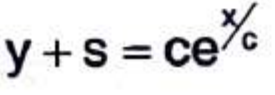
- (b) ds/dψ = c sec²ψ
- (c)
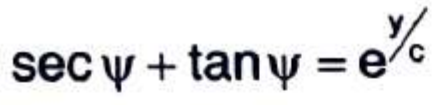
- (d)
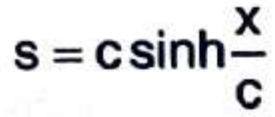
Show answer
Answer: (c)
- (a)
56. A ball is thrown vertically upward with a given velocity. It reaches a maximum height 100 m. If on second time its initial velocity is doubled then the ball will reach a maximum height of
- (a) 100 m
- (b) 150 m
- (c) 200 m
- (d) 400 m
Show answer
Answer: (d)
57. A stone is projected horizontally with a velocity 9.8 m/s from a tower of height 100 m. Its speed after 1 sec. of projection is (g = 9.8 m/s²)
- (a) 9.8 m/s
- (b) 4.9 m/s
- (c) 9.8 √2 m/s
- (d) None of the above
Show answer
Answer: (c)
58. If a body is acted upon by three forces and body is in equilibrium, then
- (a) All of them are parallel
- (b) They meet at a point
- (c) Any two of them are parallel
- (d) Either they are all parallel or they meet in a point
Show answer
Answer: (d)
59. Two projectiles are projected with same velocity but with angles of projection (45° – θ) and (45° + θ). Ratio of their horizontal range is
- (a) 1 : 2
- (b) 1 : 3
- (c) 2 : 1
- (d) 1 : 1
Show answer
Answer: (d)
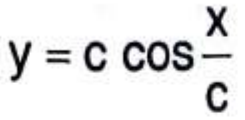
60. The Cartesian equation of a common catenary is
- (a)
- (b)
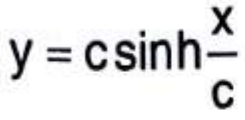
- (c)
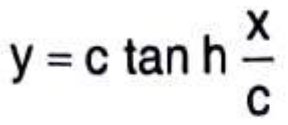
- (d)
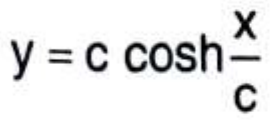
Show answer
Answer: (d)
- (a)
61. Domain of the function f(x) = √(2ˣ – 5ˣ) is
- (a) x < 0
- (b) x ≤ 0
- (c) x > 0
- (d) x ≥ 0
Show answer
Answer: (b)
62. If f(x) = (x – 1)/(x + 2) and y = f⁻¹(x), then dy/dx is equal to
- (a) 3/(1 – x)
- (b) 3/(1 + x)
- (c) 3/(1 – x)²
- (d) 3/(1 + x)²
Show answer
Answer: (c)
63. The value of 1² + 3² + 5² + . . . + (2n – 1)² is
- (a) (1/3) n(4n² – 1)
- (b) (1/3) n(4n² + 1)
- (c) (1/6) n(4n² – 1)
- (d) (1/6) n(4n² + 1)
Show answer
Answer: (a)
64. The least value of ‘n’, for which 1 + 3 + 3² + . . . + 3ⁿ⁻¹ > 700, is equal to
- (a) 4
- (b) 5
- (c) 6
- (d) 7
Show answer
Answer: (d)
65. If
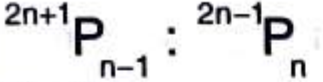 = 3 : 5, then n is equal to
- (a) 2
- (b) 3
- (c) 4
- (d) 5
Show answer
Answer: (c)
66. The inverse of a skew-symmetric of order 3
- (a) is a skew-symmetric matrix
- (b) is a symmetric matrix
- (c) is a diagonal matrix
- (d) does not exist
Show answer
Answer: (d)
67. If the sum of the coefficients of powers of x in the expansion of (a²x³ – 8ax² + 16)⁴⁸ is zero, then a is equal to
- (a) –2
- (b) –1
- (c) 2
- (d) 4
Show answer
Answer: (d)
68. Value of
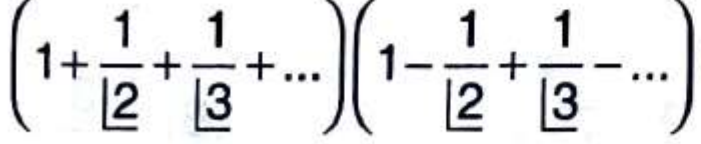 is
- (a)
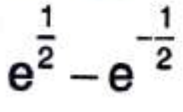
- (b)
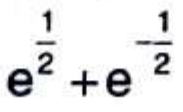
- (c)
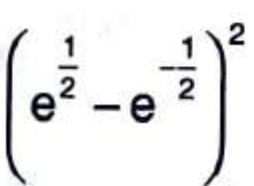
- (d)
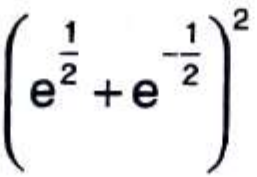
Show answer
Answer: (c)
- (a)
69. The system of linear equations x₁ + 2x₂ + x₃ = 3 2x₁ + 3x₂ + x₃ = 3 3x₁ + 5x₂ + 2x₃ = 1 has
- (a) infinitely many solutions
- (b) exactly 3 solutions
- (c) unique solution
- (d) no solution
Show answer
Answer: (d)
70. If 5ᵗʰ term of a harmonic progression is 7 and 7ᵗʰ term is 5, then 35ᵗʰ term is
- (a) 0
- (b) 1
- (c) 7/12
- (d) 1/35
Show answer
Answer: (b)
71. If log3, log(3ˣ – 2) and log(3ˣ + 4) are in arithmetical progression, then x is equal to
- (a) log₃4
- (b) log₂3
- (c) log₃8
- (d) log₈3
Show answer
Answer: (c)
72. There are 15 points in a plane such that no three of them are collinear. The number of triangles formed by joining them is
- (a) 455
- (b) 2730
- (c) 355
- (d) 454
Show answer
Answer: (a)
73. If G is a cyclic group of order 30, then total number of subgroups of G is
- (a) 6
- (b) 7
- (c) 8
- (d) 9
Show answer
Answer: (c)
74. If every element of a group G is its own inverse, then G is
- (a) finite
- (b) infinite
- (c) abelian
- (d) non-abelian
Show answer
Answer: (c)
75. 1³ – 2³ + 3³ – 4³ + ... –10³ + 11³ is equal to
- (a) 512
- (b) 756
- (c) 848
- (d) 954
Show answer
Answer: (b)
76. In the group G = {{2, 4, 6, 8}, ·₁₀} the identity element is
- (a) 2
- (b) 4
- (c) 6
- (d) 8
Show answer
Answer: (c)
77. Let G be a group with binary operation ∗ defined by a ∗ b = a + b + 1, ∀ a, b ∈ G. Inverse of element C of G is
- (a) 2 + C
- (b) 2 – C
- (c) –2 + C
- (d) –2 – C
Show answer
Answer: (d)
78. Number of all onto functions from the set {1, 2, 3, 4, 5} to itself is
- (a) 2⁵
- (b) 2⁵ – 1
- (c)

- (d)

Show answer
Answer: (c)
79. Every subgroup of a cyclic group is
- (a) normal
- (b) normal only when order of subgroup is prime
- (c) non-normal
- (d) normal when order of group is prime
Show answer
Answer: (a)
80. Which one of the following is a subspace of vector space R³ ?
- (a) {(a, b, c) ∈ R³ : a + b = 0}
- (b) {(a, b, c) ∈ R³ : a – b = 2}
- (c) {(a, b, c) ∈ R³ : a + b = 1}
- (d) {(a, b, c) ∈ R³ : a – b = 1}
Show answer
Answer: (a)
81. If T : U → V be a linear transformation then Kernel T is a subspace of
- (a) U ∩ V
- (b) U
- (c) V
- (d) U/V
Show answer
Answer: (b)
82. If T : V₂(R) → V₃(R) be defined as T(a, b) = (a + b, a – b, b) is a linear transformation, then nullity T is
- (a) 0
- (b) 1
- (c) 2
- (d) 3
Show answer
Answer: (a)
83. If V = R³, W = {(a, 0, 0) ∈ R³}, then dimension of vector space V/W is
- (a) 1
- (b) 2
- (c) 3
- (d) 4
Show answer
Answer: (b)
84. Let α, β be the roots of the equation x² + ax + a³ = 0, a ≠ 0. If (α, β) lies on the parabola y² = x, then the roots of the equation are
- (a) 2, 3
- (b) 4, –2
- (c) 4, 2
- (d) 2, – 3
Show answer
Answer: (b)
85. If 2x – y + z + 4 = 0 is a tangent plane to the sphere whose centre is (1, 0, 1), then radius of sphere is
- (a) 7
- (b) 7/√6
- (c) 5/√6
- (d) 5
Show answer
Answer: (b)
86. If the slope of one of lines represented by ax² – 6xy + y² = 0 is square of the slope of the other line, then the value of a are
- (a) 8, – 27
- (b) – 8, 27
- (c) 6, – 24
- (d) – 6, 24
Show answer
Answer: (a)
87. Distance of the point P(1, –2) from the centre of the circle x = 2 + 3cosθ, y = –4 + 3sinθ is
- (a) √7
- (b) √5
- (c) √3
- (d) √2
Show answer
Answer: (b)
88. The equations of the lines bisecting the angles between the pair of lines 3x² + xy – 2y² = 0 is
- (a) x² – 10xy – y² = 0
- (b) x² + 10xy – y² = 0
- (c) x² + 10xy + y² = 0
- (d) x² + xy – y² = 0
Show answer
Answer: (a)
89. In three dimensional geometry equation x² + y² = r² represents a
- (a) circle
- (b) sphere
- (c) cylinder
- (d) cone
Show answer
Answer: (c)
90. The equation of a plane containing x-axis is
- (a) ax + by = 0
- (b) by + cz = 0
- (c) ax + cz = 0
- (d) x + y + z = 0
Show answer
Answer: (b)
91. Let S and S′ be the foci and BB′ be the minor axis of an ellipse. If ∠BSS′ = θ, then eccentricity of the ellipse is
- (a) cos θ
- (b) sin θ
- (c) tan θ
- (d) cot θ
Show answer
Answer: (a)
92. If line ax + by + c = 0 is a normal to the curve xy = 4, then
- (a) a < 0, b < 0
- (b) a > 0, b > 0
- (c) a > 0, b < 0
- (d) a < 0, b = 0
Show answer
Answer: (c)
93. Maximum value of the function f(x) =
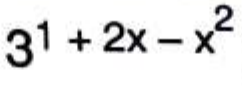 is equal to
- (a) 3
- (b) 9
- (c) 27
- (d) 81
Show answer
Answer: (b)
94. If xy = 1, then
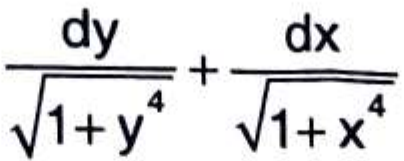 is equal to
- (a) 0
- (b) 1
- (c) y
- (d) not defined
Show answer
Answer: (a)
95. If z =
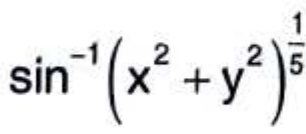 , then
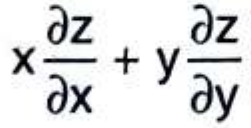 is equal to
- (a) (1/5) sin z
- (b) (2/5) tan z
- (c) (2/5) sin z
- (d) tan z
Show answer
Answer: (b)
96. If
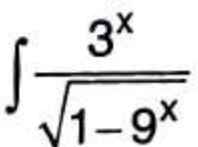 dx = a sin⁻¹ 3ˣ + C, then a is equal to
- (a) log 3
- (b) 1/log3
- (c) 1/2
- (d) 1
Show answer
Answer: (b)
97. What is
 , a > – 1, equal to ?
- (a) 1/(a + 1)
- (b) 2/(a + 1)
- (c) a/(a + 1)
- (d) (a – 1)/(a + 1)
Show answer
Answer: (a)
98. If 2y = x + 3 is a tangent line to the curve y³ = ax² + b at the point (1, 2), then 3b – 5a is equal to
- (a) 0
- (b) 2
- (c) 3
- (d) 4
Show answer
Answer: (a)
99. The least possible value of ‘a’ for which the function f(x) = x² + ax + 1 may be increasing in the interval [1, 2] is
- (a) 2
- (b) 1
- (c) 0
- (d) –2
Show answer
Answer: (d)
100. The area bounded by the curve y = sinx + cosx and the co-ordinate axes in the first quadrant is
- (a) √2 – 1
- (b) √2
- (c) √2 + 1
- (d) 1
Show answer
Answer: (c)
101. If z = f(x – y, y – t, t – x), then ∂z/∂x + ∂z/∂y + ∂z/∂t is equal to
- (a) x + y + t
- (b) x + y + t + 1
- (c) 1
- (d) 0
Show answer
Answer: (d)
102. If y =
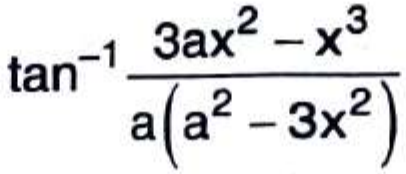 , then dy/dx is equal to
- (a) 3x/(x² + a²)
- (b) 3a/(x² + a²)
- (c) 3/(x² + a²)
- (d) a/(x² + a²)
Show answer
Answer: —
103. If a and b are arbitrary constants, then the partial differential equation of z = ax + a²y² + b is
- (a) q = 2py
- (b) p = 2q²y
- (c) q = 2p²y
- (d) p = xq²
Show answer
Answer: (c)
104. Solution of the differential equation (y – px) (p – 1) = p, p = dy/dx is (Where c is an arbitrary constant)
- (a) y = cx + c/(c – 1)
- (b) y = x² + c
- (c) y = cx + 2
- (d) y² = cx + 3
Show answer
Answer: (a)
105. If
 , then
- (a) A = 1, B = 0
- (b) A = 0, B = 1
- (c) A = 1, B = ∞
- (d) A = ∞, B = 1
Show answer
Answer: (b)
106. Which one of the following is not correct ?
- (a) tan iθ = i tanh θ
- (b) cos iθ = cosh θ
- (c) cot iθ = i coth θ
- (d) sin iθ = i sinh θ
Show answer
Answer: (c)
107. Sum of the series
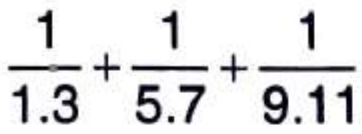 + . . . is
- (a) π/4
- (b) π/2
- (c) π/8
- (d) 3π/4
Show answer
Answer: (c)
108. Value of tan⁻¹(1/2) + tan⁻¹(1/5) + tan⁻¹(1/8) is
- (a) π/4
- (b) π/2
- (c) π
- (d) tan⁻¹2
Show answer
Answer: (a)
109. The equation sin⁴θ – 2 cos²θ + a² = 0 will have atleast one solution, if
- (a) |a| ≤ 1½
- (b) |a| ≤ 2
- (c) |a| ≤ √2
- (d) |a| ≥ 1
Show answer
Answer: (c)
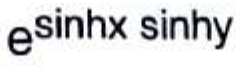
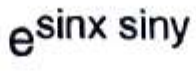
110. If
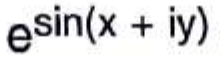 = A + iB, where A and B are real, then √(A² + B²) is equal to
- (a)
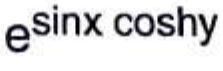
- (b)
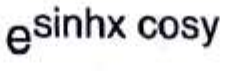
- (c)
- (d)
Show answer
Answer: (a)
- (a)
111. 2 sinh(x + y) cosh(x – y) is equal to
- (a) sin 2x + sin 2y
- (b) sin 2x + sinh 2y
- (c) sinh 2x + sinh 2y
- (d) sinh 2x + sin 2y
Show answer
Answer: (c)
112. In a triangle ABC, a = 5, b = 7 and sin A = 3/4. How many such triangles are possible ?
- (a) 0
- (b) 1
- (c) 2
- (d) 3
Show answer
Answer: (a)
113. If div (rⁿ r⃗) = 0, then n is equal to
- (a) –3
- (b) 1
- (c) 2
- (d) –1
Show answer
Answer: (a)
114. If A⃗ = î + ĵ + k̂, A⃗.B⃗ = 2 and A⃗ × B⃗ = ĵ – k̂, then |3B⃗| is equal to
- (a) 2√2
- (b) 3√2
- (c) 2√3
- (d) 3√3
Show answer
Answer: (b)
115. If (A⃗ × B⃗)² + (A⃗.B⃗)² = 81 and |B⃗| = 3, then |A⃗| is equal to
- (a) 9
- (b) 3
- (c) 27
- (d) 1
Show answer
Answer: (b)
116. Value of [î – ĵ, ĵ – k̂, k̂ – ĵ] is
- (a) 1
- (b) 2
- (c) 3
- (d) 0
Show answer
Answer: (d)
117. The directional derivative of ϕ = xy + yz + zx at (1, 1, 1) in the direction of the vector î – 2ĵ + 2k̂ is
- (a) 1/3
- (b) 2/3
- (c) 5/3
- (d) 7/3
Show answer
Answer: (b)
118. If u⃗ and v⃗ are vector point function and ϕ is a scalar function, then which statement of the following is meaningful ?
- (a) ∇⃗ u⃗
- (b) ∇⃗(u⃗ × v⃗)
- (c) ∇⃗(ϕu⃗)
- (d) ∇⃗(u⃗ · v⃗)
Show answer
Answer: (d)
119. The motion of a projectile is described by the equation y = ax – bx². Range of projectile is
- (a) a/b
- (b) a/2b
- (c) 2a/b
- (d) none of the above
Show answer
Answer: (a)
120. If two equal perfectly elastic bodies impinge directly, then after impinge
- (a) Both interchange their velocities
- (b) Both come to rest
- (c) Velocities of both do not change
- (d) None of the above
Show answer
Answer: (a)
121. The centre of gravity of a solid right circular cone of height h is
- (a) At distance h/4 from vertex
- (b) At distance 3h/4 from vertex
- (c) At distance h/2 from vertex
- (d) None of the above
Show answer
Answer: (b)
122. The resultant of P⃗ and Q⃗ is R⃗. If P⃗ is reversed and Q⃗ remaining the same the new resultant becomes R⃗′. If R⃗ is perpendicular to R⃗′, then |P⃗| : |Q⃗| is
- (a) 1 : 2
- (b) 1 : 1
- (c) 2 : 1
- (d) 2 : 3
Show answer
Answer: (b)
123. The number of numbers between 100 and 300 that are divisible by 5 but not by 15 is
- (a) 20
- (b) 26
- (c) 32
- (d) 35
Show answer
Answer: (b)
124. The coefficient of the middle term in the expansion of (1 + 3x + 3x² + x³)⁸ in powers of x is
- (a) ¹²C₆
- (b) ¹²C₈
- (c) ²⁴C₈
- (d) ²⁴C₁₂
Show answer
Answer: (d)
125. Two constant forces P⃗ = 2î – 5ĵ + 6k̂ and Q⃗ = –î + 2ĵ – k̂ act on a particle at the point A(4, –3, –2). Moment of the resultant force about O(0, 0, 0) is
- (a) 21î + 22ĵ + 9k̂
- (b) –21î – 22ĵ – 9k̂
- (c) 21î – 22ĵ + 9k̂
- (d) 21î – 22ĵ – 9k̂
Show answer
Answer: (b)
Show answers
Answer key
Answer key from the U.P. Secondary Education Services Selection Board’s official answer key for this sitting. “—” means the key gave none: the question was deleted.
Mathematics
- Q 1
- (a)
- Q 2
- (c)
- Q 3
- (c)
- Q 4
- (d)
- Q 5
- (c)
- Q 6
- (c)
- Q 7
- (c)
- Q 8
- (c)
- Q 9
- (b)
- Q 10
- (c)
- Q 11
- (a)
- Q 12
- (c)
- Q 13
- (c)
- Q 14
- (b)
- Q 15
- (a)
- Q 16
- (b)
- Q 17
- (b)
- Q 18
- (c)
- Q 19
- (c)
- Q 20
- (c)
- Q 21
- (b)
- Q 22
- (a)
- Q 23
- (c)
- Q 24
- (a)
- Q 25
- (b)
- Q 26
- (b)
- Q 27
- (c)
- Q 28
- (d)
- Q 29
- (a)
- Q 30
- (a)
- Q 31
- (b)
- Q 32
- (b)
- Q 33
- (d)
- Q 34
- (c)
- Q 35
- (c)
- Q 36
- (a)
- Q 37
- (d)
- Q 38
- (c)
- Q 39
- (b)
- Q 40
- (d)
- Q 41
- (c)
- Q 42
- (b)
- Q 43
- (b)
- Q 44
- (d)
- Q 45
- (d)
- Q 46
- (c)
- Q 47
- (b)
- Q 48
- (c)
- Q 49
- (c)
- Q 50
- (a)
- Q 51
- (b)
- Q 52
- (d)
- Q 53
- (b)
- Q 54
- (b)
- Q 55
- (c)
- Q 56
- (d)
- Q 57
- (c)
- Q 58
- (d)
- Q 59
- (d)
- Q 60
- (d)
- Q 61
- (b)
- Q 62
- (c)
- Q 63
- (a)
- Q 64
- (d)
- Q 65
- (c)
- Q 66
- (d)
- Q 67
- (d)
- Q 68
- (c)
- Q 69
- (d)
- Q 70
- (b)
- Q 71
- (c)
- Q 72
- (a)
- Q 73
- (c)
- Q 74
- (c)
- Q 75
- (b)
- Q 76
- (c)
- Q 77
- (d)
- Q 78
- (c)
- Q 79
- (a)
- Q 80
- (a)
- Q 81
- (b)
- Q 82
- (a)
- Q 83
- (b)
- Q 84
- (b)
- Q 85
- (b)
- Q 86
- (a)
- Q 87
- (b)
- Q 88
- (a)
- Q 89
- (c)
- Q 90
- (b)
- Q 91
- (a)
- Q 92
- (c)
- Q 93
- (b)
- Q 94
- (a)
- Q 95
- (b)
- Q 96
- (b)
- Q 97
- (a)
- Q 98
- (a)
- Q 99
- (d)
- Q 100
- (c)
- Q 101
- (d)
- Q 102
- —
- Q 103
- (c)
- Q 104
- (a)
- Q 105
- (b)
- Q 106
- (c)
- Q 107
- (c)
- Q 108
- (a)
- Q 109
- (c)
- Q 110
- (a)
- Q 111
- (c)
- Q 112
- (a)
- Q 113
- (a)
- Q 114
- (b)
- Q 115
- (b)
- Q 116
- (d)
- Q 117
- (b)
- Q 118
- (d)
- Q 119
- (a)
- Q 120
- (a)
- Q 121
- (b)
- Q 122
- (b)
- Q 123
- (b)
- Q 124
- (d)
- Q 125
- (b)