ExamBharo · SSC MTS 2021 — 19 July 2022, Shift 1 · exambharo.com/ssc-mts/previous-year-papers/ssc-mts-2021-19-jul-shift-1/
Question paper · SSC MTS & Havaldar
SSC MTS 2021 — 19 July 2022, Shift 1
19 July 2022 · 9:00 AM–10:30 AM93 of the paper’s 100 questions1 per correct answer
Questions from the Staff Selection Commission’s paper of 19 July 2022, 9:00 AM–10:30 AM.
Preparing for SSC MTS & Havaldar? Get more, free
Daily previous-year questions as quizzes, and every SSC MTS & Havaldar notice the day it is out.
General English
1. Select the most appropriate meaning of the given idiom. A gut feeling
- (a) False attempt
- (b) An instinct or intuition
- (c) A liability
- (d) A suppressed feeling
Show answer
Answer: (b)
2. The following sentence has been divided into parts. One of them may contain an error. Select the part that contains the error from the given options. If you don’t find any error, mark ‘No error’ as your answer. New fashion trends / come onto the / scene periodically.
- (a) come onto the
- (b) New fashion trends
- (c) scene periodically
- (d) No error
Show answer
Answer: (d)
3. Select the most appropriate option to fill in the blank. The weather patterns ______ that we will have a winter season, perhaps a good one.
- (a) suggests
- (b) has suggested
- (c) suggest
- (d) have been suggested
Show answer
Answer: (c)
5. Select the option that can be used as a one-word substitute for the given group of words. A place for breeding and keeping birds
- (a) Kennel
- (b) Aviary
- (c) Apiary
- (d) Den
Show answer
Answer: (b)
6. Select the option that will improve the underlined part of the given sentence. In case no improvement is needed, select 'No improvement required'. My son has been sleeping for twelve hours at a stretch.
- (a) is been sleeping
- (b) were sleeping
- (c) have been sleeping
- (d) No improvement required
Show answer
Answer: (d)
7. Select the most appropriate option to fill in the blank. Smoking is ______ in my office building.
- (a) banned
- (b) bend
- (c) band
- (d) bated
Show answer
Answer: (a)
8. Select the correctly spelt word.
- (a) Experienses
- (b) Immersive
- (c) Institutionalsed
- (d) Tremandous
Show answer
Answer: (b)
9. Select the most appropriate synonym of the underlined word. Our company wants to collaborate with your team.
- (a) Repel
- (b) Defy
- (c) Captivate
- (d) Collude
Show answer
Answer: (d)
10. Select the option that can be used as a one-word substitute for the given group of words. The action of using someone or something as a model
- (a) Magic
- (b) Foundation
- (c) Imitation
- (d) Caption
Show answer
Answer: (c)
11. Select the INCORRECTLY spelt word.
- (a) Local
- (b) Vehical
- (c) Focal
- (d) Vocal
Show answer
Answer: (b)
12. Select the most appropriate meaning of the given idiom. Go the extra mile
- (a) Overwhelming the competitors
- (b) Going in search of something better
- (c) Going above and beyond whatever is required for the task at hand
- (d) Wasting time in unnecessary efforts
Show answer
Answer: (c)
13. Parts of the following sentence have been given as options. One of them may contain an error. Select the part that contains the error from the given options. If you don’t find any error, mark ‘No error’ as your answer. My friend Jatin usually wears a spectacle.
- (a) My friend Jatin
- (b) usually wears
- (c) a spectacle
- (d) No error
Show answer
Answer: (c)
14. Select the most appropriate synonym of the given word. Polished
- (a) Crude
- (b) Paramount
- (c) Boring
- (d) Cultured
Show answer
Answer: (d)
15. Select the most appropriate option to substitute the underlined segment in the given sentence. If there is no need to substitute it, select ‘No substitution required.’ The main road was entirely blocked till the time the cranes move the damage vehicles.
- (a) No substitution required
- (b) moved the damaged
- (c) moving the damage
- (d) moves the damaged
Show answer
Answer: (b)
16. Select the most appropriate ANTONYM of the given word. Scold
- (a) Nag
- (b) Praise
- (c) Alarm
- (d) Avoid
Show answer
Answer: (b)
17. Select the most appropriate ANTONYM of the given word. Irrational
- (a) Gloomy
- (b) Illogical
- (c) Reasonable
- (d) Peaceful
Show answer
Answer: (c)
18. Select the most appropriate ANTONYM of the given word. Divergence
- (a) Dissonance
- (b) Separation
- (c) Departure
- (d) Confluence
Show answer
Answer: (d)
19. Select the option that will improve the underlined part of the given sentence. In case no improvement is needed, select 'No improvement required'. Doctor Bayley tripped under some large roots and cuts her head on a rock.
- (a) No improvement required
- (b) tripped over some large roots and cut
- (c) tripped over and above some large roots and cut
- (d) tripped upon some larger roots and cuts
Show answer
Answer: (b)
20. Select the option that will improve the underlined part of the given sentence. In case no improvement is needed, select ‘No improvement required’.I didn't saw any point in spending money on new clothes.
- (a) didn't seen any
- (b) don't sees any
- (c) No improvement required
- (d) didn't see any
Show answer
Answer: (d)
PassageFor questions 21–25
In the following passage, some words have been deleted. Read the passage carefully and select the most appropriate option to fill in each blank.
Regular check-ups are (1)___ for a car’s top-notch performance, but did you know that there is a direct link (2)___ your car health and its emissions? A well-maintained car engine is (3)___ efficient and burns less gas, (4)___ reducing airborne emissions. Secondly, tyre pressure (5)___ always match the manufacturer-recommended Pounds Per Square Inch (PSI) rating.
21. Select the most appropriate option to fill in blank number 1.
- (a) trivial
- (b) nominal
- (c) acute
- (d) vital
Show answer
Answer: (d)
22. Select the most appropriate option to fill in blank number 2.
- (a) along
- (b) among
- (c) between
- (d) across
Show answer
Answer: (c)
23. Select the most appropriate option to fill in blank number 3.
- (a) many
- (b) such
- (c) few
- (d) more
Show answer
Answer: (d)
24. Select the most appropriate option to fill in blank number 4.
- (a) hereby
- (b) yet
- (c) thereby
- (d) though
Show answer
Answer: (c)
25. Select the most appropriate option to fill in blank number 5.
- (a) have to
- (b) lest
- (c) must
- (d) would
Show answer
Answer: (c)
General Intelligence and Reasoning
1. Select the number from among the given options that can replace the question mark (?) in the following series. 6, 24, 60, 120, 210, ?
- (a) 336
- (b) 322
- (c) 343
- (d) 432
Show answer
Answer: (a)
2. Select the letter-cluster from among the given options that can replace the question mark (?) in the following series. WXYZ, YZWX, ABUV, CDST, ?
- (a) ABQR
- (b) EFQR
- (c) EFGR
- (d) EFUV
Show answer
Answer: (b)
3. In a certain code language, 'BRAVE' is written as '43' and 'BOTH' is written as '41'. How will 'ABACUS' be written in that code language?
- (a) 43
- (b) 47
- (c) 41
- (d) 31
Show answer
Answer: (c)
4. Select the number from among the given options that can replace the question mark (?) in the following series. 264, 288, 312, ?, 360, 384
- (a) 324
- (b) 348
- (c) 342
- (d) 336
Show answer
Answer: (d)
5. Nine people, A, B, C, D, E, F, G, H, and I, are sitting in a row facing south. E sits in the middle. Three people sit between E and G. Six people sit between G and B. Three people sit between B and A. F sits second to the right of A. I sits fourth to the left of F. I and E are not immediate neighbours. B and C are not neighbours. H sits to the right of D. Who is sitting fourth to the right of G?
- (a) A
- (b) E
- (c) F
- (d) C
Show answer
Answer: (b)
6.
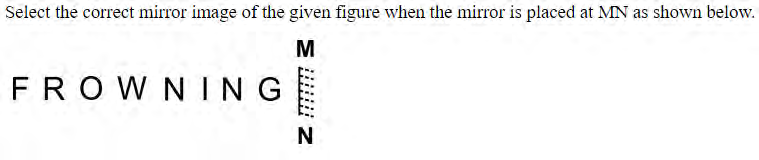
- (a)

- (b)

- (c)

- (d)

Show answer
Answer: (d)
- (a)
7. Which two numbers (NOT digits) should be interchanged to make the following equation correct? 26 ÷ 2 + 13 × 6 − 4 = 10
- (a) 13 and 4
- (b) 2 and 13
- (c) 2 and 10
- (d) 2 and 4
Show answer
Answer: (b)
8. Select the option that is related to the fifth word in the same way as the second word is related to the first word and the fourth word is related to the third word. Cup : Coffee :: Glass : Juice :: Bowl : ?
- (a) Knife
- (b) Soup
- (c) Spoon
- (d) Dish
Show answer
Answer: (b)
9. Read the given statements and conclusions carefully. Assuming that the information given in the statements is true, even if it appears to be at variance with commonly known facts, decide which of the given conclusions logically follow(s) from the statements. Statements: All cookies are sweet. Some sweets are snacks. Conclusions: I. All sweets are cookies. II. All cookies are snacks.
- (a) Neither conclusion I nor II follows.
- (b) Both conclusions I and II follow.
- (c) Only conclusion II follows.
- (d) Only conclusion I follows.
Show answer
Answer: (a)
10. Select the option in which the numbers are related in the same way as are the numbers in the following sets. (NOTE: Operations should be performed on the whole numbers, without breaking down the numbers into its constituent digits. E.g. 13 – Operations on 13 such as adding /deleting /multiplying etc. to 13 can be performed. Breaking down 13 into 1 and 3 and then performing mathematical operations on 1 and 3 is not allowed) (16, 18, 20) (17, 19, 21)
- (a) (64, 66, 68)
- (b) (24, 26, 30)
- (c) (28, 30, 26)
- (d) (36, 40, 42)
Show answer
Answer: (a)
11. Select the option in which the pair of letter-clusters share the same relationship as that shared by the given letter-clusters. RN : UQ
- (a) LA : OX
- (b) TG : WL
- (c) KR : NU
- (d) PN : SR
Show answer
Answer: (c)
12.

- (a)

- (b)

- (c)
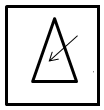
- (d)
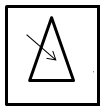
Show answer
Answer: (d)
- (a)
13. Read the given statements and conclusions carefully. Assuming that the information given in the statements is true, even if it appears to be at variance with commonly known facts, decide which of the given conclusions logically follow(s) from the statements. Statements: I. No B is A. II. No C is B. Conclusions: I. No C is A. II. No A is B. III. Some B are not C.
- (a) Both conclusions I and II follows
- (b) Only conclusion III follows
- (c) Both conclusions II and III follows
- (d) None of the conclusions follow
Show answer
Answer: (c)
14. In a certain code language, ‘HELP’ is coded as ‘851216’ and ‘GRAN’ is coded as ‘718114’. How will ‘FOMS’ be coded in that language?
- (a) 6511319
- (b) 615139
- (c) 6141319
- (d) 6151319
Show answer
Answer: (d)
15. S, T, U, V and W are sitting around a circular table facing the centre (but not necessarily in the same order). S is the immediate neighbour of T and W. U is to the immediate right of T. V is the immediate neighbour of U and W. Who is sitting to the immediate left of S?
- (a) V
- (b) W
- (c) U
- (d) T
Show answer
Answer: (b)
16. The height of five students, Aakriti, Kiran, Lisa, Manisha and Rekha, are compared. The height of Kiran is more than only two students. The height of Manisha is immediately greater than Rekha, and Rekha is immediately greater than Kiran. How many students are taller than Rekha?
- (a) Four
- (b) Two
- (c) Three
- (d) One
Show answer
Answer: (d)
17. In a certain code language, if blue is called pink, pink is called yellow, yellow is called orange, orange is called red, and red is called violet, then what is the colour of sunflower?
- (a) Orange
- (b) Red
- (c) Pink
- (d) Yellow
Show answer
Answer: (a)
18. Select the option in which the pair of letter-clusters share the same relationship as that shared by the given letter-clusters. TAP : JUN
- (a) DOC : JUI
- (b) FED : XYZ
- (c) TXA : VRY
- (d) KIB : VEE
Show answer
Answer: (b)
19. Select the set in which the numbers are related in the same way as are the numbers of the following sets. (NOTE : Operations should be performed on the whole numbers, without breaking down the numbers into its constituent digits. E.g. 13 – Operations on 13 such as adding /deleting /multiplying etc. to 13 can be performed. Breaking down 13 into 1 and 3 and then performing mathematical operations on 1 and 3 is not allowed.) (3, 5, 30) (6, 5, 60)
- (a) (4, 6, 38)
- (b) (6, 7, 84)
- (c) (4, 7, 28)
- (d) (3, 9, 44)
Show answer
Answer: (b)
20.

- (a)
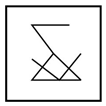
- (b)
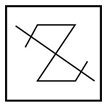
- (c)
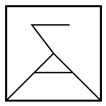
- (d)

Show answer
Answer: (a)
- (a)
21. What will come in the place of ‘?’ in the following equation, if ‘+’ and ‘ × ‘ are interchanged and also ‘–’ and ‘÷’ are interchanged? 1 × 14 + 30 – 20 ÷ 10 = ?
- (a) 43
- (b) 21
- (c) 39
- (d) 12
Show answer
Answer: (d)
22.
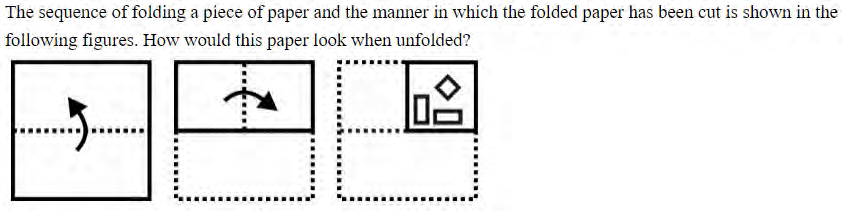
- (a)

- (b)

- (c)
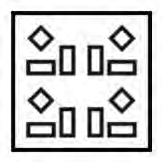
- (d)

Show answer
Answer: (a)
- (a)
23.
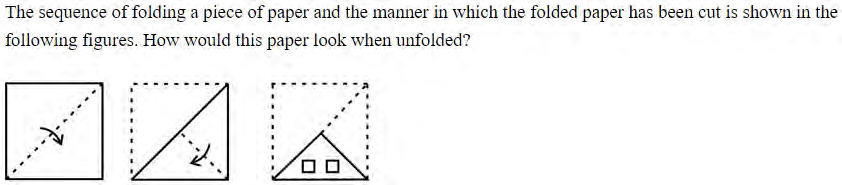
- (a)
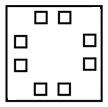
- (b)
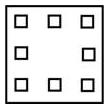
- (c)
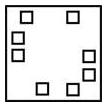
- (d)
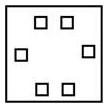
Show answer
Answer: (a)
- (a)
24. If &@$! = 8213 and &%# = 860, then what is %#&$ ?
- (a) 6801
- (b) 6081
- (c) 6810
- (d) 6018
Show answer
Answer: (b)
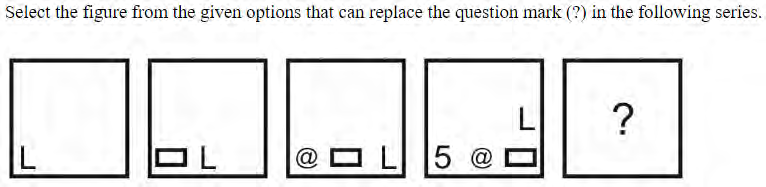
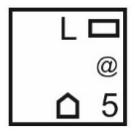
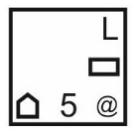
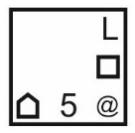
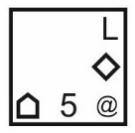
25.
- (a)
- (b)
- (c)
- (d)
Show answer
Answer: (b)
- (a)
Numerical Aptitude
1.

- (a)

- (b)

- (c)

- (d)

Show answer
Answer: (a)
- (a)
2.

- (a)

- (b)

- (c)

- (d)

Show answer
Answer: (c)
- (a)
3.

- (a)

- (b)

- (c)

- (d)

Show answer
Answer: (b)
- (a)
4.

- (a)

- (b)

- (c)

- (d)

Show answer
Answer: (d)
- (a)
6.

- (a)

- (b)

- (c)

- (d)

Show answer
Answer: (a)
- (a)
7.

- (a)

- (b)

- (c)

- (d)

Show answer
Answer: (b)
- (a)
8.

- (a)
- (b)

- (c)

- (d)

Show answer
Answer: (b)
- (a)
9.

- (a)

- (b)

- (c)

- (d)

Show answer
Answer: (b)
- (a)
10.

- (a)

- (b)

- (c)

- (d)

Show answer
Answer: (a)
- (a)
11.

- (a)

- (b)

- (c)

- (d)

Show answer
Answer: (a)
- (a)
12.

- (a)

- (b)

- (c)

- (d)

Show answer
Answer: (c)
- (a)
13.

- (a)

- (b)

- (c)

- (d)

Show answer
Answer: (a)
- (a)
14.

- (a)

- (b)

- (c)

- (d)

Show answer
Answer: (c)
- (a)
15.

- (a)

- (b)

- (c)

- (d)

Show answer
Answer: (a)
- (a)
16.

- (a)

- (b)

- (c)

- (d)

Show answer
Answer: (d)
- (a)
17.

- (a)

- (b)

- (c)

- (d)

Show answer
Answer: (a)
- (a)
18.

- (a)

- (b)

- (c)

- (d)

Show answer
Answer: (a)
- (a)
21.

- (a)

- (b)

- (c)

- (d)

Show answer
Answer: (d)
- (a)
22.

- (a)

- (b)

- (c)

- (d)

Show answer
Answer: (d)
- (a)
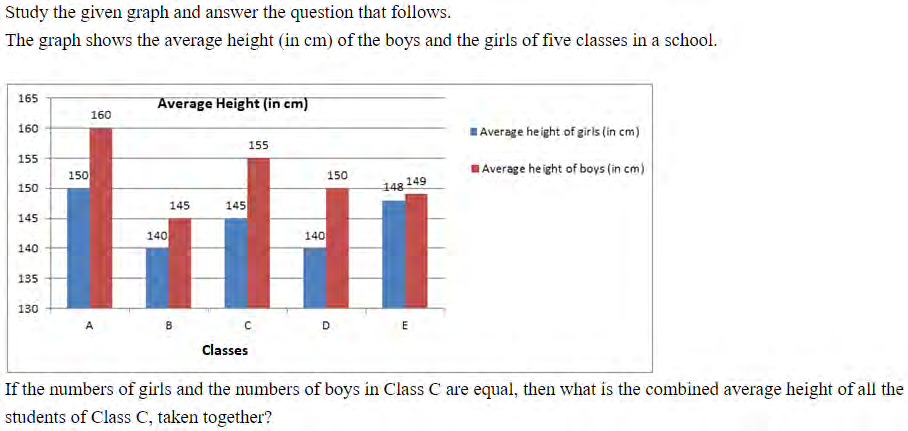
23.
- (a)

- (b)

- (c)

- (d)

Show answer
Answer: (a)
- (a)
24.

- (a)

- (b)
- (c)

- (d)
Show answer
Answer: (c)
- (a)
General Awareness
1. Which famous Rashtrakuta king built the rock-cut temple of Kailash at Ellora?
- (a) Bhoja
- (b) Govinda III
- (c) Rashtrakuta King Krishna I
- (d) Jai Chand
Show answer
Answer: (c)
2. Commercial banks keep their deposits with RBI. These deposits are called ______.
- (a) liability
- (b) loans
- (c) inheritance
- (d) reserves
Show answer
Answer: (d)
3. Pandit Rajendra Gangani is associated with which classical dance of India?
- (a) Manipuri dance
- (b) Kathak dance
- (c) Odissi dance
- (d) Sattriya dance
Show answer
Answer: (b)
4. With which musical instrument was Ustad Bismillah Khan associated?
- (a) Shehnai
- (b) Sitar
- (c) Guitar
- (d) Santoor
Show answer
Answer: (a)
5. The popular style of temple architecture in northern India is called ________.
- (a) Panchayatana
- (b) Nagara
- (c) Shikara
- (d) Dravida
Show answer
Answer: (b)
6. Who took oath as the 28th Chief Minister of Punjab in March 2022?
- (a) Bhagwant Mann
- (b) Charanjit Singh Channi
- (c) Parkash Singh Badal
- (d) Amarinder Singh
Show answer
Answer: (a)
7. Which of the following statements is INCORRECT?
- (a) Electric charge is a scalar quantity.
- (b) Protons are positively charged.
- (c) Electrons are negatively charged.
- (d) Electric charge is a vector quantity.
Show answer
Answer: (d)
8. In which year did the Mughal Emperor Shah Alam II appoint the East India Company as the Diwan of Bengal?
- (a) 1758
- (b) 1755
- (c) 1760
- (d) 1765
Show answer
Answer: (d)
9. The Sattriya dance has developed from the monasteries of:
- (a) West Bengal
- (b) Ladakh
- (c) Assam
- (d) Tripura
Show answer
Answer: (c)
10. Which of the following is NOT a reason for slowing down of the Non-cooperation Movement?
- (a) Due to the absence of alternative Indian institution, boycott of British institutions posed a problem.
- (b) Leaders of the movement shifted their focus towards domestic work thus created a void.
- (c) Many lawyers resigned but then absence of income for a longer period of time compelled them to rejoin.
- (d) Khadi cloth was often more expensive than mass-produced mill cloth and poor people could not afford to buy it.
Show answer
Answer: (b)
11. Amoeba acquires its food through the process of ______.
- (a) photosynthesis
- (b) diffusion
- (c) endocytosis
- (d) exocytosis
Show answer
Answer: (c)
12. The part of the Himalayas lying between Satluj and Kali rivers is known as _____.
- (a) Himachal Himalayas
- (b) Kumaon Himalayas
- (c) Punjab Himalayas
- (d) Kashmir Himalayas
Show answer
Answer: (b)
13. Which of the following is NOT a pair of micronutrients?
- (a) Iodine and minerals
- (b) Calcium and fats
- (c) Minerals and iron
- (d) Iodine and iron
Show answer
Answer: (b)
14. Half of India’s population lives in just five states. Which of the following is one of those states?
- (a) Uttarakhand
- (b) Kerala
- (c) Gujarat
- (d) West Bengal
Show answer
Answer: (d)
15. The largest dam in India, the Hirakud Dam, is built on which of the following rivers?
- (a) Tapi
- (b) Godavari
- (c) Kaveri
- (d) Mahanadi
Show answer
Answer: (d)
16. Which team has won the season 8 of Pro Kabbadi league?
- (a) Patna Pirates
- (b) Dabang Delhi KC
- (c) UP Yoddha
- (d) Bengaluru Bulls
Show answer
Answer: (b)
17. Who among the following won the Formula One 2022 Bahrain Grand Prix?
- (a) Charles Leclerc
- (b) Lewis Hamilton
- (c) Max Verstappen
- (d) Carlos Sainz Jr.
Show answer
Answer: (a)
18. Which of the following Indian festivals celebrates the death of the demon king Ravana at the hands of Lord Rama?
- (a) Navratri
- (b) Dussehra
- (c) Diwali
- (d) Holi
Show answer
Answer: (b)
19. What is the name of the DIGI-book launched by NITI Aayog’s Atal Innovation Mission (AIM)?
- (a) Innovations For You
- (b) Innovations and You
- (c) Innovations For All
- (d) Innovations for Youth
Show answer
Answer: (a)
20. Tendulkar Methodology is associated with the estimation of ______ in India.
- (a) unemployment
- (b) population size
- (c) poverty
- (d) national income
Show answer
Answer: (c)
21. Ashoka fought a war to conquer Kalinga. Kalinga was the ancient name of coastal ______.
- (a) Madras
- (b) Orissa
- (c) Bombay
- (d) Bengal
Show answer
Answer: (b)
24. Which of the following is a Fundamental Right?
- (a) Right to fundamental duties
- (b) Right to elect
- (c) Right to information
- (d) Right to constitutional remedies
Show answer
Answer: (d)
25. Which of the following states has one house in its state legislature?
- (a) Karnataka
- (b) Gujarat
- (c) Andhra Pradesh
- (d) Maharashtra
Show answer
Answer: (b)
Show answers
Answer key
Answer key as marked in the Staff Selection Commission’s response sheet. “—” means the sheet did not show it clearly.
General English
- Q 1
- (b)
- Q 2
- (d)
- Q 3
- (c)
- Q 5
- (b)
- Q 6
- (d)
- Q 7
- (a)
- Q 8
- (b)
- Q 9
- (d)
- Q 10
- (c)
- Q 11
- (b)
- Q 12
- (c)
- Q 13
- (c)
- Q 14
- (d)
- Q 15
- (b)
- Q 16
- (b)
- Q 17
- (c)
- Q 18
- (d)
- Q 19
- (b)
- Q 20
- (d)
- Q 21
- (d)
- Q 22
- (c)
- Q 23
- (d)
- Q 24
- (c)
- Q 25
- (c)
General Intelligence and Reasoning
- Q 1
- (a)
- Q 2
- (b)
- Q 3
- (c)
- Q 4
- (d)
- Q 5
- (b)
- Q 6
- (d)
- Q 7
- (b)
- Q 8
- (b)
- Q 9
- (a)
- Q 10
- (a)
- Q 11
- (c)
- Q 12
- (d)
- Q 13
- (c)
- Q 14
- (d)
- Q 15
- (b)
- Q 16
- (d)
- Q 17
- (a)
- Q 18
- (b)
- Q 19
- (b)
- Q 20
- (a)
- Q 21
- (d)
- Q 22
- (a)
- Q 23
- (a)
- Q 24
- (b)
- Q 25
- (b)
Numerical Aptitude
- Q 1
- (a)
- Q 2
- (c)
- Q 3
- (b)
- Q 4
- (d)
- Q 6
- (a)
- Q 7
- (b)
- Q 8
- (b)
- Q 9
- (b)
- Q 10
- (a)
- Q 11
- (a)
- Q 12
- (c)
- Q 13
- (a)
- Q 14
- (c)
- Q 15
- (a)
- Q 16
- (d)
- Q 17
- (a)
- Q 18
- (a)
- Q 21
- (d)
- Q 22
- (d)
- Q 23
- (a)
- Q 24
- (c)
General Awareness
- Q 1
- (c)
- Q 2
- (d)
- Q 3
- (b)
- Q 4
- (a)
- Q 5
- (b)
- Q 6
- (a)
- Q 7
- (d)
- Q 8
- (d)
- Q 9
- (c)
- Q 10
- (b)
- Q 11
- (c)
- Q 12
- (b)
- Q 13
- (b)
- Q 14
- (d)
- Q 15
- (d)
- Q 16
- (b)
- Q 17
- (a)
- Q 18
- (b)
- Q 19
- (a)
- Q 20
- (c)
- Q 21
- (b)
- Q 24
- (d)
- Q 25
- (b)